PeakLab
How to Improve SEO in 2026: Step-by-Step Guide
Non classé10 min de lecture

How to Improve SEO in 2026: Step-by-Step Guide

blockquote{border-left:4px solid #3b82f6;margin:1.5em 0;padding:1em 1.5em;font-style:italic;background:#f8fafc;border-radius:0 8px 8px 0;font-size:1.1em;color:#1e293b}
.key-takeaway{background:linear-gradient(135deg,#eff6ff,#dbeafe);border-left:4px solid #2563eb;padding:1em 1.5em;margin:1.5em 0;border-radius:0 8px 8px 0}
.key-takeaway strong{color:#1e40af}
.stat-highlight{text-align:center;padding:1.5em;margin:1.5em 0;background:#f0fdf4;border-radius:12px;border:1px solid #bbf7d0}
.stat-highlight .stat-number{display:block;font-size:2.5em;font-weight:800;color:#16a34a;line-height:1.2}
.stat-highlight .stat-label{display:block;font-size:.95em;color:#374151;margin-top:.3em}
.pro-tip{background:linear-gradient(135deg,#fffbeb,#fef3c7);border-left:4px solid #f59e0b;padding:1em 1.5em;margin:1.5em 0;border-radius:0 8px 8px 0}
.pro-tip strong{color:#92400e}

SEO feels broken. Rankings drop fast. You need a plan that works in 2026.

In this guide you’ll get a step‑by‑step roadmap. We’ll walk you through keyword research, technical audits, content creation, link building, and tracking.

Stick with us and you’ll see real moves in traffic.

Step 1: Keyword Research Foundations

First, you need to know what people type. That’s the base of any seo effort.

AI tools can scan thousands of queries in seconds. The Darkroom Observatory notes that good AI tools show exact topics, questions, and word counts of the top 50 pages for a term. Darkroom’s AI SEO guide breaks down which platforms actually give useful data.

Don’t just chase volume. Look at intent. BrightEdge explains that grouping keywords into clusters (also called topic clusters) helps you cover a whole theme, not just a single phrase. BrightEdge’s clustering guide shows how a pillar page plus sub‑pages signals depth to search engines.

Here’s a quick workflow:

  1. Enter a seed phrase in your AI tool.
  2. Export the list of related terms.
  3. Sort them by search intent , informational, commercial, transactional.
  4. Group similar intents into a cluster.
  5. Pick one term as the pillar keyword and the rest as supporting sub‑topics.

When you map intent, you avoid the mistake of targeting a high‑volume term that brings the wrong traffic.

Pro Tip:Use the AI “keyword clustering” feature to auto‑group terms. Then manually check each group for relevance to your buyer personas.

Remember to keep an eye on competition. Ahrefs and Semrush still provide useful difficulty scores, but AI tools now add a “topic relevance” score that tells you how well a term fits your overall theme.

Don’t forget to document everything in a simple spreadsheet. Columns for keyword, volume, intent, difficulty, and cluster name keep the process transparent for your team.

Key Takeaway:Choose AI tools that give clear, actionable keyword clusters, not just raw numbers.

Bottom line:Solid keyword clusters give your site a clear map for content and help search engines see your authority.

Step 2: Technical SEO Audit

Now that you know what to target, you must make sure search bots can read your site.

Google’s AI Overviews now answer about 18.57% of commercial queries. If your pages don’t serve clean data, you’ll miss those citations.

Start with crawlability. Use Google Search Console’s Coverage report to spot “soft 404s,” “blocked resources,” and “server errors.” Yotpo’s technical checklist walks you through each error type.

Next, check your robots.txt. It should allow AI bots like OAI-SearchBot while blocking training bots that could scrape your content for model training. A sample snippet from Yotpo looks like this:

User-agent: OAI-SearchBot
Allow: /
User-agent: GPTBot
Disallow: /

Make sure your sitemap is up‑to‑date and submitted in Search Console. That tells Google where your most important pages live.

Core Web Vitals matter more than ever. Impactplus highlights that a good INP score (under 200 ms) boosts rankings. Test your pages with PageSpeed Insights and aim for fast interaction.

Don’t forget mobile‑first indexing. Verify that the hamburger menu is present in the DOM, not hidden behind a click event. Otherwise Google’s smartphone bot can’t see your navigation.

« If your site can’t be read by AI agents, you’ll never appear in AI Overviews. »

Another hidden issue is the “Invisible 500 Error.” Some SPA frameworks return a 200 OK with an error page hidden in JavaScript. Google treats that as a thin page and may drop it from the index.

Fix these by adding proper HTTP status codes and server‑side rendering for critical content.

200 mstarget INP threshold for strong rankings

Finally, audit your internal linking. A tight linking matrix passes link equity to the pages you want to rank. Use a spreadsheet to list each page and its inbound links, then add missing links where needed.

Bottom line:A clean technical foundation lets search bots and AI agents read your site, which is the first step to ranking.

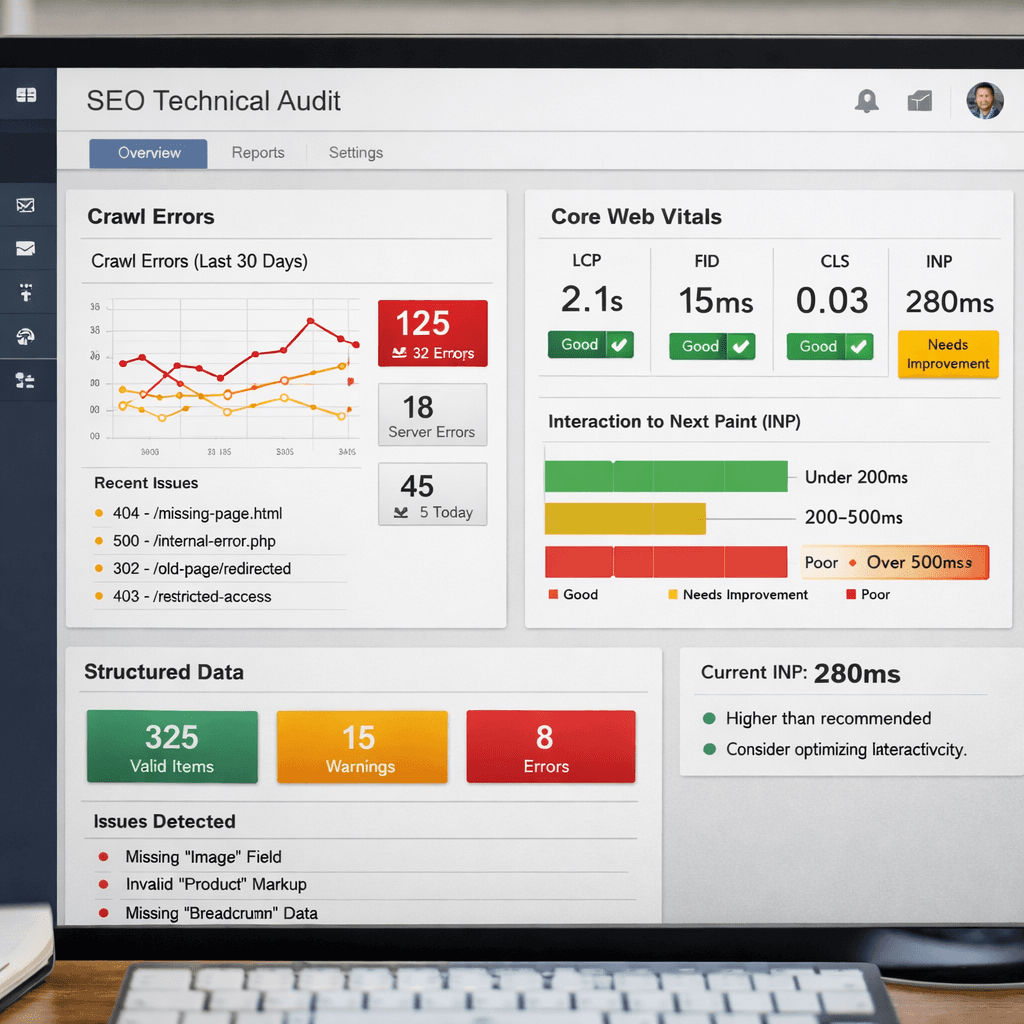
A photorealistic view of a website’s backend dashboard showing crawl errors, core web vitals, and structured data. Alt: seo technical audit dashboard with crawl error stats and INP metrics.

Outil gratuit

📊 Quiz revendabilité

Découvrez si votre entreprise est prête à être revendue grâce à son niveau de digitalisation.

Tester gratuitement

Step 3: Content Creation & Optimization

With keywords and a healthy site, you now build content that satisfies both people and AI.

The Topical Map AI guide stresses that you need a content template. A template includes the pillar keyword, a list of supporting sub‑topics, word count, and internal link slots.

Start each piece with a direct answer. If the query is « what is seo, » open with a one‑sentence definition. Then dive deeper with sections that cover related questions.

Use on‑page SEO checklists like Semrush’s. Semrush’s checklist tells you to place the primary keyword in the title tag, H1, and a few times in the body, but avoid stuffing.

Here’s a simple layout:

  • Title tag (50‑60 chars) , include the main keyword.
  • Meta description (120‑155 chars) , add a call‑to‑action.
  • H1 , match the title.
  • Intro , answer the user’s question in one sentence.
  • Body , use H2s for each sub‑question, add bullet points, and sprinkle related terms.
  • Conclusion , recap and add a CTA.

Don’t forget schema markup. Adding FAQ schema helps AI agents pull your answers directly into search snippets.

Pro Tip:After drafting, paste your copy into Clearscope or a similar AI grader to see which topics you missed.

When you create a cluster, link the supporting page back to the pillar with anchor text that includes the pillar keyword. This creates a clear hierarchy for search engines.

Example: A pillar page on « seo basics » links to a cluster page on « keyword research for seo » using the anchor “keyword research for seo”.

Measure success by tracking rankings, click‑through rates, and dwell time. If a page ranks but users bounce fast, revisit the content depth.

Mise à jour Google mars 2026 notes that sites that keep content fresh see a 15% lift in visibility.

Key Takeaway:Structure each article with a clear answer, supporting sub‑questions, and internal links to the pillar.

Bottom line:Well‑organized, answer‑first content wins both human readers and AI agents.

Links still matter. They tell Google your site is trustworthy.

White‑hat tactics focus on quality, not quantity. PageOnePower lists ten tactics, but the core ideas are simple.

Start with your own audience. Publish a guide that solves a real problem. When people find it useful, they’ll link naturally.

Next, reach out to industry sites. Offer a data‑driven study or a case‑study summary. Use the email template from PageOnePower’s “outreach checklist.”

Guest posting works when you write for reputable blogs in your niche. Include a natural link back to a relevant pillar page.

Don’t forget local citations. List your business in Google Business Profile, Yelp, and niche directories. Each citation adds a tiny boost.

Another angle is digital PR. When you launch a new product, write a press release and pitch it to journalists. If they quote your stats, you earn high‑authority backlinks.

3.45%of pages get organic traffic from Google

Finally, audit your existing backlink profile. Use Ahrefs or Semrush to find low‑quality links and request removal.

Key Takeaway:Focus on earning links from sites that share your audience and have strong authority.

Bottom line:Quality, relevance, and natural placement keep your link profile safe and effective.

PageOnePower’s white‑hat SEO tactics

Further reading on sustainable link building

Step 5: Performance Tracking & Ongoing Optimization

Tracking lets you see what works and what doesn’t.

Whatagraph’s SEO dashboard examples show how to pull data from Google Search Console, GA4, Ahrefs, and Semrush into one view. Whatagraph’s dashboard guide explains three tabs: visibility, traffic, and conversions.

Start by setting clear KPIs: organic sessions, keyword rankings, and conversion rate. Then create a weekly review habit.

In Search Console, look at the Performance report. Compare the last 28 days to the previous period. Spot any sudden drops in clicks or impressions and dig into the cause.

Use the URL Inspection tool to request re‑indexing after you fix a page.

GA4 adds user‑level data. Filter for sessions that came from AI Overviews by adding a regex include for chatgpt.com, perplexity.ai, and gemini.google.com. This lets you see how AI‑driven traffic behaves compared to traditional search.

18.57%of commercial queries now trigger AI Overviews

Combine the data in a Looker Studio report for stakeholders. Include a simple “wins, issues, recommendations” summary at the top.

When you see a keyword climbing, boost the page with fresh content or internal links. If a page falls, audit its backlinks and on‑page signals.

Automation can help. Set up alerts in Whatagraph for any KPI that drops more than 10% in a week.

Pro Tip:Schedule a monthly “content refresh” sprint. Update stats, add new FAQs, and improve page speed.

Remember, SEO is a marathon. Keep testing, keep learning, and keep the data loop tight.

Bottom line:Regular data checks and quick fixes keep your seo performance moving forward.

A photorealistic illustration of an SEO performance dashboard showing charts for visibility, traffic, and AI‑referral metrics. Alt: seo performance tracking dashboard with AI and organic data.

Conclusion

Improving seo in 2026 takes a mix of smart research, clean code, helpful content, solid links, and constant tracking. Follow the five steps we laid out, and you’ll see more clicks, higher rankings, and better conversions.

Start today by picking a keyword cluster, run a quick technical audit, write a pillar article, reach out for one link, and set up a simple dashboard. Small actions add up fast.

If you need a deeper dive, . Keep testing, keep learning, and watch your site rise.

What is the best way to find low‑competition keywords in 2026?

Use an AI‑enabled tool that shows both search volume and a “topic relevance” score. Then filter for commercial or transactional intent. Cross‑check the list in Google Search Console to find queries that already get impressions but low clicks, and optimize those pages.

How often should I run a technical SEO audit?

Do a quick audit each month and a deep audit every quarter. Focus on crawl errors, core web vitals, and new JavaScript changes. Fix any soft 404s or invisible 500 errors right away to keep the index healthy.

Can AI tools replace a human writer for content?

AI can draft outlines and meta tags, but you still need a human to add expertise, check facts, and write in a natural voice. The best results come from a human‑AI partnership where the writer refines the AI output.

How do I earn backlinks without paying for guest posts?

Create a data‑driven study or a how‑to guide that solves a real problem. Then pitch the findings to industry blogs, journalists, or niche newsletters. When the content is valuable, they’ll link back naturally.

What metrics should I track in my SEO dashboard?

Track organic sessions, keyword rankings, click‑through rate, core web vitals (especially INP), and AI‑referral traffic. Also measure conversions per channel so you can see which keywords drive sales.

How do I know if my content is ready for AI Overviews?

Check that the page has clear, concise answers, proper schema markup, and fast load times. Use a tool like Clearscope or a structured data tester to ensure the page meets the criteria for AI citation.

Parlons de votre projet

Besoin d'expertise sur le sujet ?

Nos experts vous accompagnent de la stratégie à la mise en production. Échangeons 30 min sur votre projet.

L

Lucien Arbieu

Expert en intelligence artificielle et consultant en transformation digitale chez PeakLab.

L'argent est déjà sur la table.

En 1 heure, découvrez exactement combien vous perdez et comment le récupérer.

Agence de développement web, automatisation & IA

[email protected]
Newsletter

Recevez nos conseils tech et business directement dans votre boîte mail.

Suivez-nous
Crédit d'Impôt Innovation - PeakLab agréé CII