

We build FastAPI APIs, Django applications and Python pipelines that connect your data, tools and workflows, from discovery to production.
Three questions to prepare a useful discussion.
Question 1/3

Services
Not promises. Results.
We integrate predictive models, semantic search and LLM features into your tools, with evaluation, monitoring and control over the data sent to models.
Code audit, version migration, typing and tests, workload optimisation and containerisation: we improve an existing Python codebase in controlled stages.
Multi-source ingestion, cleaning, transformation and reporting: we automate data flows with Python, Polars or Pandas and orchestration suited to their frequency.
We design documented APIs with FastAPI and Pydantic, or Django business applications with administration, authentication and structured business rules.

API, business application, data or AI: share your context so we can identify a useful and realistic first step.
Objective
1
Python can power the backend, data processing and artificial intelligence features within one coherent ecosystem. Exchanges between teams and components are easier to maintain.
2
FastAPI suits APIs and asynchronous services with Pydantic validation and OpenAPI documentation. Django provides a complete framework for business applications with ORM, administration and authentication.
3
Polars, Pandas, scikit-learn, PyTorch and orchestration tools cover the chain from ingestion to delivering a model or business metric.
4
Async for I/O, task queues for long-running work and optimised libraries for computation: the architecture is selected according to measured load and product constraints.
Maintenance
A notebook or script validates an idea. To run reliably in production, code, data and operations must be structured together.
Types, Pytest tests, Ruff linting and locked dependencies make changes safer and simplify handover to another team.
We separate requests, asynchronous tasks and intensive computation, then measure latency, memory and volumes before targeting optimisations.
Docker, continuous integration, logs, metrics and alerts provide reproducible deployments and make incidents observable.
Types, Pytest tests, Ruff linting and locked dependencies make changes safer and simplify handover to another team.
We separate requests, asynchronous tasks and intensive computation, then measure latency, memory and volumes before targeting optimisations.
Docker, continuous integration, logs, metrics and alerts provide reproducible deployments and make incidents observable.
Interfaces
For a typed, documented and asynchronous API serving a web frontend, mobile application or other services.
For a business application that benefits from a mature ORM, integrated administration and a complete authentication system.
For imports, transformations and long-running computations executed in the background, scheduled and monitored separately from user requests.
Services
We start with your users, data and operational constraints. Python is selected when it genuinely simplifies the product.
We connect Python processing to interfaces, databases and existing tools to deliver a complete feature rather than an isolated prototype.
Tests, types, reviews and regular demos make every delivery observable. Performance limits and data quality are addressed explicitly.
Repository, environments, architecture decisions and operating procedures are documented. You retain ownership of the code and the ability to evolve it.
We turn manual processing and scattered sources into a Python tool your teams can use every day.
We turn manual processing and scattered sources into a Python tool your teams can use every day.
Why us
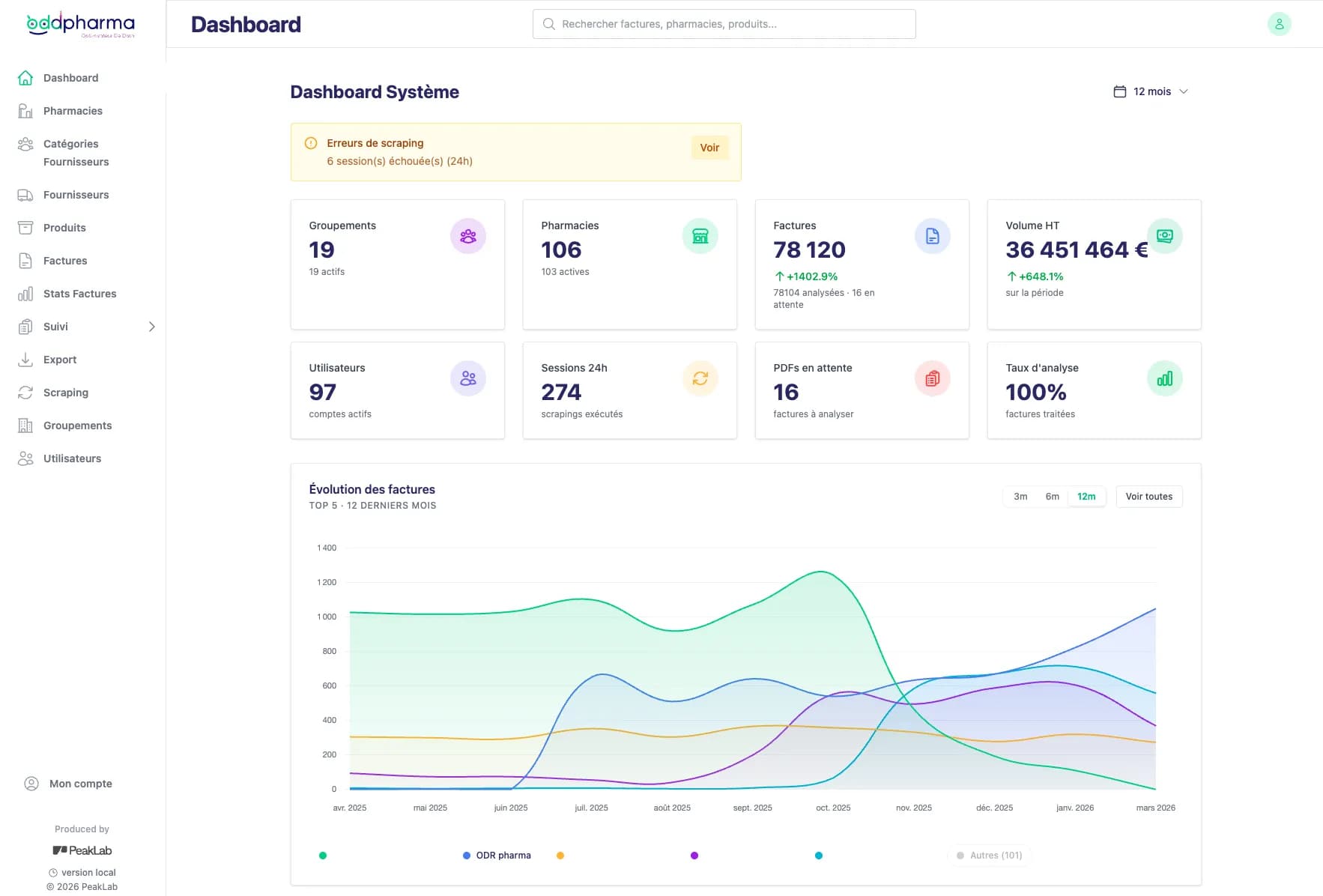
PeakLab built a platform that collects, processes and presents pharmacy business data. Python automates previously manual workflows and powers a white-label business application.
-75% processing time per case
x10 capacity per employee
< 1% data entry errors
Method
Not promises. Results.
1
We identify users, sources, data quality, security constraints and the metrics that will be used to assess the result.
2
We validate technical risks on a small scope: an API contract, a data sample or a measurable AI use case.
3
The prototype becomes a structured service with types, tests, error handling, storage, integrations and a reproducible environment.
4
We deploy, instrument workloads and track technical performance alongside business outcomes to prioritise improvements.
Versions, performance, data quality or technical debt: let’s discuss the priorities for your existing system.
FAQ
FastAPI is suitable for pure APIs, microservices and asynchronous processing, with Pydantic validation and OpenAPI documentation. Django works better for business applications that benefit from its ORM, administration and integrated authentication. The choice depends on the product and how it will be operated.
Copyright © PeakLab 2026. All rights reserved.

