We build custom chatbots connected to your knowledge and tools: a clear scope, tested answers and human handoff whenever a request requires it.

Our commitments
You receive the source code, chatbot rules and documentation required for another team to take over.
The estimate follows the scoping phase; any change in scope is priced and agreed with you.
A workshop covers the sources, limitations, monitoring and maintenance actions.
We analyze uncovered requests and prioritize improvements with your designated owner.
A chatbot is useful when your customers or teams ask recurring questions and the answers exist in reliable sources. We first assess demand volume, the available reference documents and FAQs, the business owner and the intended outcome.
It is not always the right tool. If the documents are outdated, the need is too infrequent or the decision is sensitive, we recommend strengthening the process or keeping human validation in place before automating it.
Because we bring product, development and operations together: a bounded use case, controlled integrations, repeatable tests and a team equipped to work independently.
From scoping to operations, every deliverable makes the chatbot measurable, controllable and maintainable.
01
We map the questions, users, accessible data and situations to exclude. The brief sets the pilot criteria: task completion, out-of-scope requests, appropriate handoffs and the intended business outcome.
02
We prepare the knowledge base, its access rights and its update rules. The chatbot searches approved content, cites a source when that helps the user and flags missing information.
03
We write useful flows, clarification questions and refusal rules. Users know they are interacting with AI and can be directed to the right person with the necessary context, without hiding the system's limitations.
04
CRM, support platform, calendar, catalog or internal application: each connection is limited to the required actions. When several tools need orchestrating, our n8n agency builds observable, reversible automations.
05
We test normal, ambiguous and off-topic requests, along with attempts to steer the chatbot away from its purpose. A question set checks answers, refusals, permissions and handoffs before launch and after every significant change.
06
Delivery includes documentation, training, useful alerts and monitoring of uncovered questions. Answers evolve after analysis and approval: the chatbot does not train itself on every conversation.
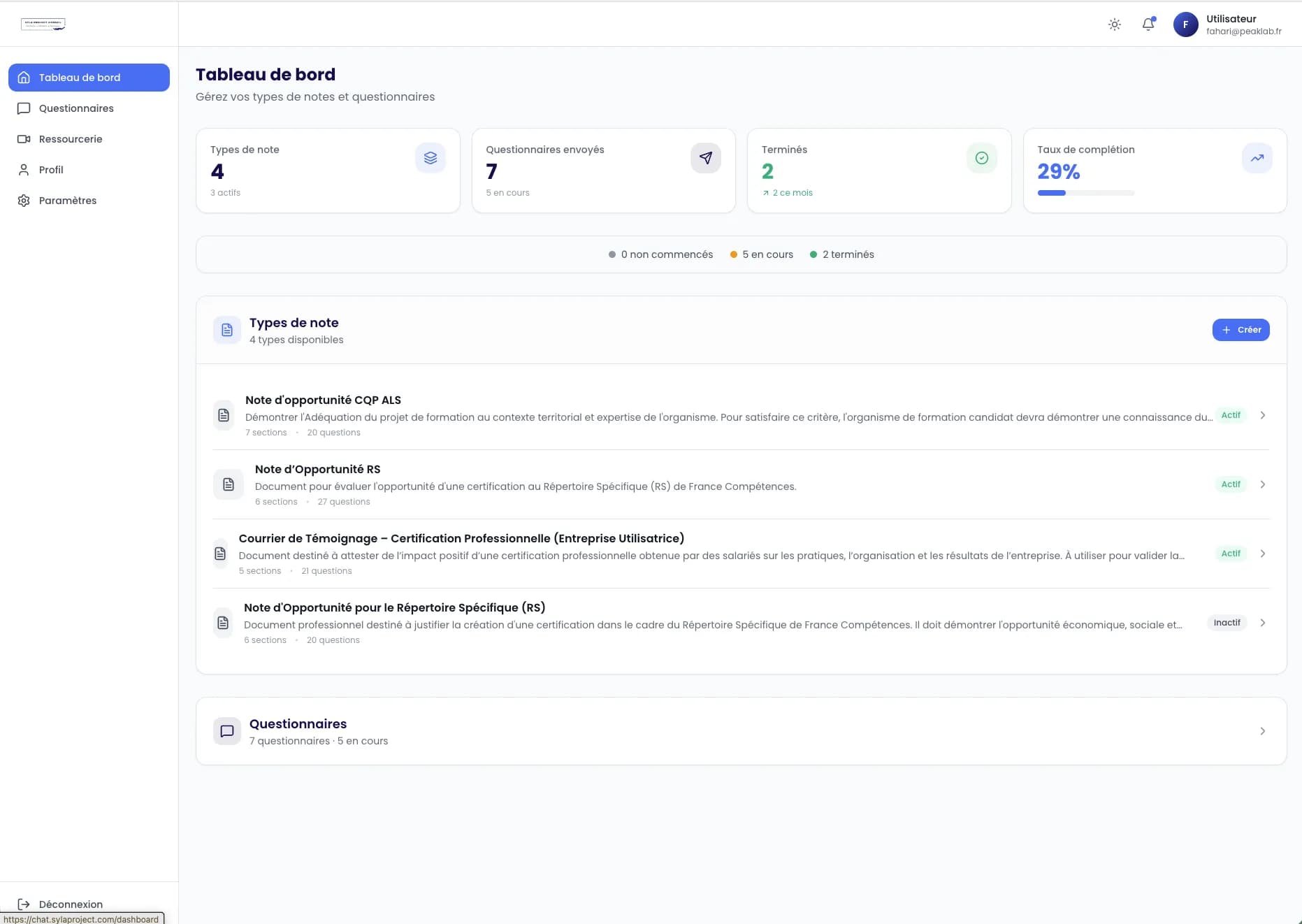
The tool you built isn't just for one thing. I can use it for other documents. You built a tool that could answer one document need, but I realize I can use it for other documents too. That's PeakLab's added value.

Our stack
Modern and proven stack for high-performance apps
Our method
01
Use case, users, limitations, metrics and the decision to launch the pilot
02
Documents, access rights, conversation flows, refusal rules and human handoff
03
Conversational interface, knowledge retrieval and initial integrations
04
Business testing, security, corrections, training and deployment plan
05
Uncovered questions, costs, answer quality and approved improvements
Quality does not depend on the model alone. It comes from an explicit scope, maintained sources, minimum access rights, a test suite and a person responsible for the service. We also document what the chatbot must not do.
For SYLA Project Conseil, PeakLab built a conversational assistant that collects a consultant's answers and prepares a first draft of a Qualiopi certification file. This demonstrates a bounded business use case: AI structures preparatory work, then a professional reviews it.
A broader requirement may be better suited to our generative AI agency. You can also explore all our digital expertise before choosing an approach.

30 minutes to understand your needs and give you a clear roadmap. No commitment.
FAQ
Budget, data, reliability, integrations and operations: the decisions to make before a pilot.
We connect it to approved sources — FAQs, procedures, catalogs or documentation — with access and update rules. This does not necessarily mean retraining a model: the answer can be built from content retrieved when the question is asked.
Absolute reliability cannot be guaranteed for a generative chatbot. We reduce risk through a limited scope, controlled sources, testing, refusal rules and human handoff. Unhandled questions help prioritize improvements after approval.
The purpose, required data, retention periods, access rights and processors must be defined for each project. From 2 August 2026, Article 50 of the AI Act also requires users to be clearly informed that they are interacting with AI, at the latest during the first interaction unless this is obvious. We document the technical choices; legal review remains specific to your circumstances.
It can integrate with a website, CRM, support platform, calendar, catalog or internal application when connection interfaces and permissions allow. We begin with essential connections and limit each access right to the expected action.
The schedule mainly depends on document quality, the number of conversation flows, integrations and the required level of testing. After scoping, we separate the measurable pilot from production deployment and provide a verifiable scope, deliverables and estimate.
The budget varies with the sources to prepare, channels, integrations, security and volume of testing; a universal price range would be misleading. After launch, the minimum is to maintain the content, monitor uncovered requests, reassess answers and control usage costs.
Copyright © PeakLab 2026. All rights reserved.