

Our team builds TypeScript applications on the front end and server. From scoping to maintenance, we strengthen code, exchanges and business journeys.
Three questions to prepare a useful conversation.
Question 1/3

Services
Not promises. Results.
We define types for exchanges between the front end, backend and APIs, then validate incoming data at runtime. TypeScript helps detect structural errors; server-side validation also protects inputs beyond the compiler’s reach.
A technical audit checks typing, tests, dependencies and recurring errors. We propose a correction plan, incremental releases and maintenance that keeps the codebase maintainable.
Already running a JavaScript website or app? Our approach starts with an audit of the existing codebase and high-risk modules. A gradual TypeScript migration keeps the product usable and gives your team time to adopt typing.
We build TypeScript apps with React or Next.js for interfaces, Node.js for services and an architecture suited to your work. Development covers features and user experience from the first screen to production.

Let’s discuss the solution, stack and technical risks to prepare a useful quote.
Objective
1
TypeScript is an open-source programming language built on JavaScript. Its type system documents parameters, return values and expected data. Used in strict mode, this tool helps developers catch some inconsistencies before production.
2
The compiler flags missing fields and incompatible types during development. Static typing replaces neither tests nor runtime data validation: business rules and external responses still need checking.
3
Across the React, Next.js, Node.js and NestJS ecosystem, TypeScript can share models between interfaces and APIs. Shared schemas clarify integration and help teams collaborate without imposing a single stack.
4
Over a long-running project, types make refactoring and code navigation easier. Teams adopt the language with targeted documentation, tests and shared conventions to keep the codebase maintainable as it evolves.
Maintenance
We assess typing coverage and codebase quality before deciding what to migrate, fix or keep.
Find overly broad types, risky assertions, recurring bugs and areas without tests.
A gradual plan converts critical modules first, then extends typing as the team reviews results.
Documentation, code reviews and focused training help your developers maintain the app after delivery.
Find overly broad types, risky assertions, recurring bugs and areas without tests.
A gradual plan converts critical modules first, then extends typing as the team reviews results.
Documentation, code reviews and focused training help your developers maintain the app after delivery.
Interfaces
Typed components, forms and states for a website, back office or SaaS app.
Request and response contracts, input validation and explicit business logic on the server.
Common models across front and back when the project warrants them, backed by tests and runtime validation.
Services
Our specialists connect discovery, design and TypeScript development to create features shaped around customer needs.
We favor types that make code clearer and more robust. A complex type is worthwhile only when it improves maintenance or the safety of data exchanges.
Tests cover critical journeys and API responses. Code review and technical checks precede production releases.
Code, documentation and architecture choices stay readable for developers. We prepare handover and future changes after delivery.
See how Astérisque uses TypeScript on a SaaS platform for understanding insurance contracts.
See how Astérisque uses TypeScript on a SaaS platform for understanding insurance contracts.
Why us
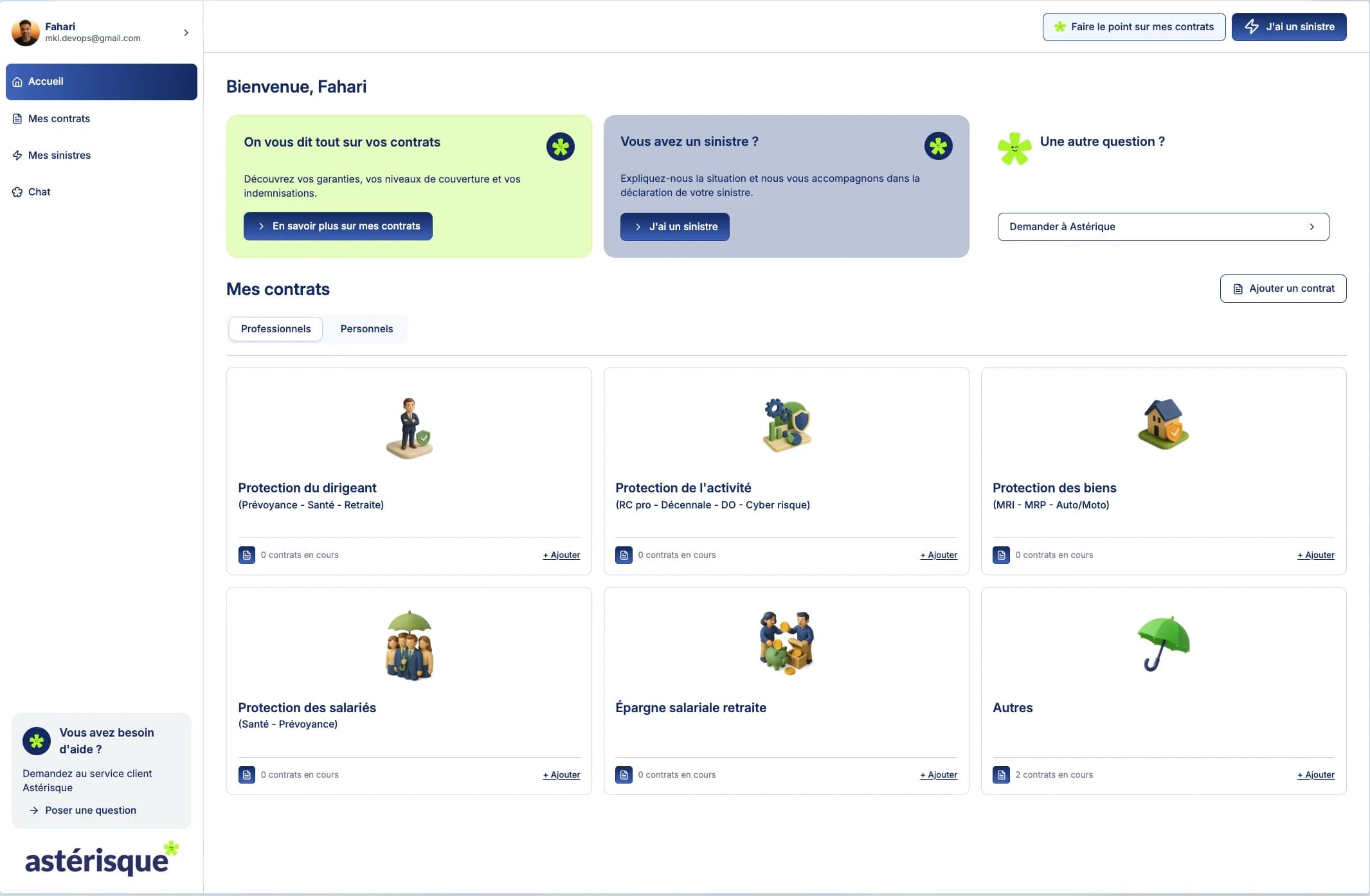
Over three months, PeakLab supported Astérisque in building an app for analyzing insurance contracts. The project combines Next.js and NestJS in a TypeScript stack, with a user interface, API and artificial intelligence features.
TypeScript Front end and backend
Next.js Web interface
NestJS Business API
Method
Not promises. Results.
1
We clarify needs, users, business flows and the existing system. The project gets a scope, delivery plan and typing priorities.
2
We define models, APIs and validation rules before building critical journeys. Typing stays proportionate to the complexity of the business process.
3
Each feature advances in testable steps. Our team checks TypeScript code, integrations and errors beyond compilation.
4
Delivery includes QA, deployment, documentation and skills transfer. We then support fixes and product maintenance.
A review of code and tests helps prioritize migration without blocking releases.
FAQ
TypeScript adds a type system to JavaScript and is compiled into JavaScript to run. Your project can use both languages during a gradual migration.
Copyright © PeakLab 2026. All rights reserved.

