PeakLab selects, builds and integrates generative AI when the use case warrants it: business assistants, document retrieval, extraction, controlled generation and agents connected to your tools. Each pilot starts with a baseline, an evaluation set and a named owner.
The need, data, exclusions, baseline and acceptance criteria are agreed before development begins.
The estimate separates scoping, pilot, integrations, model services, production rollout and operations.
Handover covers sources, instructions, controls, possible errors and escalation to a person.
Quality gaps, costs, latency and incidents are reviewed within the agreed operating scope.
The 2025 France Num Barometer, based on 11,021 companies including 7,978 very small businesses and updated on April 7, 2026, reports that 26% of respondents use an AI solution. Declared uses mainly involve text, voice or image generation (22%) and chatbots or assistants (14%); document analysis (6%) and task automation (5%) remain less common. These figures describe adoption, not return on investment.
We therefore start with the problem: frequency, current effort, errors, available data, the impact of a wrong output and the person who will validate it. An existing subscription, a deterministic rule or n8n automation may be preferable to a custom agent. When uncertainty remains high, an MVP or proof of concept can test the assumption before industrialization.
“Because the outcome matters more than the technology. PeakLab combines product, web development, automation and AI, so we can compare an existing product, deterministic rules, n8n, an assistant or a custom application. If data is insufficient, the process too unstable or the risk disproportionate, we recommend fixing those conditions first. You receive a reasoned decision before funding an integration.”
From the initial decision to production monitoring: six deliverables that test usefulness before expansion.
We observe the current process, volumes, errors, tools and people involved. Each option is compared: an existing feature, product configuration, deterministic automation, embedded AI or dedicated development. The deliverable ranks use cases by expected value, feasibility, data quality, reversibility and risk. A use case without a baseline or an owner does not move directly into production.
For searching procedures, catalogs or authorized documents, we prepare ingestion, chunking, metadata, access controls, retrieval and citations. RAG can tie an answer to sources; it does not guarantee accuracy or completeness. The scope states which questions are accepted, which answers must be refused and how a document is updated or removed. A public-facing assistant may also fall within our AI chatbot agency.
We use output schemas, business rules and representative examples to extract a field, classify a request, prepare a summary or draft content. Ambiguous data, missing files and outputs below the agreed threshold enter a review queue. The deliverable includes the expected format, tests, known errors and review rule; it never presents plausible generation as a reliable decision.
An agent can propose or perform a sequence of actions in a CRM, management tool or API. We limit its tools and permissions, validate inputs, log actions and require approval before sensitive or irreversible operations. Duplicates, timeouts, unavailable services and recovery paths are tested. More autonomy requires more controls, not less human accountability.
We build a set of representative and difficult cases, separate from design examples. Acceptance measures criteria that matter to the business: field accuracy, source presence, expected refusal, cost, latency and correction effort. Personal data, secrets, instruction injection, exfiltration, dependencies and logs are assessed for the chosen architecture. The CNIL recommendations of July 22, 2025 cover purpose, responsibilities and security when development involves personal data.
We document the model and version, instructions, sources, tools, access, thresholds, dependencies, costs and recovery procedures. Useful logs are defined with an appropriate retention period, without recording more data than needed. A change to a model, prompt, source or API triggers the agreed tests before release. Your team receives access and handover; maintenance, support hours and response times are written into the contract when included.
The tool you built isn't just for one thing. I can use it for other documents. You built a tool that could answer one document need, but I realize I can use it for other documents too. That's PeakLab's added value.

Modern and proven stack for high-performance apps
Observe current work, volumes, errors and data, then compare existing software, automation and dedicated AI
Define purpose, affected people, access, human role, applicable obligations and cases the system must not process
Compare options on representative cases with quality, refusal, cost, latency and security criteria defined before the demo
Connect one priority case with least privilege, human approval, logs, alerts and a route back to the previous process
Review quality, cost, incidents and drift, train the team, then decide whether to maintain, adjust, expand or stop
Observe current work, volumes, errors and data, then compare existing software, automation and dedicated AI
Define purpose, affected people, access, human role, applicable obligations and cases the system must not process
Compare options on representative cases with quality, refusal, cost, latency and security criteria defined before the demo
Connect one priority case with least privilege, human approval, logs, alerts and a route back to the previous process
Review quality, cost, incidents and drift, train the team, then decide whether to maintain, adjust, expand or stop
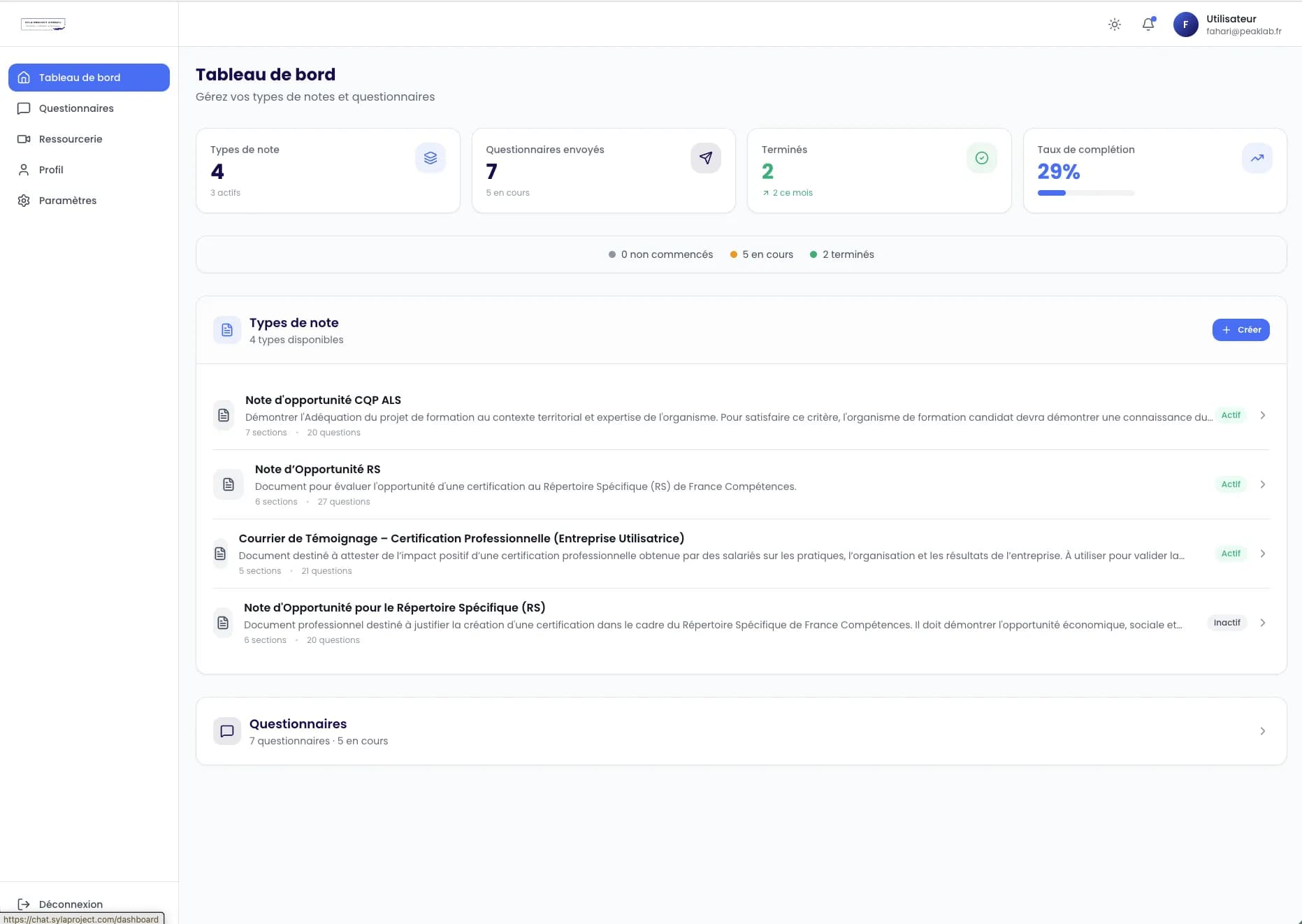
For SYLA Project Conseil, a small consulting business, PeakLab built an assistant that collects a consultant's answers and prepares a first draft of a Qualiopi file. The case shows explicit accountability: AI structures preparatory work, then the consultant reviews, corrects and remains responsible for the deliverable.
We retain this qualitative evidence without republishing the case study's older metrics, whose measurement period and method are not documented. For every new project, the baseline, evaluation set and acceptance criteria are rebuilt around the process concerned.
The France Num guide for SME leaders, updated on June 1, 2026, recommends a similar progression: start with available tools, connect AI to existing tools next, and consider a dedicated project only when the need warrants it. You can also review all our digital services.

Describe the process, data, baseline, acceptable errors and the person who will validate the result. You leave with the next decision to make before any development promise.
Use cases, agents, RAG, data, the AI Act, evaluation, budget and maintenance: decisions to clarify before a pilot.
Choose a frequent, bounded and reversible task for which you know the current effort, errors and owner. Searching procedures, preparing a draft, extracting fields or classifying requests may be suitable when the data is available and authorized. The pilot must compare the new solution with the current process and lead to a decision: maintain, adjust or stop.
An existing product works when its scope, integrations, data terms and cost meet the need. An API enables a more specific integration but adds development and operations. A dedicated system is justified when the process, sources, controls or interface create useful differentiation. We compare these options with a business application, n8n automation and an MVP or proof of concept before choosing.
Generative AI produces or transforms content. A chatbot provides a conversational interface. RAG retrieves material from sources before generating an answer. An agent selects steps and may call tools or APIs within defined boundaries. These components can be combined, but every addition increases dependencies and test scenarios. A simple search engine or deterministic workflow may still be more reliable.
We first inventory the purpose, data categories, affected people, sources, access, processors, locations, retention and logs. Data is minimized and synthetic data is used for testing when sufficient. Provider settings and contracts are checked for the selected service; European hosting, an enterprise API or self-hosting alone does not guarantee compliance. GDPR qualification and any impact assessment depend on the context and remain subject to review by your qualified advisers.
The role of provider or deployer, intended purpose and risk level determine the obligations. Article 4 has required measures to ensure sufficient AI literacy among people using AI on an organization's behalf since February 2, 2025. From August 2, 2026, transparency obligations apply to certain interactions and generated or manipulated content. We document the system and its uses; we do not replace legal review specific to your activity.
Before optimization, we define a set of representative and difficult cases with an expected result or validation rule. Depending on the use case, acceptance reviews extraction accuracy, retrieval relevance and source presence, correct refusal, human correction, cost, latency and tool failures. Tests are rerun after changes to the model, instructions, sources or integrations. A successful demo is not sufficient evidence for production.
No. Some errors can be reduced and detected through a narrow scope, controlled sources, citations, structured outputs, refusal rules and human review. Sensitive decisions must not depend on an unverified plausible answer. The acceptable residual level depends on business impact; if it cannot be reached, that use case does not move into production in its current form.
It depends on the process, data, integrations, evaluation set, security requirements, volume, providers and operating level. The proposal separates diagnosis, prototype, pilot, production rollout, third-party services and maintenance. We do not publish a universal price or schedule that would hide those differences.
No organizational outcome can be promised without studying the actual work. The project states which steps are assisted, which remain human, who validates and how affected people participate in the pilot. The goal may be to reduce re-entry, speed up retrieval or prepare a draft; decisions about roles, staffing and accountability belong to your organization. Training and a route to report incorrect output are part of deployment.
Models, prompts, sources, indexes, tools, permissions and APIs change. Quality, refusals, corrections, cost, latency, incidents and dependencies must be monitored, and tests rerun before an update. The contract identifies the service owner, alerts, review frequency, upgrades, reversibility and support hours. Without an owner or operating budget, a pilot should not be presented as a durable service.
An artificial intelligence agency starts by ruling out the use cases that are not worth it. For the ones that are, it scopes the need, chooses between an off-the-shelf tool, an API integration and custom development, then ships with guardrails: control over the data sent to models, response quality measurement and post-deployment monitoring. Generative AI is only one possible answer; classic automation often solves the problem for less.
Copyright © PeakLab 2026. All rights reserved.