Introduction
In a constantly evolving economic environment, it is essential for SMBs to optimize their operations in order to stay competitive. This is where AI business process automation comes in. But what does that actually mean?
AI business process automation refers to the integration of artificial intelligence into a company’s operational activities. Its goal is to automate and improve the efficiency of business processes.
Why is this digital transformation crucial?
- Task automation: SMBs, often faced with inefficient processes, can benefit greatly from automation.
- Time and cost savings: Intelligent agents can execute repetitive, time-consuming tasks, thereby reducing costs and the time spent on them.
- Increased responsiveness: With AI, SMBs can improve their ability to respond to market demands.
- Resource optimization: The use of AI solutions also fosters innovation, creating a virtuous cycle of growth.
In this article, we will explore how SMBs can leverage AI to transform their business processes and strengthen their competitiveness in the market.
Key Benefits of AI for Business Processes
Integrating AI into business processes offers numerous advantages for SMBs. Here are some key benefits that can transform your company:
- Time savings: Automating repetitive tasks allows employees to focus on higher-value work. This reduces processing times and improves the company’s responsiveness.
- Cost reduction: By optimizing workflows and reducing human errors, AI helps minimize operational costs. Fewer errors means fewer financial losses tied to corrections.
- Improved accuracy: With advanced processing algorithms, AI achieves a high level of precision in processes, reducing the risk of errors and improving the quality of outcomes.
- Competitive advantage: Optimizing processes through AI allows SMBs to stand out in the market. Faster, more accurate operations can boost customer satisfaction and attract new clients.
- Flexibility and scalability: AI solutions adapt easily to the changing needs of businesses. They enable scaling without requiring major overhauls of existing systems.
In summary, integrating AI into your business processes is more than just a trend; it is a strategic means of improving efficiency and securing the long-term viability of your company in an increasingly competitive environment.
AI Specifications Generator
Create professional project specifications in minutes with our AI-powered tool.
Try it free →Real-World Impact of AI on Business Processes
Having explored the theoretical advantages of AI integration, it is essential to examine the concrete results it delivers to businesses. The integration of AI business process automation has demonstrated tangible results for companies, illustrated through hard data and real-world case studies. Here are some notable examples:
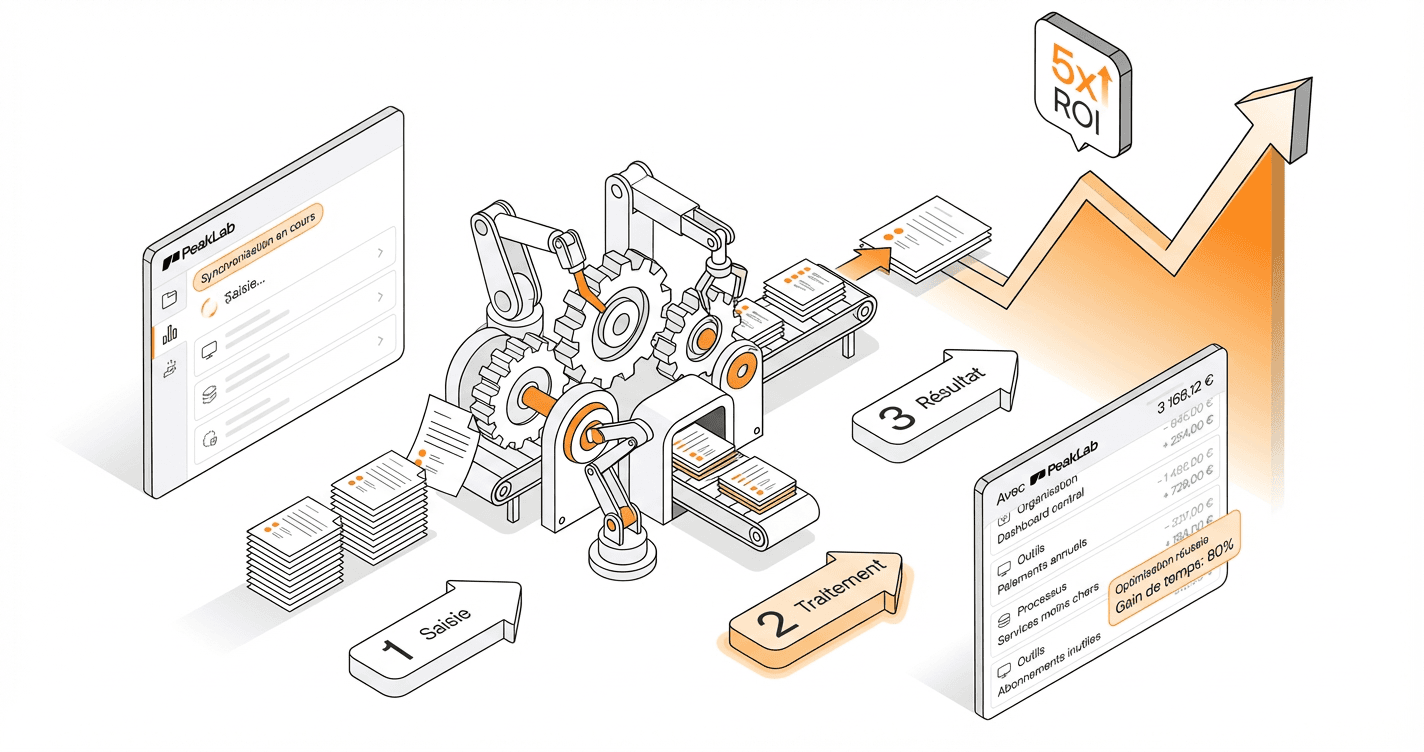
- Return on Investment (ROI) multiplied by 4 to 5: A case study conducted by PeakLab showed that implementing AI solutions in business processes made it possible to achieve an exceptional return on investment, multiplying benefits by four to five times.
- Significant savings: An SMB that integrated AI into its invoicing system generated savings of €47,000 per year. This cost reduction was achieved through effective automation of repetitive tasks.
- Workflow optimization: By analyzing the benefits observed across various sectors, it was noted that integrating AI agents reduces request processing time by 30 to 50%. Workflows become smoother and employee productivity is greatly improved.
- Client example: A PeakLab client mentioned that, thanks to AI, they were able to handle a higher workload without hiring additional staff. « Our delivery times have decreased considerably, allowing our team to focus on higher-value projects, » said a project manager.
These insights demonstrate that AI business process automation is not merely a technology trend, but a strategic shift that enables SMBs to remain competitive while improving their operational results.

| Solution Name | Key Features | ROI (%) | Implementation Time (months) |
|---|---|---|---|
| Appian | Workflow, integration, RPA | 400 to 500 | 3 to 6 |
| Lana Labs | Process mining, data analysis | 350 | 4 to 8 |
| OutSystems | Low-code, rapid application development | 200 | 2 to 5 |
| Pega | Process automation, case management | 300 | 5 to 7 |
| ProcessMaker | Process modeling, RPA | 250 | 3 to 4 |
| ServiceNow | Service management, workflow automation | 300 | 4 to 6 |
| SageMaker | Custom AI models | 400 | 3 to 5 |
| Bedrock | LLM hosting, compliance | 450 | 6 to 9 |
Conclusion
AI business process automation represents a genuine opportunity for SMBs, enabling them to radically transform their operations. Through automation work, companies can see significant improvements in terms of speed, accuracy, and cost reduction. The return on investment is compelling, with ROIs reaching up to 400–500%.
PeakLab positions itself as an essential partner, combining technological expertise with a deep understanding of business challenges. We help companies plug their financial leaks through tailor-made tools adapted to their needs. Our automation solutions not only optimize processes but also promote a culture of innovation within SMBs.
Don’t let your business stagnate: make a strategic decision by integrating AI. With PeakLab, get ready to reduce your costs and improve your performance starting today.
AI Business Process Automation: A Lever for SMB Efficiency
Integrating AI business process automation allows SMBs to radically transform their operations. Through automation solutions, companies can improve their efficiency, reduce costs, and respond more quickly to their customers’ needs. Here is how AI is changing the game for B2B, distribution, and healthcare sectors:
- Improved responsiveness: Companies can handle customer requests more quickly through automated systems, helping them stay competitive in the market.
- Time savings: Repetitive manual tasks are automated, freeing staff to focus on strategic analysis and other high-value activities.
- Error reduction: AI, through its ability to analyze large volumes of data, limits human errors in information processing.
- Inventory optimization: In the distribution sector, AI can help predict demand and manage stock levels, thereby reducing inventory costs.
- Better use of resources: In the healthcare sector, patient record management and billing processes can be optimized, allowing practitioners to focus on patient care.
By integrating AI into their business processes, SMBs can not only achieve considerable savings but also build an agile infrastructure that is ready for the future.
| Aspect | Traditional Methods | AI-Driven Process Management |
|---|---|---|
| Speed | Slower processing, manual tasks | Rapid task automation |
| Error Rate | High error rate due to human intervention | Reduced error rate through data analysis |
| Scalability | Difficult to adapt during growth | High scalability with automatic adjustments |
| Return on Investment (ROI) | Limited ROI, dependent on human effort | High ROI, up to 400–500% according to studies |
| Flexibility | Less flexible, adaptation takes time | High flexibility, rapid adjustments to meet needs |

Evidence: The Impact of AI on Business Processes
The integration of AI business process automation has delivered impressive results for SMBs that have made the leap to automation. Here are some key figures and compelling case studies that bear witness to these outcomes:
- Return on Investment (ROI): Studies show that companies that have integrated AI solutions have seen a return on investment multiplied by 4 to 5 times. This figure highlights the power of automation to improve financial performance.
- Reduction in Processing Times: An SMB that adopted AI for its invoice processing saw a reduction in request processing time of 30 to 50%. This freed up valuable resources, thereby strengthening overall efficiency.
- Considerable Savings: A PeakLab client achieved savings of €47,000 per year by integrating an AI system to automate repetitive tasks. This substantial amount underscores how little operational effort can generate significant savings.
- Workflow Improvement: Using intelligent agents to manage workflows increased process speed while reducing errors. A company in the distribution sector reported greater fluidity in its order cycle thanks to this technology.
- Client Testimonial: « Since we integrated AI, our delivery times have decreased considerably, which we attribute to better inventory management and order automation, » says a logistics manager at an SMB.
These clear results show that AI business process automation is not just a passing trend, but an essential strategy for SMBs looking to boost their efficiency, reduce costs, and prepare for the future. Beyond the immediate benefits, AI paves the way for a culture of innovation and continuous progress within organizations.
Concrete Benefits of AI in Business Processes
Integrating AI business process automation offers tangible advantages for SMBs, transforming their day-to-day operations. Here is an overview of the concrete benefits observed across several use cases:
- Task Automation: SMBs see a reduction in manual tasks, allowing their teams to focus on high-value activities. For example, an SMB in the logistics sector managed to cut the time spent on order management by 50% through automation.
- Improved Efficiency: Implementing AI tools led to a 30% reduction in error rates, as automated systems minimize human mistakes. This improvement is particularly noticeable in the healthcare sector, where AI assists with patient record management.
- High Return on Investment (ROI): Results show returns on investment multiplied by 4 to 5 times for SMBs that have adopted AI solutions. A case study conducted by PeakLab highlighted these results among their clients, confirming that process optimization leads to unmatched profitability.
- Flexibility and Scalability: AI-based solutions, such as those offered by OutSystems and SageMaker, allow SMBs to adapt quickly to market changes, ensuring their long-term viability in a constantly evolving environment.
- Client Testimonials: A manager at a technology company stated: « Integrating AI into our processes not only improved our efficiency, but also significantly reduced our operational costs, enabling us to better serve our clients. »
These examples clearly show that investing in AI business process automation is not simply a technology decision, but a vital strategy for fostering the long-term growth and competitiveness of SMBs. By leveraging modern tools, companies position themselves for the future with confidence and agility.
| Metric | Before AI Implementation | After AI Implementation |
|---|---|---|
| Processing Time | 48 hours to complete an order | 24 hours to complete an order |
| Operational Cost | €10,000 per month | €6,000 per month |
| Error Rate | 15% | 5% |
| Production Capacity | 100 orders per week | 200 orders per week |
| Return on Investment (ROI) | N/A | 400% – 500% |
Common Challenges in Implementing AI Business Process Automation
Adopting AI business process automation represents an incredible opportunity for SMBs. However, it is not without its challenges. Here are some common obstacles companies encounter on this transformational journey:
- High Initial Costs: Implementing AI solutions can require a significant upfront investment, which can be a barrier for many SMBs. Although the return on investment is often high, initial costs can generate doubt or hesitation among decision-makers.
- Technical Complexity: Setting up an AI solution often involves a deep technical understanding. SMBs may find themselves facing complex systems that require skills they do not have in-house. This can lead to the need to bring in external agencies, incurring additional costs and delays.
- Technology Barriers: Many SMBs still operate with legacy systems that do not integrate easily with modern AI tools. These technology barriers frequently stand in the way of migrating to higher-performing solutions.
- Resistance to Change: Integrating new technologies can generate reluctance among employees. Fear of the unknown and concerns about job security can slow the acceptance of AI within the organization.
- Lack of Strategic Vision: SMBs that do not have a clear vision of their AI objectives may find themselves managing chaotic and ineffective projects, which can undermine the potential of the expected benefits.
Overcoming these challenges is essential to ensuring the successful integration of AI into business processes. Working with partners like PeakLab makes it possible to address these issues proactively, thereby maximizing the benefits of automation and AI. The road to process optimization is fraught with obstacles, but it can lead to a more promising future for SMBs.