

Our Paris-based agency builds your innovative software, web application or SaaS and prepares the technical justification of the work. You recover 20% of eligible expenses, up to €400,000 of expenses a year.
Three quick steps to prepare a useful conversation.
Step 1/3
They trusted our tech team with their application









We check whether your project targets a new product, which expenses can enter the base and which evidence to keep. The deliverable: a written opinion with the limits and the points to document.
Our tech team designs and builds your prototype, web application or SaaS. Our invoices can enter your CII base, and the justification is built during development, not afterwards.
Your in-house team built the software? We review the work, the state of the art and the time spent to produce clear documentation before the tax return.
Projects and expenses covered
An SME hires PeakLab to design a platform prototype invoiced €60,000 excluding VAT. If it meets the CII criteria, these invoices enter the base because PeakLab is CII-approved: the tax credit reaches €12,000.
With a non-approved provider, the same invoice does not count, however good the work. Salaries of your staff assigned to this work remain eligible in both cases.
This example is illustrative: the actual amount depends on your expenses, the subsidies to deduct and the share of the work that truly relates to the prototype. An eligibility audit provides that certainty before you file.
Solar platform & administrative automation
Platform redesign to automate administrative procedures and accelerate photovoltaic project management.
-60%
Administrative time
+38%
Revenue generated

Pharmaceutical distribution & data analysis
Full data chain automation: scraping, AI analysis and reporting to multiply processing capacity by 10.
x10
Processing capacity
75%
Time saved

Instant access to technical documents for municipalities
Technical document access platform via QR code/NFC for municipalities. From safety registers to citizen communication.
1 month
MVP delivered
3
Validated sectors
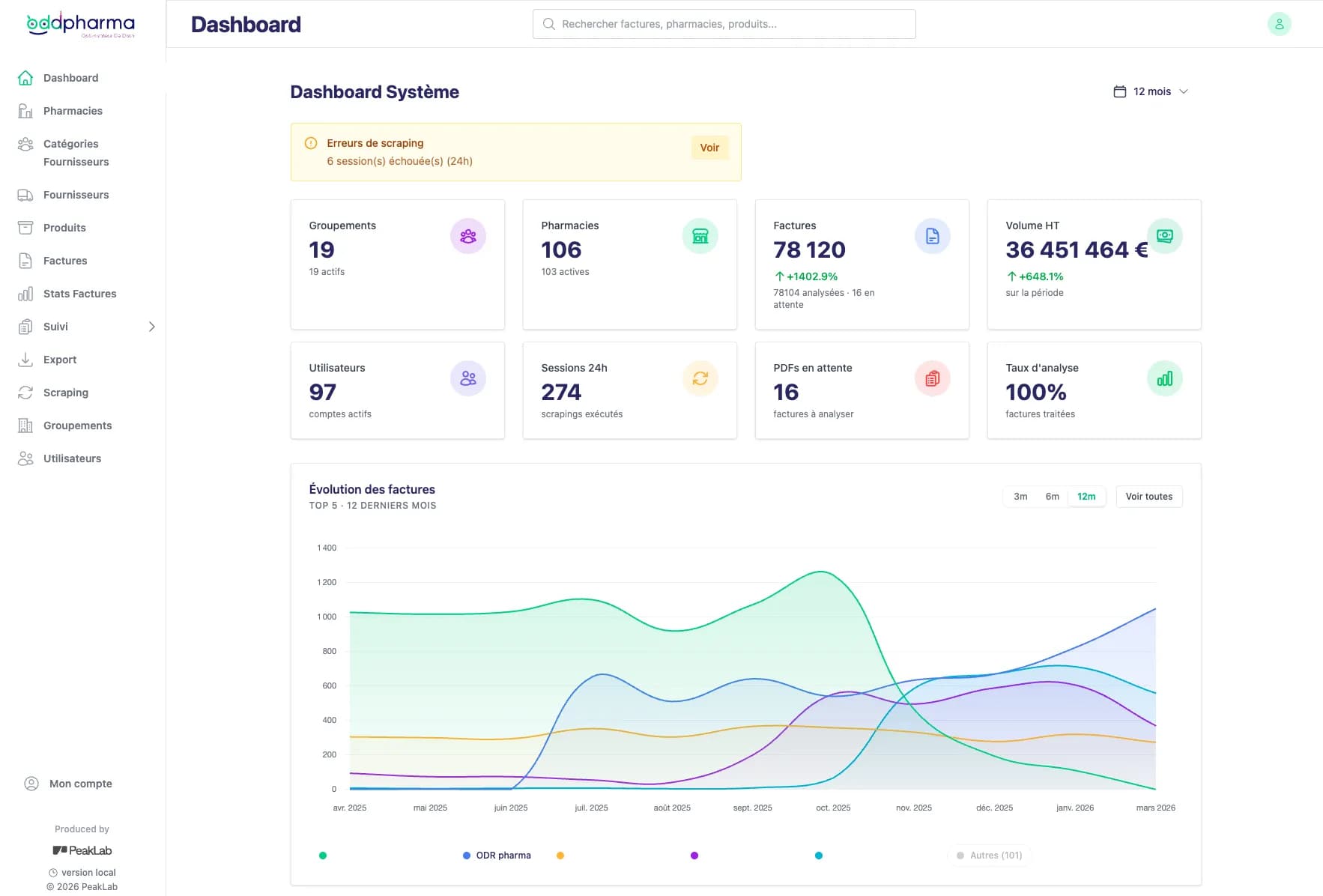
We went from 1 hour per file to 15 minutes. The tool allowed us to multiply our processing capacity by 10 while improving the quality of our analyses. ROI was achieved in 3 months.
x4 ROI in 3 months
+30 Connected pharmacies
+100K€ ARR generated in year 1

Six areas of expertise to take you from a software idea to a solid technical file, with no gap between the code and the tax return.
We analyse your project: target solution, users, business processes, market, technical challenges and planned expenses, then state clearly what falls under the CII, what falls under the research tax credit (CIR) and what qualifies for no credit.
The CII requires a product that stands out from what exists. We compare your solution with market offers and describe what it brings: performance, features, ergonomics or efficiency.
Our tech team builds the prototype of your software or web application. Thanks to our approval, its invoices can enter your base.
In-house tech team time, subcontracting invoices, depreciation: each expense is linked to the innovation work. Series production and commercial rollout stay outside the base.
We write the description of the work and follow the filing process with your accountant, who reports the amounts on form 2069-A-SD. Subsidies received are deducted from the base.
If the tax authorities request evidence, we provide the technical file: work log, code versions, comparison with existing products. Your tax adviser leads the procedure.
The team that designs and builds your software also writes its technical justification: no gap between the code delivered and the description of the work.
If your project does not meet the CII conditions, we tell you in the first conversation, before you commit to anything.
We work with your chartered accountant, who handles the tax return and the final calculation.
Ownership of the code and data from day one, secured access and full documentation: you stay in control of your application.
Target solution, CII criteria and budget
Comparison with market solutions and challenges to solve
Prototype development by our tech team
Time, invoices and architecture choices recorded throughout
Amounts sent to your accountant for the tax return
“We're going to talk about AI, development, digitalization, but I think we shouldn't forget the human aspect and that's what I found with PeakLab. This proximity, this human support. I needed advice, not just an executor.”

Victor
CEO at ODD Pharma
“Great collaboration experience. Lucien demonstrated excellent technical skills, organization and listening. The project progressed efficiently under great conditions with smooth communication. Reliable, involved and full of initiative. I recommend.”

Janine
Co-founder at Astérisque
“Smooth collaboration and concrete results. The platform allowed us to automate our procedures and accelerate the management of our solar projects.”

Alexandre
Co-founder at Solteo
The innovation tax credit (crédit d'impôt innovation, CII) is a French tax scheme reserved for SMEs and attached to the research tax credit (CIR). It covers part of the expenses incurred until 31 December 2027 to design a prototype or pilot installation of a new product, according to the Service Public Entreprendre page checked in February 2026.
A product is new if it is not yet available on the market and stands out from existing offers through its technical performance, features, ergonomics or eco-design. Software or a SaaS platform can therefore qualify; a simple update to an existing service cannot.
In mainland France, the rate is 20%, on a base capped at €400,000 a year, so the credit reaches €80,000 at most. For a custom development budget, it should be built into the quote from the start. For a startup, it also reduces the amount to raise from investors.
Because approval changes the net cost of your project: invoices from an approved company can enter your CII base, others cannot. At PeakLab, the same tech team designs the application, tracks time spent and writes the technical file. For a first version, our MVP agency scopes what needs testing.
Describe your software, its users and what sets it apart from existing products in a shareable document.
Discover the generatorNo-codeCheck whether your current tool lets you leave with your code and your history.
Take the testWorkflowsSpot the processes in your teams that custom software could take over.
Discover the tool
Can't find your question?
Ask Lucien, PeakLab's CEO, directly during a free discovery call.
The CII is reserved for SMEs: fewer than 250 employees, with revenue under €50M or a balance sheet under €43M. The company must be taxed under a real regime, corporate or income tax, or fall under a planned exemption such as the young innovative company (JEI) status. The project must then target the design of a new product.
Salaries of staff assigned to designing the prototype, depreciation of the equipment used, some patent, design and model costs, and work entrusted to approved companies. Production costs for the prototype or pilot installation are excluded.
In mainland France, 20% of eligible expenses, retained up to €400,000 a year, i.e. a maximum credit of €80,000. The rate is 60% in overseas departments and 40% or 35% in Corsica depending on company size.
Yes, if it is a new product: not yet available on the market and superior to existing ones technically, functionally, ergonomically or in eco-design. An innovative service, a new organisation or a simple update of an existing offer does not fall under the CII.
Subcontracted work only enters the base if it is entrusted to an approved company or engineering firm. Without approval, a provider's invoice generates no credit, even for an eligible project. PeakLab is a brand of TECHINS8, CII-approved for 2026 to 2030 (approval no. 28623733 of 22 January 2026, issued by the national CII expertise unit, DRIEETS Île-de-France).
The ministry in charge of research publishes an indicative list of approved organisations, updated several times a year. It is not proof on its own: ask the provider for its approval decision and check that it covers the year of the work. The approval decision of TECHINS8 (PeakLab) is available in the CapCII directory.
The CIR funds research and development for companies of all sizes at a 30% rate. The CII, reserved for SMEs, funds the design of prototypes of new products at 20% in mainland France. The same expense cannot be counted in both credits.
Expenses are declared on form 2069-A-SD, the same as for the CIR, filed with the annual tax return. A company subject to corporate tax files it no later than the 15th day of the fourth month after its financial year-end. The credit is calculated per calendar year.
The credit is first offset against the tax due for the year of the expenses, then against the following three years; any balance is then refunded. Young innovative companies, companies created less than two years ago and companies in insolvency proceedings can request a direct refund.
Yes. Public subsidies received for the project are deducted from the expenses retained in the calculation. Repayable advances follow specific rules: your accountant decides based on the signed agreement.
A description of the work, the state of the art, time spent per person, invoices, successive versions of the product and evidence that it was not yet on the market. Documentation kept during the project is worth more than a reconstruction afterwards.
Yes, by requesting a tax ruling (rescrit) from the tax authorities, who then take a position on the project's eligibility. It requires a precise description of the product and its novelty.
Yes, if it meets the SME conditions and runs a new-product project. A startup with young innovative company status can request a direct refund of its credit, which reduces the need to raise funds from investors.
No. SEO, a graphic redesign or a showcase website do not create a new product within the meaning of the CII. Our SEO agency can handle them, but these expenses stay outside the base.
The eligibility audit starts with a free 30-minute call. Development and technical justification then come with a written proposal, priced according to the product scope. Advisory fees are not CII-eligible expenses.
Can't find your question?
Ask Lucien, PeakLab's CEO, directly during a free discovery call.
A Paris-based CII agency, PeakLab works with SMEs and startups across France, remotely. A free 30-minute first call: a frank opinion on your project's eligibility, the evidence to keep and the best way to build it.

Lucien ArbieuCEO and co-founder of PeakLab
Copyright © PeakLab 2026. All rights reserved.