Our MVP development agency turns your idea into a testable, evolvable digital product: a custom MVP (Minimum Viable Product) or POC built by senior developers to validate your market, gather feedback from real users and decide what comes next. You own the code.
Three questions to prepare a useful conversation.
Question 1/3
Our references: they launched their product with PeakLab

Repository, access and documentation are yours from go-live. A throwaway mockup or POC is flagged as such.
After scoping, price and schedule are set on a written scope: inclusions, exclusions, dependencies and recurring costs.
Before building, we set who to observe, the expected signals and the decision the test must inform.
Evolvable code to move from MVP to V1, even with a team other than PeakLab.
Coding should not always be the first choice. First, name the uncertainty: market interest, understanding of a journey, technical feasibility or actual usage of a solution.
In March 2026, Bpifrance Création explains that an MVP is a coherent minimum offer tested under real-world conditions that complements market research. The hypothesis and observation criteria are therefore defined before code is written. Four options exist:
“Because a useful MVP is not measured by its number of features. If a mockup, demo or POC better meets the need, we say so before you commit the budget: just what is needed, without wasted time or money.”
Depending on how far your idea has progressed, our Paris development team steps in at the right level.
Scoping workshop, priority journey and clickable prototype to help you validate the idea with your internal teams and real users.
Product designA working product, application or website, live within a few weeks and ready to gather feedback.
Web developmentBubble, Airtable or AI-generated app hitting its limits: audit, hardening and move to an evolvable foundation.
Assess my toolWhat an MVP often includes
Our approach links each deliverable to a hypothesis, a testable version and a decision. Product, design and tech experts and senior developers support you from idea to go-live.
Problem, segment, marketing message, business model, expected value, goals and the signals that will lead you to continue, adjust or stop. Our product management agency deepens discovery, prioritisation and decision support.
Essential journey, necessary screens and a mockup tested with representative users. Our product design agency steps in when user experience is the main risk.
When feasibility remains uncertain, our technical expertise isolates the point to test, the data model, the environment and the exit criterion. The POC validates a technical solution; non-reusable code is flagged.
Agile method, short sprints, code review for quality and a demo at the end of each sprint, with a backlog tracked day to day. This backlog separates the essential from what can wait, without hiding a full V1 behind the MVP label.
MVP hosted in France or Europe, documented GDPR framework, measurement plan and interviews with the target audience to gather feedback on real usage. A single metric does not validate a hypothesis.
Results, limits, onboarding training, running costs and options for an evolvable product: iterate, accelerate, change direction or stop, with no contractual lock-in.
Not promises. Results.
Automated margin and discount analysis tool for faster and more precise management.

Redesigned solar platform to automate procedures and accelerate project management.

Brand-creator matching platform with integrated performance analytics.

Modern and proven stack for high-performance apps
Problem, target, hypothesis, constraints and expected signals
Manual test, prototype, POC or MVP: inclusions, exclusions, budget and schedule
Working delivery in increments, with a demo at each sprint
Pilot with the right profiles, usage data and interviews
Handover, known debt and recurring costs to improve the next version
Problem, target, hypothesis, constraints and expected signals
Manual test, prototype, POC or MVP: inclusions, exclusions, budget and schedule
Working delivery in increments, with a demo at each sprint
Pilot with the right profiles, usage data and interviews
Handover, known debt and recurring costs to improve the next version
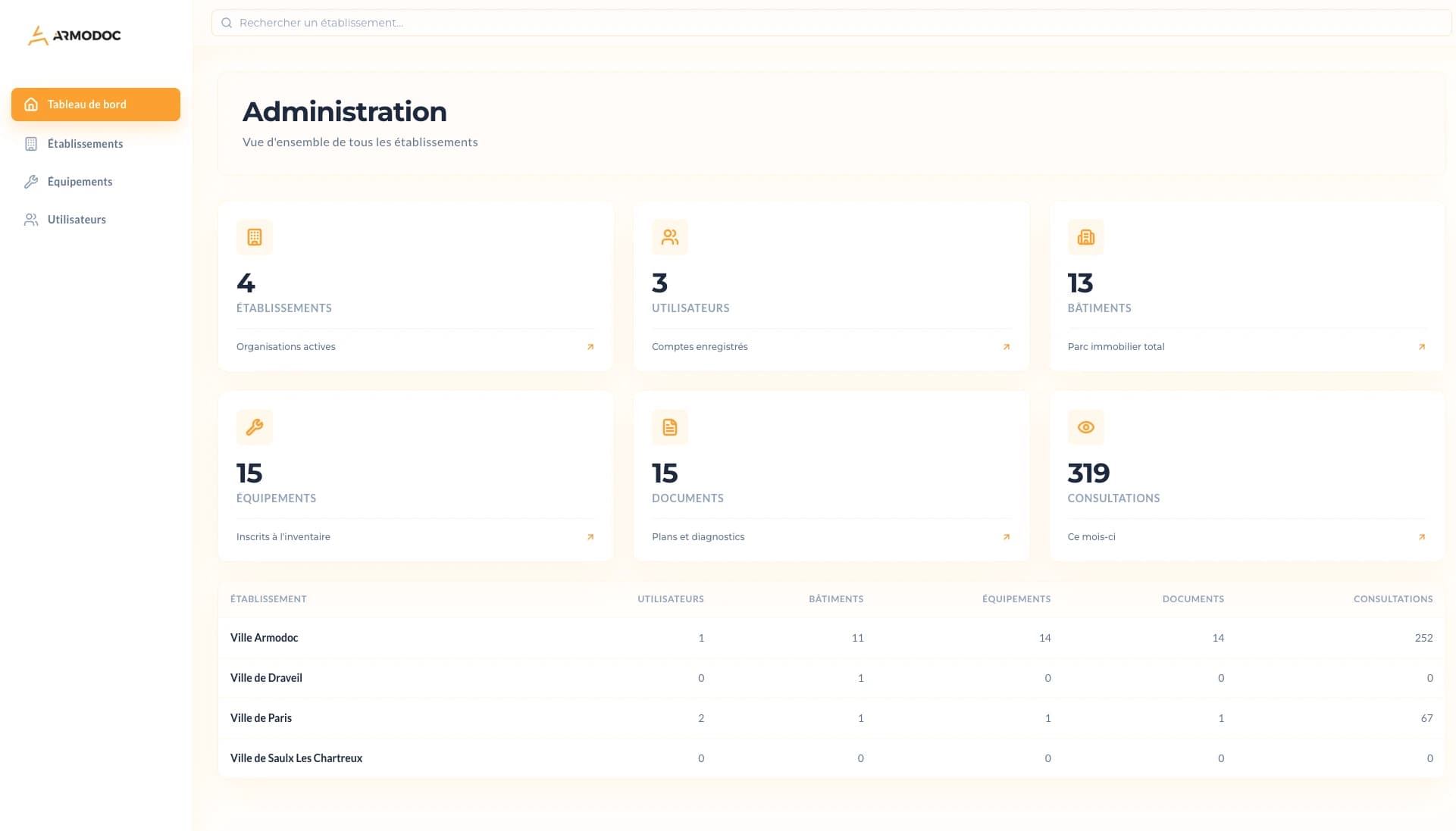
Reference case study · Armodoc
For Armodoc, PeakLab scoped and then developed an MVP that gives field teams access to technical documents using QR codes and NFC tags. The project was delivered in one month for this specific scope; after a first demo, its founder secured a meeting with a local authority. This timeframe describes this particular project; it is not our standard delivery time.
This case shows the intended sequence: a limited scope, a tangible version in front of a real stakeholder, then next steps decided on feedback. On its own, it does not prove that an entire market has been validated.
Authentic testimonials from those who trusted us.
“Thank you so much for everything, your work was incredible. We went through 1000 hurdles, and you never gave up. You were patient, organized, available, and you transformed the project into something really solid! Without you, Upcreators wouldn't exist.”

Sofiane
CEO at UpCreators
“Great collaboration experience. Lucien demonstrated excellent technical skills, organization and listening. The project progressed efficiently under great conditions with smooth communication. Reliable, involved and full of initiative. I recommend.”

Janine
Co-founder at Astérisque
“Smooth collaboration and concrete results. The platform allowed us to automate our procedures and accelerate the management of our solar projects.”

Alexandre
Co-founder at Solteo
Before development, three helpful resources to clarify the idea.
Structure your MVP's goals, users and priorities in a document you can share.
Open the generatorNo-codeCheck whether your current no-code tool lets you recover your sources and access.
Run the assessmentAutomationSpot the manual tasks your future product could automate.
Start the assessment
A Paris-based development agency, PeakLab helps startup founders, SMEs and large groups of every size turn an idea into a testable digital product. Free 30-minute video call to start.
Price, timeline, technologies, team, security and ownership: the decisions to make before building.
A minimal version of a product, usable by real customers, to learn as much as possible with the least building. It complements market research without replacing it.
A manual test lets you observe an initial signal without complete software. A prototype represents a journey so you can observe whether people understand it. A POC answers a focused technical feasibility question. An MVP is a coherent minimum offer used under real-world conditions to observe behavior; it may itself begin as a manually delivered service. These formats are not mandatory steps.
No, but you need to be able to describe the problem, the target audience, known constraints and the people who will test the solution. Scoping turns those elements into a hypothesis, priority journey, exclusions and decision criteria. Our requirements document generator can help you prepare an initial brief.
Yes: that is the purpose of the initial workshop. We separate the essential from what can wait to test the main hypothesis with the smallest useful content.
An MVP limited to the essentials is often built in a few weeks; a richer product takes several months. After the workshop, the schedule is tied to deliverables.
The budget varies with the selected format, functional scope, design, user roles, integrations, data migration, testing and production release. The proposal distinguishes scoping, construction, third-party services and recurring costs — hosting, licences, monitoring and maintenance — so that you can compare equivalent scopes. Depending on the project, the French Innovation Tax Credit can reduce the final cost.
A proven web stack chosen to evolve: Next.js and React for the interface, Node.js or Python on the server, hosting in Europe. The choice follows your constraints, not a trend.
A freelancer suits a short assignment; in-house hiring takes time. An agency brings a complete team (product, design, senior developers) available from the start.
PeakLab builds responsive web MVPs, usable on mobile from the browser. A native app is rarely justified for a first validation.
A negative result can be useful when it leads to a documented decision before a larger commitment. We distinguish what challenges the problem, the target audience, the journey or the technical solution. The next step may be another test, an adjustment, a pause or a stop; we do not systematically present a V1 as the only possible outcome.
When reusable code is produced, the repository, access credentials and documentation specified in the proposal are handed over to you. A deliberately disposable prototype or POC is identified as such before it is built. For an MVP, the architecture is proportionate to known risks; if the pilot confirms usage, performance, security and architecture are reassessed against actual volumes before broader deployment.
Yes, at a level proportionate to the context: access control, backups, useful logging, secrets management and testing of critical journeys are not reserved for V1. The 2025 Cybermalveillance.gouv.fr barometer, based on 588 companies with fewer than 250 employees, reports that 16% said they had experienced at least one incident during the previous twelve months. If the test processes personal data, we document purposes, access, recipients, retention periods and safeguards in line with the France Num guide updated on 3 February 2026; legal validation depends on your specific context.
Copyright © PeakLab 2026. All rights reserved.