Our custom web development agency designs applications, portals and platforms when existing tools no longer fit your workflow, covering discovery, UX, integrations, testing, deployment and handover.
Three questions to prepare a useful conversation.
Question 1/3
They trust us with their web applications

Journeys, roles, integrations, failure cases and acceptance criteria are agreed before a feature is considered complete. Out-of-scope items remain visible.
The plan separates design, development, acceptance, migration and decisions that depend on your team or third parties. A date is committed only after those dependencies are assessed.
The contract identifies repositories, environments, data, accounts, third-party components, licences and assigned rights. Portability is not reduced to a general sales claim.
Monitoring, backup, restoration, incident procedures, ownership and maintenance are defined according to criticality. A required service level receives its own explicit scope.
PeakLab designs a custom web application when an important workflow, business rule, user experience or integration cannot be covered properly by an existing tool. Discovery must also be able to conclude that a SaaS product, CMS, native configuration or simple automation is enough. Custom development is not an end in itself.
The France Num guide published in March 2026 recommends documenting objectives, users, scope, technical considerations, responsibilities, budget and schedule before comparing providers. We turn these inputs into decisions, acceptance criteria and operational ownership instead of an unprioritized feature list.
The 2025 France Num Barometer surveyed 11,021 businesses. It reports that 78% of respondents see real benefits from digital tools, while 52% are concerned about data being hacked. These self-reported figures prove neither a need to build nor a future result. They explain why usefulness, risk and maintenance should be considered together.
“We compare configuration of an existing tool, integration, no-code and custom development against the workflow, risks and operating cost. If the need is primarily an internal tool, see our business application agency. If it still needs validation, start with an MVP or POC.”
Build, rebuild or take over: the engagement model follows the state of your tool.
Customer portal, platform or internal tool designed from scratch, from scoping to launch.
Business applicationModernise a slow or fragile application step by step, without stopping operations or losing history.
Systems migrationBubble, Airtable or AI-generated code hitting its limits: audit, hardening, takeover and maintenance.
Assess my toolFeatures we often build
We work on business applications, client or partner portals, dashboards, service platforms, API integrations and progressive modernization of existing applications. Each assignment connects a business decision to a verifiable deliverable.
Web development remains the broad discipline of building and integrating a platform. A business application focuses on an internal workflow. A SaaS product is distributed and operated for customers. A systems migration emphasizes continuity and rollback.
We examine the current workflow, users, decisions, data, exceptions and tools already in place. The deliverable separates objectives, available baseline, included and excluded scope, priority journeys, dependencies, risks and acceptance criteria. Your team can prepare these inputs with our requirements document generator. A target number is retained only when its measurement method and owner are defined.
Journeys are designed around roles, context of use, critical tasks and failure cases. A prototype helps verify comprehension, navigation, language, permissions and behavior on agreed devices before complete screens are developed. Feedback is recorded with the resulting decision: revise, retain, defer or remove. Accessibility and the compatibility matrix become acceptance criteria suited to the service, not a blanket statement.
We map data sources, owners, formats, volumes, permissions, retention periods and exchanges with existing software. API contracts, validation rules, errors, rate limits and recovery mechanisms are specified before critical synchronization is built. For the outsourced-product scenario it covers, the France Num guide updated in May 2026 explains that the company collecting the data remains the controller and should assess the contract, subprocessors, locations and safeguards.
The product progresses through demonstrable increments in a dedicated environment. Code review, relevant automated tests, functional checks, permission checks and business acceptance reduce defects without promising their absence. Security criteria can use an agreed reference: OWASP ASVS 5.0 provides identifiable requirements for verifying web application technical controls. Every version ends with a documented decision, not only a demo.
Threats, permissions, secrets, logging, dependencies, backups and restoration are treated according to the data and criticality. The CNIL guidance dated June 19, 2026 states that risks affect businesses of every size and recommends measures including updates, stronger authentication, backups and restoration tests. For services in scope, EU accessibility rules and their exceptions are assessed before development. A migration includes proportionate checks, backup and rollback.
Handover can include the source repository, build and deployment procedure, architecture and data diagrams, API contracts, access inventory, test suites, known decisions and an operations guide. The contract identifies assigned rights as well as licences and third-party services that remain subject to their own terms. A maintenance plan names owners for dependencies, incidents, backups and changes. Its response times and service levels depend on the selected agreement.
Not promises. Results.
Technical management and citizen communication platform for municipalities.

Redesigned solar platform to automate procedures and accelerate project management.

Brand-creator matching platform with integrated performance analytics.

Modern and proven stack for high-performance apps
Workflow, users, data, risks, baseline and existing products are assessed. The outcome may be development, a smaller test or adoption of an existing tool.
Journeys, data model, integrations, architecture, non-functional requirements, acceptance and responsibilities form a scope that can be estimated.
Priority capabilities are built, reviewed, tested and presented. Each demonstration is used to decide the next backlog items.
Named users, data, roles, performance, security, backup and rollback are checked against the agreed plan before access is opened.
Documentation, access, monitoring, incident procedure and maintenance are handed over. Observed measures inform the decision about subsequent changes.
Workflow, users, data, risks, baseline and existing products are assessed. The outcome may be development, a smaller test or adoption of an existing tool.
Journeys, data model, integrations, architecture, non-functional requirements, acceptance and responsibilities form a scope that can be estimated.
Priority capabilities are built, reviewed, tested and presented. Each demonstration is used to decide the next backlog items.
Named users, data, roles, performance, security, backup and rollback are checked against the agreed plan before access is opened.
Documentation, access, monitoring, incident procedure and maintenance are handed over. Observed measures inform the decision about subsequent changes.
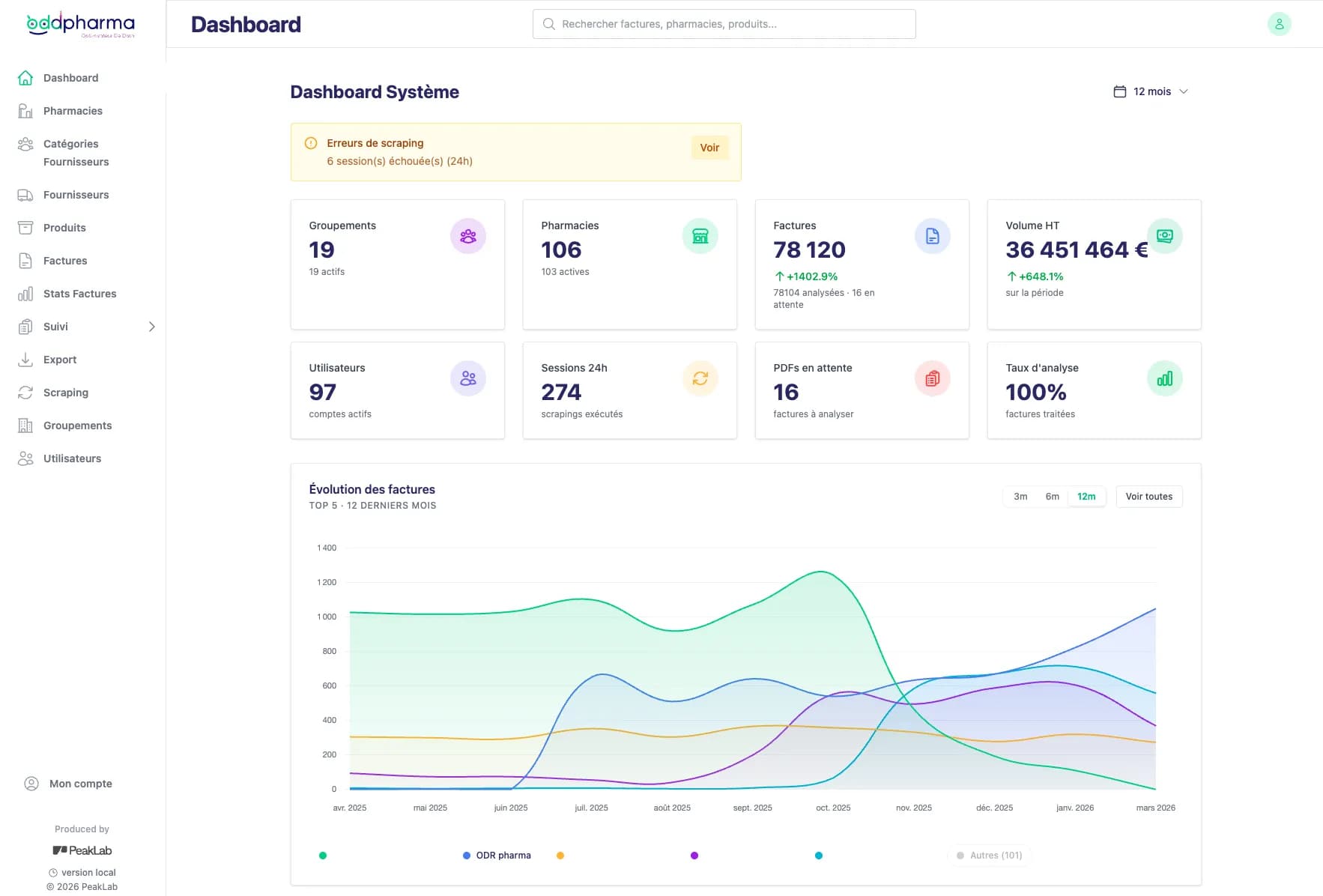
Case study · ODD Pharma
For ODD Pharma, PeakLab designed a white-label platform that collects data, presents it in a dashboard and generates tailored reports. The published case describes the need, the solution and a testimonial attributed to Victor Ottavi.
This evidence shows our ability to turn a workflow into an application that can be distributed and administered. It sets no standard outcome, schedule or budget for another project. The measurement period and protocol for indicators shown elsewhere in the case are not published, so this page does not turn them into a sales promise.
If the need is primarily an internal workflow, explore our business application service. For a product sold to several customers, see our SaaS agency. To take over a critical existing system, systems migration addresses inventory, continuity and rollback.
Authentic testimonials from those who trusted us.
“Great collaboration experience. Lucien demonstrated excellent technical skills, organization and listening. The project progressed efficiently under great conditions with smooth communication. Reliable, involved and full of initiative. I recommend.”

Janine
Co-founder at Astérisque
“Excellent DEV. Complex Back and Front mission handled brilliantly. Real technical expertise serving our needs.”

Fabrice
Project Manager at Celeste
“Lucien was able to make himself available quickly in a high-load context where I needed immediate support. Reactive and autonomous, he took ownership of the subject efficiently and anticipated next steps without waiting for instructions. Communication was smooth throughout the mission.”

Sylvain
Founder at NéoNiv
Before talking budget, three tools to clarify the need.
Structure goals, users and features in a document you can share.
Generate my requirementsReversibilityCheck whether you can recover the code, data and access of your application.
Run the assessmentAutomationSpot the manual tasks a custom tool could automate.
Start the assessment
Describe the workflow, users, data, existing tools and priority constraint. You leave with the next question to investigate, without an instant quote or promised result before discovery.
Budget, schedule, technology, rights, security, migration and maintenance
To bring scoping, design, development, testing and maintenance into one team accountable for the result, instead of coordinating several providers.
List goals, users, priority journeys, integrations and constraints, then rank features by priority. Our requirements document generator guides you step by step.
Custom development is useful when an important operational gap cannot be resolved properly through configuration or integration: specific rules, complex roles, a differentiating experience, or data and systems that must be connected. We compare initial cost, operating cost, limitations, data export and dependencies. If an existing product meets the need and risk, rebuilding it is generally not the right decision.
A responsible budget follows a verifiable scope. It varies with the number of journeys and roles, integrations, state of the data, migration, security or accessibility requirements, volumes, acceptance and maintenance level. We separate discovery, construction, third-party services and operations, then expose assumptions and exclusions. There is no universal price that can promise the same application to every SME.
The schedule depends on scope, decisions, third-party APIs, data quality, migration and user availability for acceptance. We propose increments and decision milestones after discovery. A prototype, an MVP and a critical application takeover do not share the same goal or timeline. A reliable date cannot be inferred from the number of screens.
The choice follows the constraints: available skills, existing ecosystem, browsers and devices, integrations, volumes, hosting, security, maintainability and operating cost. We record the decision and its trade-offs. A familiar technology is not automatically suitable, and a complex architecture is not a sign of quality when a simpler system covers the need.
The contract should distinguish custom code, pre-existing components, open-source dependencies, third-party services, data and design assets. It identifies assigned rights, repositories and access to be handed over, with their conditions. Your data is identified separately from the code. We prepare takeover by another team through agreed documentation and inventory without claiming that every technical or contractual dependency disappears.
Yes, when the product offers authorized and sufficiently documented access. We assess authentication, permissions, formats, volumes, rate limits, webhooks, test environments and provider policy. A missing API, restrictive licence or inconsistent data may require another route. A critical integration also needs deduplication, logging, alerts and a manual procedure.
Discovery identifies data, purposes, roles, risks and obligations with the appropriate owners. We translate decisions into permissions, minimization, secrets, suitable encryption, logs, updates, backups, restoration and tests. PeakLab can provide technical evidence, but does not replace your legal adviser or controller and does not declare absolute compliance outside an audited scope.
We begin with an inventory of capabilities, interfaces, data and dependencies, then define cleanup, mappings, migration rehearsals, checks and validation ownership. Depending on risk, rollout may be progressive or parallel. Backups, go/no-go criteria and rollback are tested at a suitable scale. See our systems migration approach.
Launch starts an observation period covering errors, performance, usage, support requests and agreed measures. The runbook names who monitors, decides, restores and communicates. Corrective maintenance, dependency updates, product changes and service levels are scoped separately according to criticality. They are not assumed to be included without a contract.
Yes. An MVP or POC helps reduce uncertainty about need, usage or feasibility. A technical audit is more suitable when an application already exists and its architecture, quality, security, performance or takeover readiness must be understood. The deliverable should support a decision: continue, fix, migrate, replace or stop. You can also compare our product and technology expertise.
A freelance developer suits a short, well-bounded assignment. An agency brings a team: a project lead, senior developers, a design expert and code review, with continuity if someone is unavailable. PeakLab focuses on development rather than general digital services. Collaboration runs on short sprints, a weekly meeting and a direct channel for day-to-day communication.
Our core business remains custom web applications. A content-led brochure website is often easier to manage with a CMS; to sell online, see our e-commerce agency. If the goal is visibility on Google, our SEO agency covers organic search, content and digital marketing.
Yes, when it serves a specific goal: document sorting, team assistants, information extraction or decision support. We first measure answer quality on your real cases, then control costs and information protection before adding a new feature. For an AI-centred project, see our generative AI agency.
PeakLab's head office is at 60 rue François Ier, Paris 8th. Workshops and follow-up run by video, with a weekly meeting, for clients across France.
Copyright © PeakLab 2026. All rights reserved.