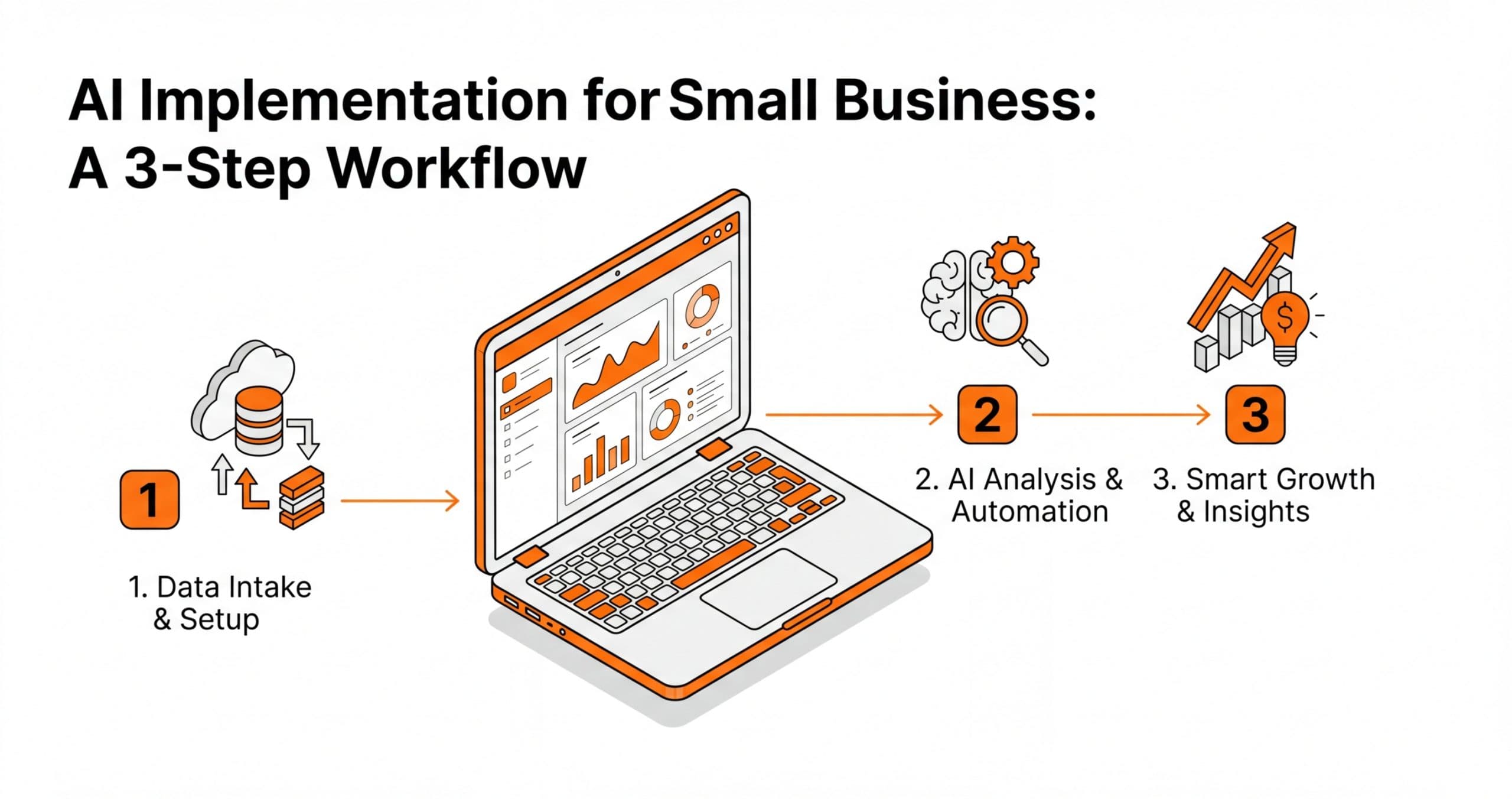
Artificial intelligence is no longer reserved for large enterprises. Today, AI solutions for SMBs are becoming accessible, concrete and above all profitable. Automation, customer service, marketing, data analysis… the opportunities are numerous, but one question remains central: how do you implement AI effectively in an SMB without wasting time or money?
Many business owners see the potential, but hesitate to take action. Due to a lack of clarity, fear of technical complexity, or simply because they don’t know where to start. The result: projects that stall or poorly used tools with no real business impact.
Yet, when used correctly, AI can become a genuine growth driver: productivity gains, cost reduction, improved customer experience and faster decision-making.
In this article, you will discover how to concretely integrate AI solutions into your SMB, which steps to follow, which tools to prioritize and, most importantly, how to avoid the most common mistakes.
What Are the Best AI Solutions for an SMB in 2026?
In 2026, AI solutions for SMBs are no longer futuristic tools reserved for large enterprises. They are concrete, accessible and directly applicable to real business challenges: saving time, automating, selling better and making smarter decisions. The key is choosing the right solutions.
ChatGPT for Content Production and Automation
ChatGPT stands out as the most versatile tool for an SMB. It enables rapid content production (SEO articles, emails, sales scripts) while also automating repetitive tasks. When used effectively, it becomes a true assistant capable of structuring ideas, proofreading texts or even helping create internal processes. It is often the first building block to integrate, as its return on investment is quick.
Claude for Strategic Analysis and Structuring
Claude is particularly powerful for handling complex content. It excels at analyzing lengthy documents, synthesizing information and structuring strategic thinking. For an SMB, this enables better decision-making, improved quality of existing content and a clearer perspective on key topics. It is a highly useful tool for shifting from an operational mindset to a more strategic one.
Gemini for a Connected Google Ecosystem
Gemini is a particularly interesting solution for SMBs that already use Google Workspace. Its integration with tools such as Docs, Sheets or Gmail makes it possible to automate tasks, analyze data or streamline internal collaboration. The advantage is straightforward: you don’t change your tools — you simply make them smarter.
AI Chatbots to Improve Customer Service
AI-powered chatbots have become a powerful lever for SMBs. They enable instant responses to frequently asked questions, prospect qualification and partial customer support management without human intervention. The result: significant time savings and greater availability for your customers. This is a particularly relevant solution for businesses that receive a high volume of repetitive inquiries.
Automation Tools to Boost Productivity
Platforms like Zapier or Make, combined with AI, allow you to connect your tools and automate time-consuming tasks. This can cover lead management, email sending or data synchronization. For an SMB, these automations make it possible to structure processes without hiring, and therefore to gain efficiency quickly.
AI for Marketing and Customer Acquisition
AI is also transforming the way SMBs manage their marketing. It enables performance analysis, campaign optimization and message personalization. This translates into better conversion rates, more targeted acquisition and smarter use of budgets. AI becomes a direct growth lever here.
AI Solutions for Data and Decision-Making
Finally, certain AI solutions allow you to leverage your company’s data to make better decisions. They identify trends, anticipate behaviors and help you adjust your strategy. For an SMB, this represents a significant competitive advantage: moving from intuition-based management to an approach grounded in concrete data.
How to Integrate AI into an SMB Without Technical Complexity?
One of the biggest barriers to adopting AI solutions in SMBs is not budget… but the perception of complexity. Many business owners believe they need advanced technical skills, a dedicated team or a long and costly project. In reality, integrating AI can be simple, fast and gradual, provided you take the right approach.
The first step is to start from needs, not tools. The most common mistake is looking for « which AI to use » instead of asking « which problem to solve. » Are you losing time on repetitive tasks? Is your team spending too much time answering the same questions? Is your content creation too slow?
👉 AI must address a concrete need — otherwise it becomes useless.
Once that need is identified, it is essential to start small. There is no need to transform your entire business at once. The goal is to test a first simple use case with a quick impact.
For example:
- automating email drafting
- creating content more quickly
- setting up a chatbot for frequently asked questions
These use cases allow you to see the benefits quickly, without complexity.
Next, prioritize simple and accessible tools, such as ChatGPT or Gemini. These solutions require no technical development and can be used directly by your teams.
The goal is not to build a custom solution from the start, but to integrate AI into your day-to-day operations.
Another key point is team training. AI does not replace employees — it supports them. It is therefore important to show them how to use these tools effectively.
A few hours of training can be enough to:
- understand the basics
- avoid mistakes
- gain autonomy
👉 A trained team = AI that is actually used.
It is also important to structure usage. Without a framework, AI can be used in a disorganized way, which limits its impact.
Define:
- priority use cases
- approved tools
- best practices
This helps prevent misuse and maximize results.
Automation is a powerful lever for simplifying integration. Tools like Zapier or Make allow you to connect your applications without code. You can create simple workflows: a form submitted → an email sent → a task created.
👉 Result: fewer manual tasks, more time for high-value actions.
Another essential element is to measure results. AI must deliver a concrete benefit: time saved, increased leads, improved customer satisfaction.
Track simple indicators:
- time saved
- number of automated tasks
- content performance
This allows you to adjust your strategy and prioritize the most effective actions.
Finally, adopt a progressive mindset. Integrating AI is not a one-off project, but a continuous improvement process.
Start with one use case, then expand:
- marketing
- customer service
- operations
- internal management
👉 This is the approach that enables genuine transformation, without complexity.
In summary, integrating AI into an SMB without difficulty rests on a few simple principles:
- start from a concrete need
- begin with simple use cases
- use accessible tools
- train your teams
- structure usage
- measure results
👉 AI should not be a technical project.
👉 It should become an operational tool in service of your growth.