What Is the Difference Between Claude and Claude Code?
LALucien Arbieu8 min read
With the rise of artificial intelligence in software development, many tools have emerged to support developers. Among them, Claude has quickly established itself as one of the most powerful AI models for advanced reasoning, analysis, and content generation. But recently, another name has been making the rounds: Claude Code.
So, what is the difference between Claude and Claude Code? Are they the same tool? A specialized version? A simple marketing variation, or a genuine technical evolution?
In this article, we will clarify the differences between Claude and Claude Code, understand their respective use cases, and determine which one to choose based on your profile: developer, startup, tech team, or simply someone curious about AI.
What Is Claude and What Is It Actually Used For?
Defining Claude
Claude is a conversational artificial intelligence model developed by Anthropic. It is a LLM (Large Language Model) designed to understand, analyze, and generate text in an advanced manner.
Claude operates on the principle of natural language processing (NLP). It is capable of interpreting complex instructions, producing structured content, summarizing lengthy documents, and assisting with technical or creative tasks.
In 2026, Claude is recognized for:
Its advanced reasoning capabilities
Its contextual understanding across long documents
Its precision in technical analysis
Its security- and reliability-oriented approach
Unlike a simple chatbot, Claude is designed to handle complex conversations and maintain coherence across long interactions. It can analyze entire files, understand detailed instructions, and produce structured responses.
Claude is accessible via a web interface, an API, or integrations within certain professional environments.
What Is Claude Used For?
Claude is a versatile tool used across many fields. Its primary role is to assist users with tasks requiring analysis, writing, or advanced comprehension.
1. Writing Assistance
Claude is widely used to:
Write articles
Structure professional documents
Generate emails
Create scripts or presentations
It is particularly effective at producing long-form, structured content.
2. Document Analysis
Claude can analyze:
Reports
Legal documents
Large text corpora
Complex textual data
It is capable of summarizing hundreds of pages and extracting the key points.
3. Development and Code Assistance
Although Claude is not exclusively a development tool, it is widely used in technical contexts to:
Explain code
Generate scripts
Suggest improvements
Fix errors
It is in this context that Claude Code begins to emerge — a version or usage more specialized in software development.
4. Strategic Support and Reasoning
Claude is also used as a decision-support tool. Thanks to its reasoning capabilities, it can:
Compare options
Structure strategies
Analyze scenarios
This makes it a useful assistant for entrepreneurs, marketing teams, and developers alike.
5. Automation via API
Companies use the Claude API to integrate AI into their products:
Intelligent chatbots
Internal analysis tools
Automated customer assistants
Claude then becomes a technological building block integrated into a larger system.
What Is Claude Code?
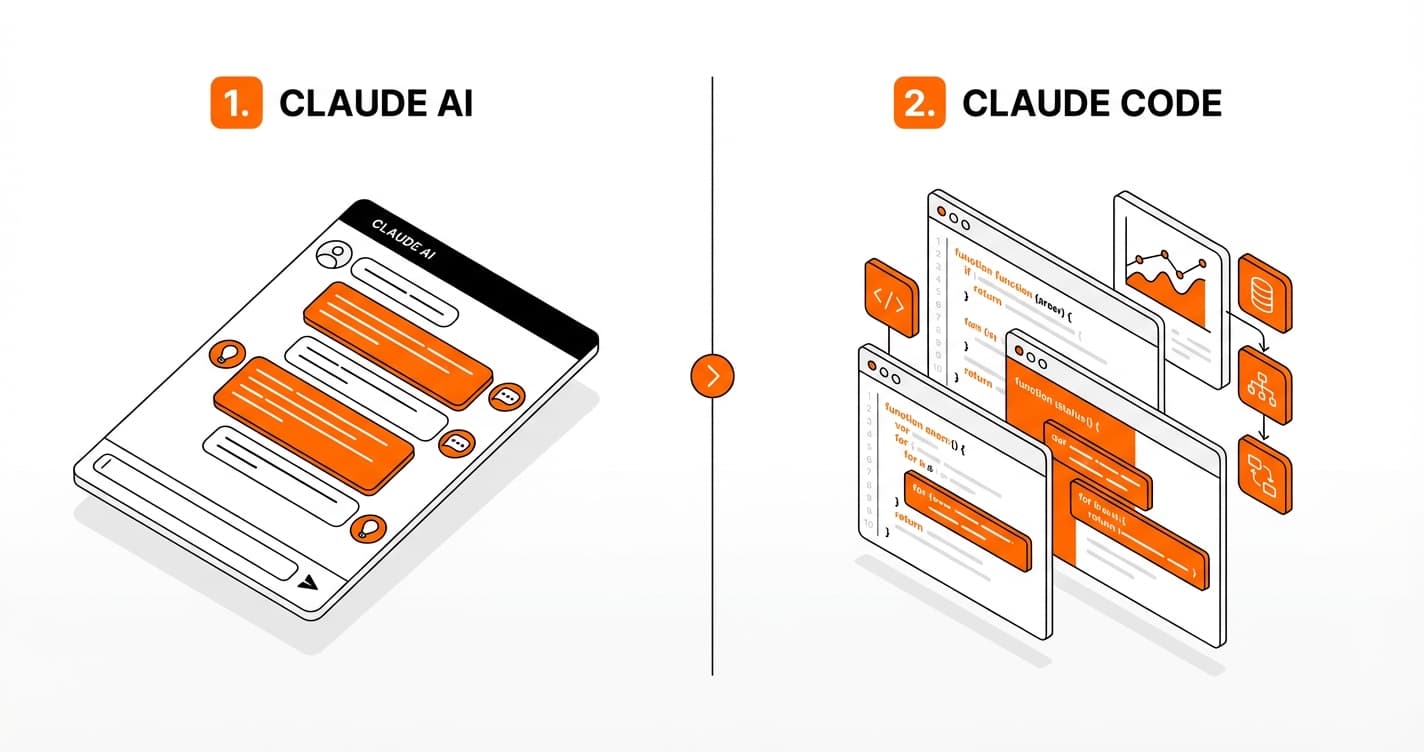
Claude Code refers to the specialized use of Claude in the field of software development. Unlike « standard » Claude — a versatile conversational model capable of writing, analyzing, or structuring content — Claude Code focuses primarily on tasks related to programming, software architecture, and developer workflows.
It is not an entirely different model, but rather an optimized version or a dedicated environment for code, integrating Claude into advanced technical contexts.
An AI Built for Developers
Claude Code is used to:
Generate complete functions
Refactor existing code
Explain complex codebases
Detect logical errors
Optimize performance
Where Claude can write an article or analyze a legal document, Claude Code intervenes directly on technical projects, often integrated into development environments.
In 2026, Vibe Coding and AI-assisted development have reinforced the demand for tools capable of understanding not just a single line of code, but an entire architecture.
Understanding Project Context
One of Claude Code’s major strengths is its ability to understand the overall context of a project. It can analyze multiple files, identify inconsistencies, and suggest structural improvements.
This allows developers to:
Save time on repetitive tasks
Accelerate prototyping
Reduce human errors
Improve the overall quality of the code
This contextual understanding is essential for complex projects.
Integration into Technical Environments
Claude Code is typically used:
Via API in internal applications
In compatible IDEs
In cloud environments
To automate DevOps workflows
It can be integrated into CI/CD pipelines, code analysis tools, or SaaS platforms.
This sets it apart from a simple conversational chatbot used through a web interface.
Intelligent Generation and Technical Reasoning
Claude Code is not limited to autocomplete. It is capable of:
Translating business requirements into technical architecture
Proposing database schemas
Generating complete APIs
Transforming pseudo-code into functional implementations
This technical reasoning capability makes it a strategic tool for development teams.
Free tool
AI Specifications Generator
Create professional project specifications in minutes with our AI-powered tool.
What Are the Differences Between Claude and Claude Code?
Confusion between Claude and Claude Code is common. Yet, even though they share the same technological foundation developed by Anthropic, their use cases, environments, and objectives differ clearly.
Claude is a general-purpose artificial intelligence model, designed to understand and generate text across many domains: writing, analysis, strategy, explanation, and summarization. It functions as a versatile conversational assistant.
Claude Code, on the other hand, refers to the specialized use of Claude in software development. It is oriented toward generating, optimizing, and understanding code, and is often integrated into technical environments.
The main difference does not lie in the model’s « brain, » but in the context of use and the type of tasks targeted.
Claude can write an SEO article, analyze a contract, or structure a marketing strategy. Claude Code, meanwhile, operates on codebases, software architectures, and DevOps workflows.
For clarity, here is a detailed comparison table:
Criterion
Claude
Claude Code
Nature
General-purpose conversational AI
Specialized development-oriented usage
Primary objective
Writing, analysis, strategy
Code generation and optimization
Target audience
Entrepreneurs, writers, analysts, developers
Developers, tech teams, startups
Task types
Articles, summaries, emails, complex analyses
Functions, scripts, APIs, refactoring
Integration
Web interface or API
API + IDE + technical environments
Reasoning
General and multi-domain
Technical and architectural
File analysis
Long text documents
Multi-file projects and source code
Automation
Chatbots, business tools
DevOps pipelines, development tools
Required technical level
Accessible to everyone
Primarily intended for developers
In practice, Claude is often used as a versatile strategic assistant. It can help structure thinking, generate a business plan, analyze a market, or write SEO-optimized content.
Claude Code, for its part, fits into a logic of AI-assisted development. It accelerates software production, reduces errors, and improves the technical quality of a project.
Another important difference concerns the workflow. Claude operates primarily through conversational dialogue. Claude Code is often integrated directly into development environments, enabling it to act on multiple files simultaneously and apply structural changes.
It is also essential to understand that Claude Code does not replace the developer. It acts as a technical co-pilot, capable of suggesting, correcting, and optimizing — but human validation remains indispensable.
In summary:
Claude = versatile AI assistant
Claude Code = specialized variant for code
The choice therefore depends on your needs. If you are looking for a tool to write, analyze, or structure content, Claude is the right fit. If your goal is to improve your productivity in software development, Claude Code will be more relevant.
In the current Vibe Coding ecosystem, these two use cases are complementary rather than opposing.
Are Claude and Claude Code Two Different Tools?
No, they are built on the same technology developed by Anthropic. Claude is a general-purpose AI model, while Claude Code refers to its specialized use in software development. The difference lies primarily in the context of use and the features integrated into technical environments.
Is Claude Code a Paid Version of Claude?
Claude offers various plans (free and paid depending on usage and API access). Claude Code is not an entirely different version, but rather a developer-oriented implementation, typically used via API or integrated into an IDE. Access generally depends on the plan selected.
Can You Use Claude for Coding Without Claude Code?
Yes. Claude can already generate, explain, and fix code in its standard version. However, Claude Code is more optimized for complex projects, with better multi-file context management and advanced technical integrations.
Does Claude Code Replace a Developer?
No. Claude Code acts as an AI assistant. It can accelerate production, suggest optimizations, and detect errors, but human validation remains essential to ensure the quality, security, and performance of the code.
Is Claude Suitable for Non-Developers?
Yes. Claude is designed to be versatile. It can be used to:
Write articles
Analyze documents
Structure strategies
Summarize content
Claude Code, on the other hand, is primarily intended for technical profiles.
What Is the Main Difference Between Claude and Claude Code?
The main difference lies in the use case:
Claude → general-purpose conversational AI
Claude Code → specialized use for software development
The underlying model may be similar, but the environment and features differ.
Is Claude Code Integrated into IDEs?
Yes, in certain cases. Claude Code can be integrated via API into development environments or internal tools, enabling it to analyze multiple files and intervene directly on a project.
Is Claude Code Better Than GitHub Copilot?
It depends on the use case. Claude Code is recognized for its advanced reasoning and contextual understanding. Other tools like GitHub Copilot are highly effective for fast autocomplete within the IDE. The two can be complementary.
Should You Choose Claude or Claude Code for a Startup?
For a tech startup, the ideal approach may be to use:
Claude for strategy, writing, and analysis
Claude Code for product development
Both tools can work together within an augmented productivity framework.
LA
Lucien Arbieu
AI expert and digital transformation consultant at PeakLab.