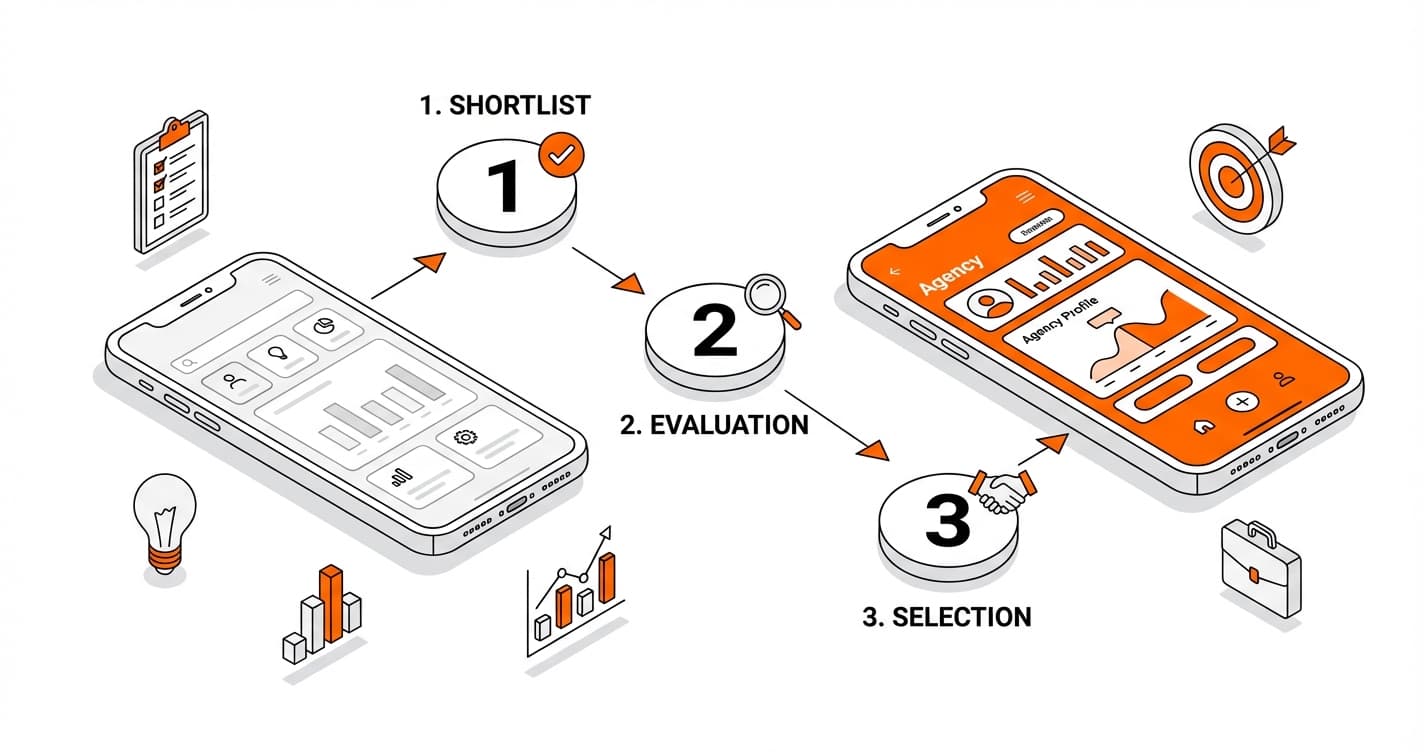
How to Choose the Best Digital Marketing Agency in 2026
LALucien Arbieu14 min read
In 2026, choosing a digital marketing agency is no longer a matter of quotes or LinkedIn reputation. It is a strategic decision that directly impacts your growth, profitability and ability to scale.
The market has changed.
AI is transforming content creation. Tracking is becoming more complex. Acquisition costs are rising. SEO is evolving toward advanced semantics. Advertising requires far more refined data expertise. CRM and automation are no longer optional.
The result: not all agencies are created equal anymore.
Some execute. Others drive growth.
So how do you choose the best digital marketing agency in 2026 without wasting 6 months, burning through your budget and starting from scratch?
This 2026 guide gives you:
A clear method for aligning your agency with your business objectives
The criteria that truly differentiate agencies today
The strategic mistakes to avoid
Realistic budget benchmarks
The right way to structure a pilot in 6–8 weeks
The goal is not to find « the cheapest option ».
The goal is to find the one that understands your business model and knows how to generate measurable ROI.
Why has choosing a marketing agency become more complex in 2026?
In 2026, choosing a digital marketing agency has become far more strategic and complex than it was just a few years ago. The market has grown denser, the levers have multiplied, algorithms are constantly evolving and pressure on profitability has intensified. As a result, selecting the right agency is no longer about comparing three commercial proposals.
The first reason for this complexity is the explosion of specializations. An agency today can position itself as a specialist in semantic SEO, performance media, CRM automation, data analytics, social commerce or generative AI. Some master a single lever to perfection, while others take a 360° approach. For a business, the challenge lies in identifying the right profile based on its actual priority: rapid acquisition, sustainable growth, funnel optimization or data structuring.
The second key factor is the transformation of tracking and performance measurement. Between the gradual end of third-party cookies, GDPR constraints, server-side conversions and the complexity of GA4, data reliability has become a major issue. An agency in 2026 can no longer settle for managing by click or cost per lead. It must connect media performance to the commercial pipeline, margin and overall ROAS. This technical requirement makes selection more demanding, as not all agencies truly have a command of data.
The third element is the rise of artificial intelligence. AI is impacting advertising creative, SEO, predictive analytics and automation. Some agencies use these tools to gain efficiency and execution speed. Others simply mention them in their marketing pitch. Distinguishing genuine operational competence from mere buzzwords has become a real challenge.
Complexity also stems from rising acquisition costs. Advertising platforms are more competitive. Cost per click is increasing, and margin pressure is more intense. In 2026, an agency must know how to intelligently balance short-term performance with long-term strategy. Choosing a partner capable of scaling while protecting profitability requires a careful analysis of their client cases and methodology.
Another difficulty is the fragmentation of agency models. You now find:
Highly specialized niche agencies
Integrators capable of orchestrating multiple levers
Collectives of independent experts
Branding-focused agencies
Pure performance-focused agencies
This diversity creates confusion for businesses that don’t always know which model matches their digital maturity.
Governance also represents a factor of complexity. In 2026, an agency must not only produce campaigns. It must integrate into the client’s organization, collaborate with internal teams, define management rituals and clarify data ownership. Without clear governance, even the best strategy can fail.
Finally, execution speed has become a central criterion. Businesses can no longer wait six months to see results. They are looking for agencies capable of launching a structured pilot in 6 to 8 weeks, with testable hypotheses and clear indicators.
In summary, choosing a marketing agency in 2026 is more complex because it involves:
A deep understanding of business objectives
Advanced mastery of data
The ability to integrate AI intelligently
Profitability-driven management
Clear and structured governance
It is no longer a simple vendor selection, but a strategic decision that directly impacts your growth trajectory.
What criteria should you analyze to choose the best digital marketing agency in 2026?
In 2026, choosing the best digital marketing agency is no longer an operational decision. It is a strategic choice that directly impacts your profitability, your growth velocity and your ability to scale intelligently. The market is more mature, more technical and more demanding. To avoid costly mistakes, several criteria must be analyzed in depth.
Alignment with your business objectives
The first criterion is often overlooked, yet it is fundamental: alignment with your actual business objectives. A relevant agency does not start by talking about traffic or impressions. It seeks to understand your business model, your margin, your sales cycle and your operational capacity.
If you are in B2B with a long sales cycle, the priority will be opportunity quality and pipeline value. In e-commerce, the conversation must revolve around real acquisition cost, overall ROAS and net margin. A serious agency talks about business impact before talking about tools.
Specialization and depth of expertise
In 2026, ultra-specialization has become the norm. Advanced technical SEO, data-driven paid media, CRM automation, B2B growth, server-side tracking… Few agencies truly master all of these levers with the same depth.
It is essential to identify whether the agency is a specialist or an integrator. A specialist will go deeper on a specific lever. An integrator will better coordinate a multi-channel strategy. The choice depends on your digital maturity and your current priority.
What matters is not the pitch, but recent, quantified proof.
Mastery of tracking and data
Marketing in 2026 relies on data quality. With the complexity of GA4, the gradual disappearance of third-party cookies and the importance of server-side tracking, performance measurement has become a competitive advantage.
A credible agency must be able to explain how it connects campaigns to real margin. If management is limited to cost per click or cost per lead, that is not enough. True performance is measured by overall profitability and contribution to revenue.
Data mastery is now a decisive filter.
The ability to execute quickly through a structured pilot
Businesses can no longer wait six months for actionable results. A high-performing agency must be able to structure a clear pilot over six to eight weeks, with defined hypotheses, precise indicators and a fast arbitration logic.
Learning speed has become a key factor. What matters is not the promise, but the ability to test, analyze and adjust quickly.
Management methodology and governance
Many failures do not stem from a lack of technical skill, but from a lack of method. A good agency has a clear framework: weekly rituals, an understandable dashboard, defined responsibilities and structured validation processes.
Governance is an underestimated element. Without it, even the best campaigns lose effectiveness.
Creative strength
In 2026, advertising creative has become a major performance lever. Audiences tire quickly, algorithms evolve constantly and angles must be regularly refreshed.
A truly high-performing agency invests in continuous creative production. It tests different hooks, formats and messages. The ability to produce quickly and iterate often makes the difference between a stable campaign and a profitable one.
Understanding the full funnel
Finally, a serious agency does not limit itself to acquisition. It takes an interest in your entire funnel: landing pages, conversion, nurturing, CRM, repeat purchase.
Optimizing the top of the funnel without working on conversion is like filling a leaky bucket. In 2026, performance is built across the entire customer journey.
Free tool
AI Specifications Generator
Create professional project specifications in minutes with our AI-powered tool.
What type of Growth marketing agency suits your situation?
Choosing a Growth marketing agency should never be a generic decision. In 2026, the right choice depends above all on your primary objective, your digital maturity and your budget capacity.
The most common mistake is selecting a « reputable » agency without verifying whether its expertise truly matches your context. A B2B SME with a six-month sales cycle does not have the same needs as an e-commerce business looking to scale quickly. Likewise, a company with unstable tracking must first secure its data before investing heavily in acquisition.
To help you be pragmatic from the outset, here is a clear decision matrix.
Choosing your agency based on objective (6–8 week pilot)
Primary objective
Your current context
Recommended agency type
Why
Pilot budget 6–8 wks
Decision KPI
Time to launch
Generate qualified B2B leads
SME/mid-market with CRM, 2–6 month cycle
B2B performance + CRM agency
Connects Search, Social and pipeline
€15–40k media, €8–15k service
Cost per opportunity, MQL→SQL, pipeline value
2–4 weeks
Boost e-commerce sales
AOV €60–150, clean product feeds
E-commerce paid media + creative agency
Expertise in Google Ads, PMax, Meta, UGC
€10–30k media, €6–12k service, €2–6k creative
Overall ROAS, MER, CAC/basket
1–3 weeks
Strengthen SEO over 12 months
Established editorial site or e-shop
Technical SEO + content agency
Solid technical foundation + editorial calendar
€5–15k audit, €3–10k/month content
Non-brand traffic, strategic rankings, SEO revenue
3–6 weeks
Launch a new offer
Zero media history
Creative + Social Video Ads agency
Designs angles and manages distribution
€15–50k all-inclusive
Useful reach, qualified views, search uplift
3–5 weeks
Stabilize tracking & data
Unstable or inconsistent figures
Data & analytics agency
Normalizes data and secures measurement
€8–25k depending on scope
Server-side match rate, GA4 consistency
2–6 weeks
Your 6 to 8 week pilot: the pragmatic method
Once the right type of agency has been identified, the key is to structure a clear and measurable pilot.
Week 0 – Strategic framing Definition of business objectives, hypotheses to test, tracking audit, CRM verification and creative production plan. This phase determines the quality of results.
Week 1 – Structured launch Deployment of a limited number of well-built campaigns. The goal is not to spread the budget thin, but to learn quickly through angle variations.
Weeks 2–3 – Rapid arbitration Cut what is not performing, reinforce positive signals, adjust offers or pages as needed. Optimization speed is decisive.
Weeks 4–5 – Controlled scale-up Budgets increase progressively where margin has been validated. Data stability is closely monitored.
Weeks 6–8 – Strategic decision Analyze the KPIs defined upfront. Based on results, three options: continue, adjust or stop. The following quarter is planned with a clear vision.
How to avoid the strategic mistakes that cause agency collaborations to fail?
In 2026, failing with a digital marketing agency almost never comes down to a lack of pure skill. Most collaborations that end badly suffer from strategic mistakes made from the very beginning: poor framing, vague objectives, an undersized budget or non-existent governance.
Understanding these mistakes helps you avoid wasting time, money and energy.
Failing to clarify business objectives from the start
The first mistake is launching a collaboration without clear, quantified objectives. Too many businesses ask for « more visibility » or « more traffic » without connecting these ambitions to concrete indicators.
Before even discussing tools or campaigns, you need to define:
The target volume of opportunities
The acceptable acquisition cost
The minimum ROAS
The expected payback period
Without this foundation, the agency and the business are not steering in the same direction. Frustration arrives quickly.
Choosing an agency based solely on price
The entry price is often misleading. A cheaper agency can end up costing far more over 6 to 12 months if the strategy is ineffective or if management lacks rigor.
In digital marketing, the real cost is not the monthly fee, but the opportunity cost. Every poorly executed month is a month of lost growth.
It is better to evaluate the expertise / methodology / business impact ratio rather than the price in isolation.
Undersizing the media or creative budget
Another common mistake is investing in support without properly funding media or creative production.
In 2026, algorithms need volume to learn. Campaigns require regular creative variations. If the budget is too tight, tests are limited and results become unstable.
An effective pilot requires a budget that is consistent with the ambitions.
Neglecting data and tracking
Collaborating with an agency without verifying the reliability of your tracking is a major strategic mistake. If conversions are not properly measured, every decision rests on biased data.
Before scaling, you need to ensure that:
Events are correctly configured
The CRM is connected
Attribution is consistent
The figures are stable
A poor data foundation leads to poor decisions.
Leaving governance undefined
Even with an excellent agency, the absence of a framework can cause the collaboration to fail.
Who approves the creatives? Who decides on budget arbitrations? What is the feedback turnaround time? How often do strategic reviews take place?
Without clear governance, timelines stretch, decisions stall and performance slows.
A high-performing collaboration relies on a structured rhythm and clearly defined responsibilities.
Expecting unrealistic results
Some businesses expect an immediate return without any learning phase. Yet in 2026, campaigns require an optimization period, especially in B2B or on long sales cycles.
A 6 to 8 week pilot generates actionable signals. Demanding massive ROI within a few days creates counterproductive pressure.
Strategic patience is a key factor.
Failing to challenge the agency (or accepting everything)
A healthy collaboration involves critical dialogue. If the agency systematically validates every request without challenging priorities or hypotheses, that is a red flag.
Conversely, the business must also be willing to be challenged. A performance-oriented agency questions objectives, offers and sometimes even positioning.
Growth is born from that exchange.
How to structure a strategic brief to attract the right agency in 2026?
In 2026, the quality of your strategic brief directly determines the quality of the agencies that will respond to your request. A vague brief attracts generic responses. A structured brief attracts partners capable of thinking alongside you.
The first step is to clarify your quantified business objectives. State precisely what you are looking to achieve: volume of qualified leads, additional revenue, target acquisition cost, expected ROAS or market share to capture. A serious agency wants to understand the desired impact, not just the lever to activate.
Next, detail your current context. Mention your average basket, your margin, your sales cycle, your current conversion rate and the channels you have already activated. The more concrete information the agency has, the more relevant its recommendation will be.
Also explain your digital maturity. Do you have reliable tracking? A connected CRM? Existing campaigns? Internal creative resources? These elements strongly influence the proposed strategy.
A good brief must also specify your indicative budget and timeline. Without a budget reference, agencies cannot properly size their proposal. In 2026, budget transparency is a sign of maturity.
Do not forget to state your expectations regarding management: meeting frequency, desired reporting level, key decision indicators. This allows governance to be aligned from the very start.
Finally, be clear about your selection criteria. Are you looking for a specialist? A multi-lever integrator? A pure performance approach or brand plus performance?
A well-structured strategic brief is not looking for fast execution. It is looking for a partner capable of generating measurable impact.
How much should you invest to work with a digital marketing agency in 2026?
In 2026, the question is no longer simply « how much does a digital marketing agency cost? », but rather how much do you need to invest to generate profitable, measurable learning? The budget depends on your objective, your digital maturity and your level of ambition.
For an SME in an acceleration phase, a structured 6 to 8 week pilot typically represents a total investment of between €15,000 and €30,000. This amount includes the media budget, strategic support and often a dedicated creative envelope. The goal is not to spend massively, but to fund tests that are robust enough to yield actionable signals.
For an established SME or a mid-market company looking to scale multiple levers (Search, Social, CRM, SEO), the budget can quickly reach €40,000 to €70,000 over two months, particularly if creative production and media volume are significant.
In SEO, the investment is often progressive. A serious technical audit can cost between €5,000 and €15,000, followed by monthly support ranging from €3,000 to €10,000 depending on the intensity of content production and the competitive stakes.
What truly matters is not the amount in isolation, but the coherence between:
The media budget
The support budget
The creative budget
Your profitability objectives
Under-investing limits learning. Over-investing without structure wastes resources.
In 2026, a digital marketing budget must be seen as a strategic investment, calibrated to test, measure and scale intelligently.
LA
Lucien Arbieu
AI expert and digital transformation consultant at PeakLab.