With the rapid rise of generative artificial intelligence, more and more companies are looking to build advanced AI applications capable of leveraging language models while connecting them to business data, APIs, or internal tools. It is in this context that LangChain has established itself as a key technology for orchestrating AI agents, prompt chains, and complex conversational systems. But given the technical complexity of these projects, one question keeps coming up: why work with a LangChain specialist agency, and how do you choose the right one?
A LangChain specialist agency does far more than build a chatbot. It works on high-value projects: business conversational AI, intelligent automation, augmented search engines (RAG), internal assistants, and custom AI solutions. Choosing the right agency is therefore critical to ensuring the performance, security, and scalability of your project.
However, not every AI agency truly has an in-depth command of LangChain. When it comes to genuine technical expertise, understanding of business challenges, and the ability to industrialize an AI solution, the gaps can be significant. Choosing the wrong provider can lead to cost overruns, technical limitations, or a product that is difficult to maintain.
In this article, we will explain why you should work with a LangChain specialist agency, what benefits to expect, and above all how to choose the right partner by identifying the essential criteria for a successful AI project, from the design phase through to deployment.
Why work with a LangChain specialist agency for your AI projects?
Deploying a generative artificial intelligence project is no longer simply a matter of calling a language model API. Companies today expect solutions that are reliable, connected to their data, secure, and genuinely useful to the business. It is precisely in this context that LangChain has become a central technology building block… and that a LangChain specialist agency becomes a strategic partner rather than just a vendor.
The first reason to work with a LangChain expert agency lies in the real complexity of modern AI projects. LangChain makes it possible to orchestrate prompt chains, autonomous agents, knowledge bases (RAG), external tools, and complex workflows. Truly mastering these components requires advanced expertise across language models, software architecture, data management, and application performance. A specialist agency brings this cross-functional technical mastery, which is difficult to assemble quickly in-house.
A second major advantage is the ability to turn a POC into an industrial-grade solution. Many AI projects work well in a demo but fail as soon as they need to scale. An experienced LangChain agency designs architectures built for production: inference cost management, performance monitoring, error handling, data security, and scalability. It anticipates constraints from the design phase, avoiding costly rework down the line.
Working with a LangChain specialist agency also makes it possible to connect AI to business data in a reliable way. Augmented document search, internal assistants, business copilots, and intelligent automation all require robust connections to databases, CRMs, ERPs, or internal APIs. An agency knows how to structure these data flows, clean the data, and put control mechanisms in place to ensure relevant and actionable responses.
Another key point is security and compliance. AI projects often handle sensitive data. A LangChain specialist agency integrates best practices from the outset: data isolation, access management, logging, compliance with internal policies, and, where necessary, hosting on private or secure cloud infrastructure. This aspect is often underestimated, yet it is critical for enterprises.
Strategic guidance is also a strong differentiator. A good LangChain agency does not just execute: it helps to clarify use cases, prioritize features, and align AI with business objectives. It knows when to say no to gimmick features and steers the project toward a measurable ROI, which is essential for justifying an AI investment.
Furthermore, a specialist agency delivers a significant time saving. Training an internal team on LangChain, LLMs, RAG architectures, and AI agents can take several months. An operational agency accelerates time-to-market while progressively transferring best practices to internal teams when needed.
Finally, working with a LangChain agency means benefiting from continuous technology monitoring. AI tools evolve very quickly. A specialist agency constantly tests new models, frameworks, and approaches, and knows how to adapt existing solutions to market developments without starting from scratch.
In summary, a LangChain specialist agency brings technical expertise, strategic vision, security, scalability, and speed of execution. For a serious AI project focused on production and business value, this choice becomes a genuine driver of success.
What criteria should you analyze to choose the right LangChain specialist agency?
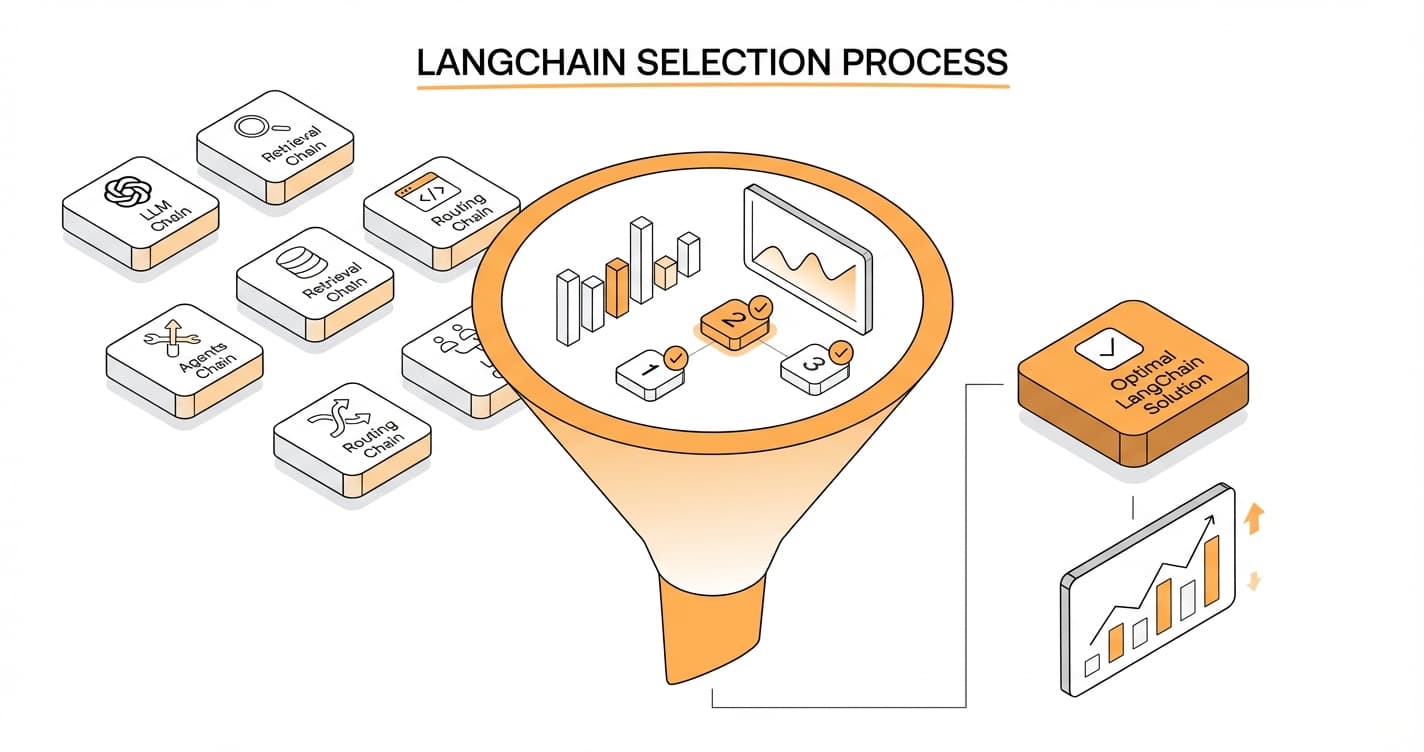
Choosing a LangChain specialist agency is a defining decision for the success of a generative AI project. Not all AI agencies have the same level of expertise or the same ability to deliver robust, production-ready solutions. To avoid costly mistakes, it is essential to analyze several key criteria, both technical and strategic as well as operational.
Real, demonstrable expertise in LangChain
The first criterion to analyze is the actual level of LangChain proficiency. A specialist agency does not simply use LangChain as a tool: it understands its internal mechanisms, its limitations, and its architectural best practices.
This expertise is measured through:
- concrete projects already delivered (RAG, AI agents, business assistants),
- the ability to clearly explain technical choices,
- mastery of advanced concepts such as complex chains, memory, tools, agents, and multi-LLM orchestration.
A truly specialist agency will also be able to adapt LangChain to different contexts, rather than proposing a one-size-fits-all solution.
The ability to think « production » rather than just prototype
Many AI projects fail because they remain stuck at the proof of concept stage. A key criterion is therefore the agency’s ability to design solutions that are production-ready.
This requires in-depth thinking about:
- inference cost management,
- performance and latency,
- scalability under load,
- system maintenance and evolvability.
A good LangChain agency anticipates these challenges from the design phase, in order to avoid costly rework once the project is live.
Mastery of RAG architectures and business data
The majority of LangChain projects rely on Retrieval Augmented Generation (RAG) systems. It is therefore crucial that the agency has command of the entire data value chain.
This includes:
- data structuring and cleaning,
- indexing in vector databases,
- relevance of information retrieval,
- reducing model hallucinations.
A competent agency will ask the right questions about your business data and propose an architecture tailored to your specific challenges, rather than a generic blueprint.
Addressing security and compliance requirements
Security is a criterion that is too often underestimated in AI projects. A serious LangChain agency integrates constraints related to data confidentiality, user access, and the company’s internal policies from the very beginning.
It is important to evaluate:
- rights and role management,
- request traceability,
- data hosting (public cloud, private cloud, or on-premise),
- compliance with regulatory requirements.
A specialist agency must be able to propose secure architectures suited to sensitive professional environments.
A thorough understanding of business challenges
A good LangChain agency does not simply deliver a technically impressive solution. It must understand the business objectives of the project: productivity gains, improved user experience, process automation, or cost reduction.
This criterion manifests itself through:
- the ability to frame use cases,
- prioritization of high-value features,
- the definition of clear performance indicators.
A business-oriented agency will avoid gimmick features and focus on the real impact of AI.
Quality of support and communication
Choosing an agency also depends on the quality of the collaboration. Since LangChain is a constantly evolving framework, communication and knowledge-sharing are essential.
A good agency should:
- clearly explain its choices,
- document deliverables,
- support the upskilling of internal teams when needed,
- offer post-deployment follow-up.
This capacity for support ensures better long-term adoption of the solution.
Technology monitoring and adaptability
The AI ecosystem evolves extremely fast. A LangChain specialist agency must maintain continuous technology monitoring, capable of integrating new models, tools, or approaches without disrupting what already exists.
This criterion is decisive for ensuring the long-term viability of the project. An agency that regularly tests new technology building blocks will be better positioned to evolve your solution over time.
Transparency on costs and timelines
Finally, a criterion that is often decisive is the clarity of the commercial proposal. A good LangChain agency is transparent about:
- development costs,
- recurring costs related to models and infrastructure,
- realistic delivery timelines.
This transparency helps avoid unpleasant surprises and builds a lasting relationship of trust.