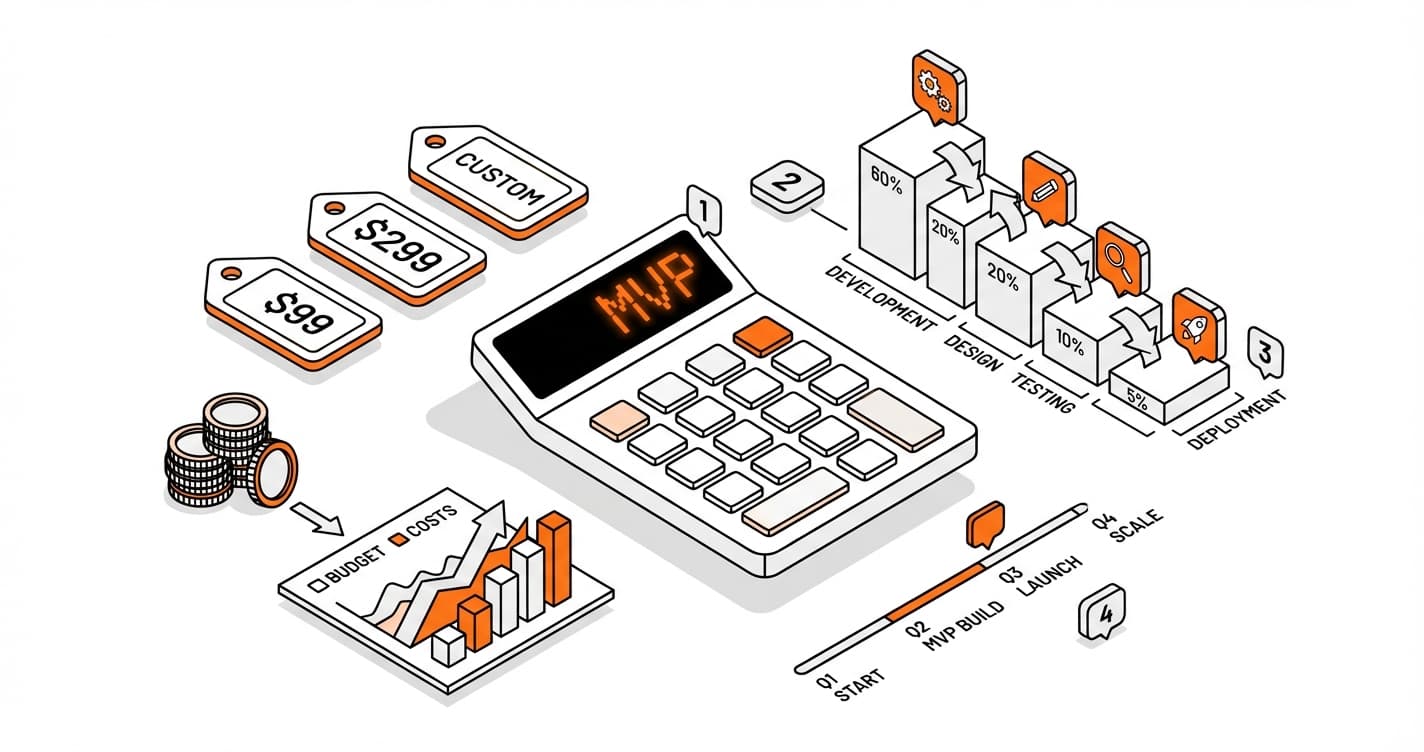
In 2026, the price of an MVP typically ranges from €5,000 to €40,000 for the vast majority of projects — with the lower end covering a very simple MVP and the upper end covering an ambitious, fully custom MVP ready to be tested under solid conditions. Some projects even exceed this budget significantly when they incorporate AI, mobile, complex workflows or heavier business logic.
If you want a truly direct answer, keep this in mind:
- €5,000 to €10,000: Very simple MVP, often no-code, low-code or a site with 1 to 2 core features.
- €10,000 to €20,000: Classic MVP with clean design, a lightweight back office, a clear user funnel and a solid technical foundation.
- €20,000 to €40,000: More robust MVP, usually custom-built, with more advanced business logic, better UX, scalability and sometimes a mobile component or automation layer.
Why such a wide range? Because an MVP doesn’t mean the same thing to everyone. For some, it’s a simple test version with a single core feature. For others, it’s already a near-market-ready product with onboarding, payments, an admin panel, analytics and automations. That’s where the budget climbs very quickly.
The price depends primarily on 5 factors.
First, there is the level of functional complexity. An MVP with user login, a dashboard, profiles, payments, notifications and an admin area will logically cost more than a landing page with a form and simple logic.
Next, there is the technology chosen. A no-code MVP can cost significantly less upfront, whereas a custom-built product in React, Next.js, Laravel or Node will cost more — but is often more scalable. Recent articles on the subject also show that AI can accelerate certain development tasks, without making costs disappear entirely.
Third: who builds the MVP. A freelancer, a small agency, an offshore team or a product studio don’t charge the same rates at all. Agency listings show entry-level prices typically starting at €5,000, €10,000 or €25,000 depending on the level of service.
Fourth factor: the level of product quality expected. If you simply want to test an idea, costs can remain contained. If you also want polished UX, a visual identity, clean architecture and solid SEO or growth foundations, the budget rises mechanically.
Finally, you need to factor in what many people forget: the cost of an MVP is not limited to development. You sometimes need to budget for scoping, design, hosting, third-party tools, post-launch iterations and fixes following the first user feedback.
So, if you want a simple and credible estimate:
an MVP in 2026 costs on average between €5,000 and €40,000, and this price is driven by the product’s complexity, the level of customization, the tech stack and the quality expected at launch. For a very large MVP, costs can go beyond that — but for most early-stage projects
Why can the price of an MVP vary so much from one project to another?
When discussing the price of an MVP (Minimum Viable Product), it is common to see significant gaps between projects. Some MVPs can be developed for a few thousand euros, while others can easily reach several tens of thousands of euros. This variation is explained by several factors related to product complexity, the technologies used and the project’s objectives.
An MVP is not simply a « cheaper » version of a final product. It is above all a minimal yet functional version of a product, designed to test an idea, validate a market and gather early user feedback. Depending on the project’s needs, this version can be more or less sophisticated, which directly influences the budget required to build it.
Feature complexity
The first factor influencing the price of an MVP is the number and complexity of features. Some projects make do with a single core feature, while others already require several modules.
For example, a simple MVP might include:
- user registration
- a main page
- a core feature
- a basic dashboard
Conversely, a more advanced MVP might integrate:
- a payment system
- notifications
- an admin area
- complex data management
- automations
The more numerous or complex the features, the more development time increases. And since the cost of an MVP often depends on the number of development hours, the budget can escalate quickly.
The technologies used
The choice of technologies also plays a major role in the cost of an MVP. Today, there are several ways to build a digital product: no-code, low-code or custom development.
No-code solutions make it possible to create a product quickly and at lower cost. They are particularly well-suited for testing an idea rapidly. However, they can have certain limitations in terms of customization or performance.
Conversely, an MVP developed with custom technologies such as React, Next.js, Node.js or Python can cost more upfront. However, this type of development generally offers better scalability and makes it easier to add new features down the line.
The technology choice therefore often depends on the project’s strategy: testing an idea quickly or building a solid technical foundation from the outset.
Design and user experience
Another factor that can cause the price of an MVP to vary is the level of design quality and user experience. Some projects prioritize a simple, functional interface, while others want to deliver a highly polished product from the very first version.
An MVP with minimal design can be developed more quickly. On the other hand, a product that requires:
- in-depth UX work
- detailed wireframes
- a complete visual identity
will demand more time and expertise. This design work can represent a significant portion of the overall budget.
The team building the MVP
The cost of an MVP also depends on the team handling the development. A freelancer, a small technical team or a specialized agency will not charge the same rates.
For example:
- a freelancer can offer more accessible rates
- a product agency often provides full end-to-end support (strategy, design, development)
- an experienced team can deliver a more robust and scalable product
The choice generally depends on the level of support desired and the complexity of the project.
The level of project preparation
Finally, the price of an MVP can vary depending on the level of project preparation. A project that is already well-defined — with wireframes, a clear brief and a precise product vision — will generally be faster to develop.
Conversely, if everything still needs to be defined — concept, features, user journeys — more time will need to be spent on the thinking and design phase. This step is essential to avoid mistakes, but it can also increase the overall budget.
In summary, the price of an MVP can vary significantly because every project has its own constraints, its own objectives and its own level of complexity. It is precisely this diversity that explains why some MVPs cost a few thousand euros while others can reach several tens of thousands of euros.
How much does an MVP cost depending on the type of project (SaaS, marketplace, mobile app)?
The price of an MVP depends heavily on the type of project you want to launch. Indeed, an MVP for a SaaS, a marketplace or a mobile application does not require the same level of technical development or the same architecture. Some products only need a few essential features to test the market, while others must integrate several systems from the very first version.
To understand why costs can vary, it is worth recalling the main objective of an MVP: to launch a first version of the product quickly in order to validate an idea with users. The goal is not to build a complete product, but rather a minimal version with the indispensable features.
However, depending on the project model, the indispensable elements can be very different. A SaaS may require a subscription system, a marketplace must manage two types of users (sellers and buyers), while a mobile application may require specific development for iOS and Android.
The cost of an MVP for a SaaS
A SaaS MVP (Software as a Service) is often one of the most common formats in startup projects. This type of product is generally based on a web application accessible via a browser.
A SaaS MVP typically includes:
- a registration and login system
- a user dashboard
- the product’s core feature
- a simple admin area
- sometimes a subscription or payment system
In this case, the cost can remain relatively reasonable if the product stays simple. A basic SaaS MVP can start at around €8,000 to €15,000. If more business logic, automations or a more robust technical architecture are added, the budget can reach €20,000 to €30,000.
The cost of an MVP for a marketplace
Developing a marketplace MVP is generally more complex, as this type of platform must manage several types of users. It often requires integrating a seller space, a buyer space and a transaction system between the two.
A marketplace MVP often includes:
- user account creation
- seller profile management
- listing or product publication
- a search or filtering system
- secure payment
- transaction management
This architecture makes the project more complex than a simple SaaS. That is why a marketplace MVP typically costs between €15,000 and €35,000 depending on the required features.
The cost of an MVP for a mobile application
Mobile applications can be more expensive to develop, especially if you want to offer a native application for both iOS and Android. Indeed, this sometimes means developing two distinct versions of the product.
A mobile MVP can include:
- a registration system
- a content feed or dashboard
- notifications
- a user database
- social interactions or interactive features
To keep costs down, some projects choose to develop a mobile application using hybrid technologies or to start with a web version. In this case, the budget can remain around €10,000 to €20,000.
However, if the mobile application requires a complex interface or advanced features, the cost can easily reach €30,000 to €40,000 for a solid MVP.
Summary table of MVP costs by project type
| Project type | Core MVP features | Average budget |
|---|---|---|
| SaaS | Dashboard, user management, core feature | €8,000 – €30,000 |
| Marketplace | Sellers, buyers, listings, payments | €15,000 – €35,000 |
| Mobile application | iOS/Android app, notifications, mobile interface | €10,000 – €40,000 |
| SaaS with automation or AI | Algorithms, automation, data processing | €20,000 – €40,000 |
This table shows that the price depends primarily on the technical complexity of the product and the number of features needed to test the idea.
In all cases, it is important to keep in mind that an MVP is not meant to be perfect. Its role is simply to validate a concept with early users, gather feedback and progressively improve the product before a more complete development phase.
Thus, even if some MVPs can reach several tens of thousands of euros, many projects can be launched with a reasonable budget if you focus exclusively on the essential features.