No-code vs Custom Development for a SaaS: Which Should You Choose?
LALucien Arbieu12 min read
It’s one of the most defining questions every entrepreneur faces when launching a SaaS in 2026. Should you build your product with no-code tools like Bubble, Webflow, or Glide to move fast and stay agile? Or should you invest from the start in custom development with a team of developers to build solid, scalable technical foundations? This decision shapes your time to market, your development costs, your ability to iterate quickly, and your long-term scalability potential.
The good news is that in 2026, no-code tools have reached a remarkable level of maturity that makes them genuinely competitive for many SaaS use cases that would have required custom development just three or four years ago. SaaS products generating several million euros in annual recurring revenue have been built entirely on Bubble or hybrid no-code stacks without ever resorting to traditional development. This reality definitively invalidates the misconception that no-code is only suited to early-stage projects or prototypes.
But custom development retains decisive advantages on specific dimensions that can be absolutely critical depending on the nature of your SaaS. Performance at very large scale, deep technical customization, complex integrations, and intellectual property protection are areas where custom development remains structurally superior to no-code in the vast majority of cases.
In this article, we help you choose between no-code and custom development for your SaaS by objectively analyzing the advantages and limitations of each approach based on your specific situation.
What is no-code and how far can it go for a SaaS?
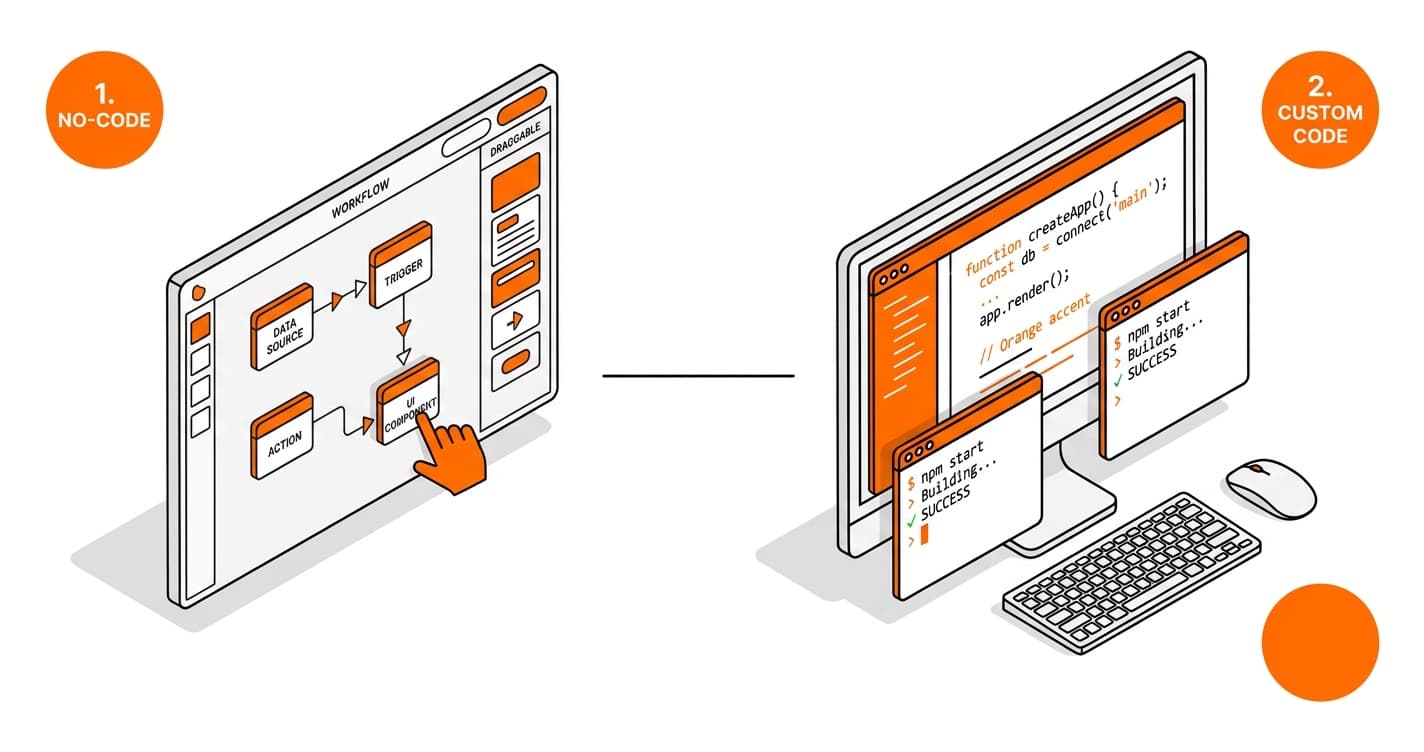
No-code refers to a set of tools and platforms that allow you to create functional web and mobile applications without writing code. These platforms offer visual drag-and-drop interfaces, pre-built components, and configurable automation logic that enable non-developers to design complex digital products without mastering a programming language. In 2026, the no-code ecosystem has expanded considerably with specialized tools that cover virtually every aspect of building a SaaS.
The most widely used no-code platforms for building SaaS products fall into several complementary categories. Bubble is the go-to reference for complex web applications with advanced business logic and integrated database management. Webflow is ideal for marketing interfaces and acquisition sites associated with your SaaS. Glide and Adalo allow you to quickly create no-code mobile applications. And automation tools like Make and Zapier let you connect your various no-code components and automate workflows without any development.
What has changed radically in 2025 and 2026 is the integration of artificial intelligence into no-code platforms. Tools like Bubble AI, Cursor integrated into no-code stacks, or AI interface generators now make it possible to create complex features in a matter of hours that would have required several weeks of custom development just two years ago. This convergence of no-code and AI is what has made no-code tools truly competitive for ambitious SaaS products.
How far can no-code go for a SaaS? The honest answer is further than most entrepreneurs think. SaaS products with several million euros in MRR have been built and still operate entirely on Bubble. Products with thousands of active users, complex billing logic, multi-user collaborative spaces, and advanced API integrations run perfectly on well-architected no-code stacks.
No-code capability table by SaaS development phase
Phase
Objective
Recommended no-code tools
Feasibility
Validation
Landing page + email collection
Carrd, Webflow, Notion
Excellent
MVP
Basic functional product
Bubble, Glide, Adalo
Very good
Launch
Billing + onboarding
Bubble + Stripe + Make
Good
Growth
Automations + integrations
Make, Zapier, n8n
Good
Scale 0–1,000 users
Performance + reliability
Optimized Bubble
Adequate
Scale 1,000–10,000 users
Advanced scalability
No-code + hybrid dev
Limited
Scale 10,000+ users
Maximum performance
Custom development
Insufficient
This table illustrates an important reality. No-code is excellent for the early phases of validation, MVP construction, and launch. It progressively becomes limiting beyond several thousand active users, where performance, scalability, and technical customization constraints begin to weigh significantly on the product experience and the architecture’s ability to evolve.
What are the advantages of custom development for a SaaS?
Custom development remains the benchmark for SaaS products targeting significant scalability, deep technical differentiation, or high performance and security requirements. Here are its most decisive advantages.
Total technical freedom and a tailor-made architecture
The first fundamental advantage of custom development is absolute technical freedom. Unlike no-code, whose possibilities are limited by the features provided by the platform vendor, custom development allows you to build exactly what your SaaS needs without compromise or technical workarounds. You choose your technology stack, your database architecture, your development patterns, and your infrastructure decisions based on your product’s specific requirements. This freedom is particularly valuable for SaaS products that address complex or highly specific use cases that no-code tools cannot cover natively.
Unlimited scalability with no platform constraints
The second advantage is the structurally superior scalability of custom development. An application built in native code can be optimized, refactored, and scaled in a practically unlimited way as your needs evolve. Performance bottlenecks can be identified and resolved precisely without the constraints imposed by a no-code platform’s architecture over which you have no control. For SaaS products targeting tens of thousands or even millions of active users, custom development is the only approach that guarantees scalability without structural limits.
Intellectual property protection
The third advantage is the protection of your intellectual property. Your custom-developed code belongs entirely to you and constitutes a strategic asset for your company. This technical asset can be valued during a fundraising round, an acquisition, or a sale. A SaaS built on Bubble or another no-code platform is technically dependent on that platform and cannot be as easily valued as a proprietary technology asset in discussions with investors or potential acquirers.
Advanced technical integrations without limitations
The fourth advantage is the ability to carry out complex technical integrations without the limitations imposed by the connectors available in no-code platforms. A SaaS that needs to integrate deeply with legacy systems, complex proprietary APIs, or technical protocols specific to an industrial sector generally cannot be built with no-code tools that only offer standardized integrations via predefined connectors.
Optimized performance and user experience
The fifth advantage is performance and user experience quality. Code well written by an experienced development team produces load times, response times, and usage fluidity that are structurally superior to those of an equivalent no-code application, whose auto-generated code is rarely as optimized as handwritten code. This performance difference may seem minor at low volumes but becomes significant at large user bases, where every additional millisecond of latency translates into a measurable degradation in retention rate and customer satisfaction.
Free tool
AI Specifications Generator
Create professional project specifications in minutes with our AI-powered tool.
No-code or custom development: how to choose based on your situation?
The choice between no-code and custom development for your SaaS is not an abstract question of technological preference. It is a strategic decision that must be grounded in a rigorous analysis of your specific situation, your available resources, and your short- and long-term objectives. Here are the most decisive criteria to guide this choice.
The first criterion is the stage of your project’s development. If you are in the validation phase and looking to confirm market demand before investing significantly in development, no-code is the obvious answer. The ability to build a functional MVP in a few weeks at marginal cost is no-code’s most valuable competitive advantage at this stage. A Bubble prototype that simulates the key features of your SaaS allows you to validate your value proposition with real customers and gather valuable feedback before locking your technical architecture into custom code.
The second criterion is your technical profile and human resources. If you are a solo entrepreneur without development skills and without the budget to hire a technical team, no-code is often the only realistic option for launching your SaaS within a reasonable timeframe. If you have access to experienced developers, either in-house or through trusted partners, and your use case requires features that no-code cannot properly cover, custom development becomes the best option.
The third criterion is the technical complexity of your SaaS. A project management SaaS, a simplified CRM, a billing tool, or a scheduling application can generally be built with no-code tools that cover these use cases natively and robustly. A SaaS that requires complex proprietary algorithms, massive real-time data processing, integrations with specific industrial systems, or highly atypical business logic needs custom development to be built correctly.
The fourth criterion is your scalability ambition. If your growth model anticipates several thousand active users within twelve to eighteen months, it is better to anticipate no-code’s limitations and plan a migration to custom development before performance constraints become problematic. If your SaaS addresses a niche market with a maximum of a few hundred users, no-code may be perfectly sufficient in the long run without ever requiring a migration.
The fifth criterion is your available budget. A quality custom development project for a SaaS represents an investment of several tens to several hundreds of thousands of euros depending on the product’s complexity. A no-code MVP can be built for a few thousand euros or less. This ten-to-twenty-fold difference in initial cost is the most powerful argument in favor of no-code for entrepreneurs starting out without a significant fundraising round.
The wisest strategy for the majority of entrepreneurs launching a SaaS in 2026 is the no-code first approach. Build your MVP and validate your market with no-code tools. Generate your first recurring revenue. Then progressively migrate to custom development when your growth justifies this investment and your revenue allows you to finance it comfortably.
Can a no-code SaaS really generate significant revenue?
Yes, and there are many concrete examples in 2026. Several SaaS products built entirely on Bubble generate several hundred thousand or even several million euros in annual recurring revenue without ever having migrated to custom development. The no-code platform is not a commercial glass ceiling. It is a technical constraint that can become limiting at very large scale but does not prevent you from building a profitable and meaningful SaaS business. What determines a SaaS’s revenue is the relevance of its value proposition and the quality of its customer acquisition, not the technology used to build it.
How much does it cost to build a no-code SaaS vs. a custom one?
The cost difference between the two approaches is considerable. A functional no-code MVP can be built for between €2,000 and €15,000 depending on the complexity of the features and whether you hire a Bubble freelancer or build it yourself. An MVP developed in custom code by an experienced development team typically represents a minimum investment of €50,000 to €150,000 for an equivalent functional scope. This ten-to-twenty-fold difference in initial cost is the most powerful argument in favor of no-code for entrepreneurs starting out without a significant fundraising round.
Is it possible to migrate from a no-code SaaS to custom development?
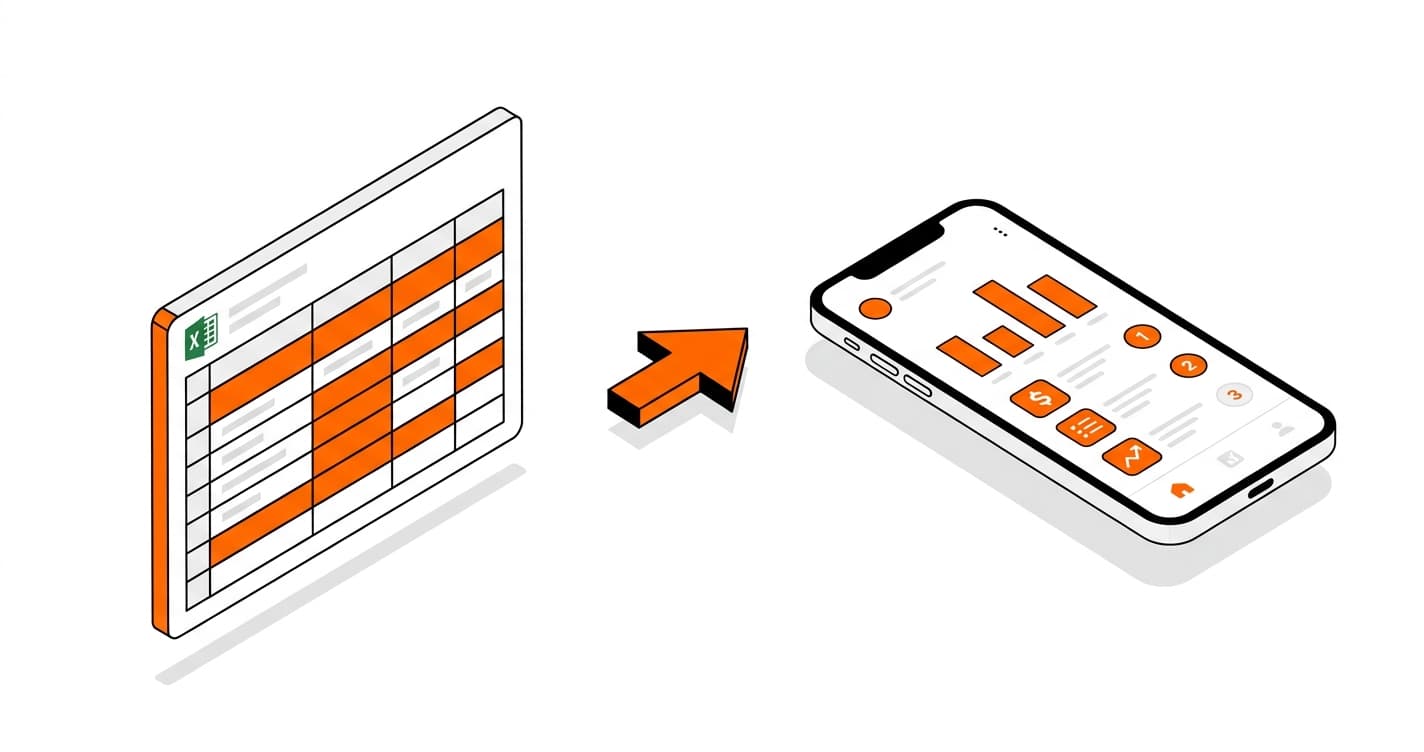
Yes, migrating a no-code SaaS to custom development is technically possible but represents a substantial project that should not be underestimated. This migration involves completely rebuilding the product in a new technology stack while preserving all existing data, all integrations in place, and all the business logic developed on the no-code platform. Timelines typically range from six to eighteen months depending on the product’s complexity and the size of the development team mobilized. The best practice is to anticipate this migration before you urgently need it and to plan it when your revenue allows you to finance it comfortably without jeopardizing service continuity for your existing users.
Is no-code suitable for a B2B SaaS with high security requirements?
This is a legitimate question that many entrepreneurs targeting enterprise clients ask. Leading no-code platforms like Bubble have significantly improved their security standards in recent years with SOC 2 Type II certifications, dedicated hosting options, and advanced access and permissions management features. For B2B SaaS products targeting SMEs and mid-market companies with standard security requirements, no-code is generally sufficient. For SaaS products targeting large enterprises or highly regulated sectors such as banking, healthcare, or defense with very strict compliance requirements, custom development with dedicated hosting and regular security audits remains the most appropriate solution.
Do you need technical skills to use Bubble or no-code tools?
No, no-code was specifically designed to be accessible to non-developers. However, there is a real learning curve to mastering tools like Bubble, whose capabilities are advanced enough to require a learning investment of several weeks before becoming productive. Quality learning resources are freely available on YouTube, in Bubble’s official documentation, and in specialized online courses. If you want to move faster, hiring an experienced Bubble freelancer to build your MVP is an option that can save you several weeks of training while delivering a more professional result from the outset.
Is no-code suitable for a SaaS with large amounts of data?
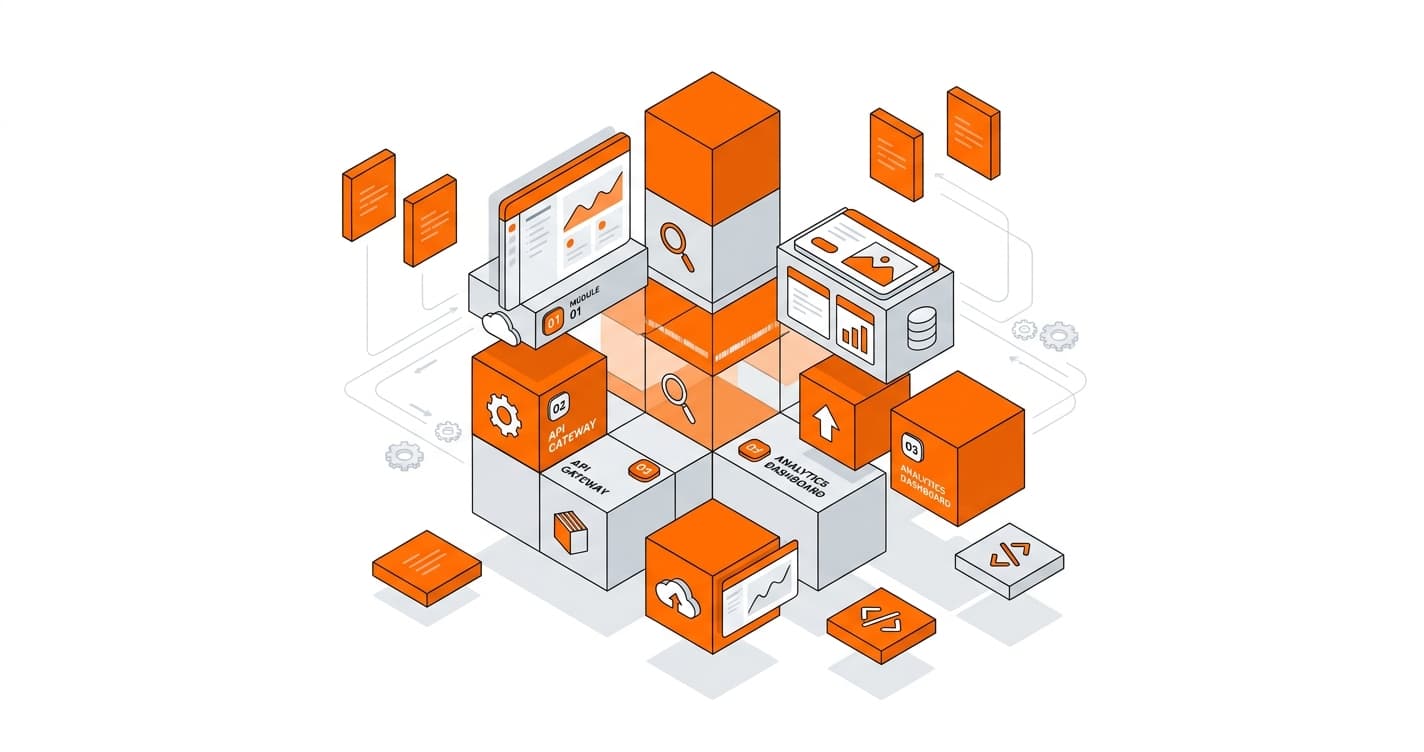
No-code platforms like Bubble handle moderately sized databases of up to a few hundred thousand records with acceptable performance. Beyond this volume, or for complex real-time data processing, no-code’s limitations begin to show, with degraded response times and difficulty optimizing queries. For SaaS products that process very large data volumes, hybrid architectures that combine Bubble for the interface and business logic with external databases like Xano or Supabase for data storage and processing can significantly push back these limits without resorting to fully custom development.
What is the best approach for a non-technical entrepreneur launching their first SaaS?
The most recommended strategy for a non-technical entrepreneur launching their first SaaS in 2026 is to start with no-code to validate their market and generate their first revenue, then consider migrating to custom development only when no-code’s technical constraints become a real barrier to growth. This no-code first approach minimizes financial risk at the outset, allows rapid iteration on the product based on early customer feedback, and enables fundraising on the basis of real commercial traction rather than an unvalidated idea. The vast majority of seed investors in 2026 are perfectly comfortable funding SaaS products built on no-code, provided the value proposition and commercial traction are demonstrated.