The SaaS (Software as a Service) model has established itself as one of the pillars of the digital economy. Many startups and companies today choose to launch a SaaS product to offer software accessible directly online, without complex installation. But even before developing a product, a strategic question arises: should you build a SaaS B2B or a SaaS B2C?
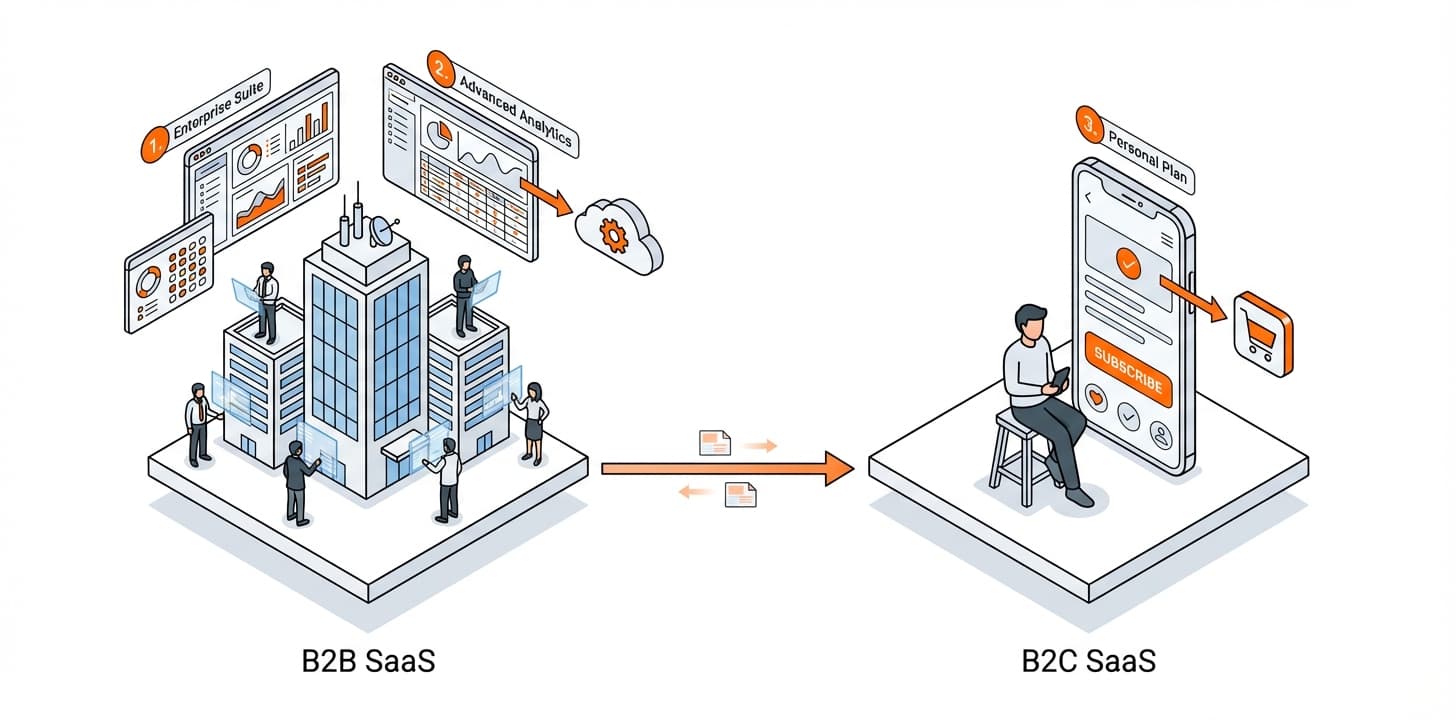
Both models are built on the same technological principle — software accessible via the internet — but they differ profoundly in their target market, marketing strategy, sales cycle, and growth model. A SaaS B2B targets businesses and aims to solve professional challenges, while a SaaS B2C targets consumers directly with services that are often simpler and more mainstream.
The choice between SaaS B2B and SaaS B2C influences almost every strategic decision: the type of product to develop, the customer acquisition strategy, the subscription price, customer support, and even the pace of growth of the project.
In this article, we will analyze the differences between SaaS B2B and SaaS B2C, their respective advantages, their challenges, and the criteria to consider when choosing the model best suited to your project.
What is the difference between SaaS B2B and SaaS B2C?
The term SaaS (Software as a Service) refers to software accessible directly via the internet, generally offered as a monthly or annual subscription. This model has become one of the most profitable in the digital economy, as it allows for a scalable, accessible, and easily scalable service. However, behind this technological model lie two very different approaches: SaaS B2B and SaaS B2C.
The main difference between these two models lies in the target audience. While SaaS B2B targets businesses, SaaS B2C targets consumers directly. This distinction profoundly influences product strategy, marketing, pricing, and even the way the software is designed.
SaaS B2B: software designed for businesses
SaaS B2B (Business to Business) is software intended for companies, organizations, or professionals. Its goal is generally to solve a specific business problem or improve a team’s productivity.
Examples of SaaS B2B are numerous: project management tools, CRM software, marketing automation platforms, accounting solutions, and HR management software. In this model, the software often becomes a strategic tool for businesses, which explains why clients are willing to pay a higher subscription fee.
One of the defining characteristics of SaaS B2B is the longer sales cycle. Unlike a service aimed at the general public, a company typically takes more time to adopt a software solution. Purchase decisions sometimes involve multiple stakeholders: IT managers, executives, business teams, or the finance department.
On the other hand, once a company adopts a SaaS solution, it tends to use it over the long term. This means that the customer retention rate can be very high. A well-positioned SaaS B2B can therefore generate stable recurring revenue for several years.
The price of a SaaS B2B is also higher than that of a SaaS B2C. Subscriptions can range from a few dozen euros per month to several thousand euros depending on the size of the company and the features offered.
Finally, the marketing strategy of a SaaS B2B often relies on SEO, content marketing, product demos, free trials, and sales teams. The goal is to convince businesses of the value of the software.
SaaS B2C: software designed for the general public
SaaS B2C (Business to Consumer) targets individuals directly. The software is designed to be easy to use, quickly accessible, and suited to a broad audience.
Examples of SaaS B2C include streaming applications, personal cloud storage tools, personal productivity apps, and certain online design services.
Unlike SaaS B2B, the purchase cycle of a SaaS B2C is generally very short. A user can sign up, try the service, and subscribe in just a few minutes. Purchase decisions are quick and often impulsive.
On the other hand, subscriptions are generally less expensive. A SaaS B2C often offers pricing between €5 and €20 per month, which means profitability depends on a large volume of users.
The main challenge of a SaaS B2C is therefore the mass acquisition of customers. To reach profitability, companies must attract thousands, or even millions, of users.
The marketing strategy is therefore very different from that of a SaaS B2B. B2C companies rely more heavily on digital marketing, social media, online advertising, influencer marketing, and growth hacking.
Finally, ease of use is a key element of success for a SaaS B2C. Users must be able to immediately understand how the product works, without any training or onboarding.
In summary, the difference between SaaS B2B and SaaS B2C is not only about the type of customer. It influences the entire product strategy, marketing approach, and business model.
SaaS B2B vs SaaS B2C: which is more profitable?
When an entrepreneur wants to launch a SaaS (Software as a Service), the question of profitability quickly becomes central. Between a SaaS B2B aimed at businesses and a SaaS B2C oriented toward consumers, both models can generate significant revenue. However, their economic logic, growth strategy, and profit potential differ greatly.
To determine which model is more profitable, several key factors must be analyzed: the average price per customer, acquisition cost, customer retention, and the ability to scale quickly.
More stable profitability with SaaS B2B
SaaS B2B is generally considered the most stable model in terms of revenue. Businesses are willing to pay more for tools that improve their productivity or optimize their operations. Software that helps a company save time, automate a process, or increase its revenue has a very strong perceived value.
This translates into higher subscription fees. A SaaS B2B can charge between €30 and several hundred euros per month, or even much more for solutions aimed at large enterprises. In some cases, contracts can reach several thousand euros annually.
Another major advantage of SaaS B2B is customer loyalty. Once a company integrates a software solution into its internal processes, switching tools becomes difficult. This dependency creates a high retention rate, which supports recurring revenue.
However, growth can be slower. The B2B sales cycle is often longer, as decisions involve multiple stakeholders: executives, technical teams, or financial managers. This requires greater investment in B2B marketing, product demonstrations, and sometimes a dedicated sales team.
Massive growth potential with SaaS B2C
SaaS B2C operates according to a different logic. Subscriptions are generally less expensive, often between €5 and €20 per month. This means profitability depends on a high volume of users.
The main advantage of SaaS B2C is its ability to scale rapidly. If a product becomes popular, it can attract thousands or millions of users in a short period of time. Companies like Spotify, Dropbox, and Canva perfectly illustrate this model based on mass adoption.
The B2C purchase cycle is also much shorter. A user can sign up and pay in just a few minutes, without any complex validation process. This allows revenue to be generated quickly if customer acquisition is well managed.
However, this model also comes with significant challenges. The customer acquisition cost (CAC) can be very high, particularly due to online advertising and competition on digital platforms. Moreover, individual users can unsubscribe more easily, leading to a higher churn rate than in SaaS B2B.
Profitability depends above all on the market and the product
Saying that SaaS B2B is always more profitable would be an oversimplification. In reality, profitability depends primarily on the problem your software solves and the size of the market.
A SaaS B2B that solves a critical problem for businesses can become extremely profitable with just a few hundred customers. Conversely, a SaaS B2C can achieve spectacular profitability if it manages to capture a massive audience.
In practice, many entrepreneurs consider SaaS B2B to be more predictable and easier to monetize, while SaaS B2C offers explosive but riskier growth potential.
Therefore, the choice between SaaS B2B and SaaS B2C should not be based solely on theoretical profitability. It should above all take into account your target market, your acquisition strategy, and the real value your product brings to users.
How to choose between SaaS B2B and SaaS B2C for your project?
Choosing between SaaS B2B and SaaS B2C is a strategic decision that influences every aspect of your project: the type of product to develop, how to acquire users, the monetization strategy, and even the pace of growth of your business. There is no universal answer, as the best choice depends above all on the problem you want to solve, the market you are targeting, and the resources at your disposal.
The first question to ask concerns the nature of the problem your SaaS software will solve. If your solution addresses a professional need — for example, automating a task, improving project management, or optimizing customer relationships — it is often more logical to lean toward a SaaS B2B. Businesses are willing to pay for tools that help them save time, reduce costs, or increase productivity.
Conversely, if your product aims to simplify an everyday task, entertain, or make a service easier to use for individuals, a SaaS B2C may be more appropriate. Personal management apps, online design tools, cloud storage, and e-learning platforms are often built on this model.
Another determining factor is the size of the market. SaaS B2B generally targets a smaller market, but with a higher value per customer. A professional software solution can generate significant revenue with just a few hundred or thousand business clients. In contrast, a SaaS B2C typically relies on a much larger audience. Reaching profitability usually requires acquiring a large number of users.
The customer acquisition model is also very different. In SaaS B2B, the strategy often relies on SEO, content marketing, product demos, free trials, or sales teams. Sales cycles are longer, as businesses take time to evaluate a solution before adopting it.
In a SaaS B2C, acquisition is generally faster but also more competitive. Companies rely on digital marketing, social media, online advertising, and growth hacking to quickly attract a large volume of users.
The resources at your disposal should also influence your choice. SaaS B2B often requires more domain expertise and sometimes more significant customer support, particularly during the software integration phase into the company’s processes. In contrast, a SaaS B2C often requires larger investments in marketing and user acquisition to reach a critical mass.
It is also important to think about your monetization strategy. In a SaaS B2B, subscriptions are generally higher and can include different tiers based on company size. In a SaaS B2C, prices are lower, but the model often relies on a large number of subscribers or a freemium strategy.
Finally, you need to analyze the competition and market saturation. Some SaaS segments are already highly competitive. Identifying a specific niche can allow you to build a stronger value proposition and differentiate yourself more easily.
In reality, many SaaS projects today combine both approaches. Some products start as a SaaS B2C to attract a user base, then develop advanced features aimed at businesses. Others adopt a hybrid strategy known as B2B2C, where the software is sold to businesses but used by individuals.
The choice between SaaS B2B and SaaS B2C should therefore be guided by your market, your product vision, and your growth strategy.
SaaS B2B or SaaS B2C: which model should you choose to launch your SaaS?
When looking to launch a SaaS (Software as a Service), the choice between SaaS B2B and SaaS B2C is one of the most important decisions you will make. This choice directly influences your product strategy, your business model, your customer acquisition approach, and even the pace of growth of your project. Although both models are built on the same principle — software accessible via the internet on a subscription basis — their mechanics and challenges are very different.
To choose the most suitable model, it is essential to analyze several key factors: the problem your product solves, your target market, your monetization strategy, and your ability to acquire users.
SaaS B2B is generally preferred when the software addresses a specific professional challenge. Businesses are constantly looking for tools capable of improving their productivity, automating certain tasks, or optimizing their internal processes. In this context, software that delivers clear value can quickly become indispensable for its users.
One of the great advantages of SaaS B2B is the higher value per customer. Unlike SaaS B2C, businesses are willing to pay larger subscription fees if the software allows them to save time or money. This means it is possible to build a profitable business with a relatively limited number of clients.
However, this model often requires a longer sales cycle. Businesses take time to evaluate a solution before adopting it. It may be necessary to offer demos, free trials, or commercial support to convince professional clients.
Conversely, SaaS B2C targets individuals directly. B2C software is generally designed to be simple to use, quickly accessible, and understandable without any training. The most well-known examples include personal productivity apps, online design platforms, and cloud storage services.
The main advantage of SaaS B2C is its rapid growth potential. If a product meets a popular need and is well distributed, it can attract thousands or millions of users in a short period of time. Purchase decisions are quick, which significantly shortens the sales cycle.
However, monetization can be more complex. Subscriptions are generally lower, which means profitability depends on a large volume of users. Customer acquisition therefore becomes a major challenge, often driven by digital marketing, online advertising, and social media.
For many entrepreneurs, SaaS B2B is often considered more predictable and more stable. Recurring revenue is generally higher and customer loyalty stronger. In contrast, SaaS B2C offers spectacular growth potential if the product manages to reach a wide audience.
In practice, the best model depends above all on your product vision and your market. If you identify a clear problem faced by businesses, SaaS B2B can be an excellent choice. If your product addresses a universal consumer need, SaaS B2C can offer massive growth opportunities.
Finally, it is worth noting that some projects today adopt hybrid models. A product can start as a SaaS B2C, then evolve to include professional features for businesses. Others adopt a freemium approach, where the free version attracts a large number of users before converting some of them into paying customers.
Ultimately, the choice between SaaS B2B and SaaS B2C should be guided by the value your software brings to users. The most relevant model will always be the one that best matches your market and the problem your product solves.
Common mistakes to avoid when launching a SaaS
Launching a SaaS (Software as a Service) can be an extremely profitable opportunity, but it is also a complex project that requires a solid strategy. Many startups fail not because of the technology, but because of avoidable strategic mistakes. Understanding the most common mistakes when launching a SaaS can significantly increase your product’s chances of success.
The first mistake is building a product without validating market demand. Many entrepreneurs develop software believing it will be useful, without verifying whether users are actually willing to pay for the solution. In the world of SaaS, product-market fit is essential. Before writing a single line of code, it is important to test the idea, talk to potential users, and understand their real problems.
Another common mistake is wanting to create a product that is too complex from the outset. Many founders try to develop highly comprehensive software with numerous features. Yet in most cases, it is better to start with an MVP (Minimum Viable Product). An MVP allows you to quickly launch a first version of the product, test the market, and progressively improve the software based on user feedback.
A lack of customer acquisition strategy is also a critical mistake. Some entrepreneurs believe that a good product will sell itself naturally. In reality, distribution is often just as important as the product itself. It is essential to think from the very beginning about how to attract users: SEO, content marketing, online advertising, social media, or partnerships.
Another frequent mistake is poorly defining the pricing model. In a SaaS, pricing is a major strategic lever. If the price is too low, the company may struggle to reach profitability. If it is too high, it can hinder product adoption. It is therefore essential to test different SaaS pricing strategies, such as subscription plans, tiered pricing, or freemium models.
Many SaaS projects also fail due to a churn rate that is too high. Churn represents the percentage of users who cancel their subscription. If users leave the service quickly, growth becomes difficult. To limit this phenomenon, it is important to invest in user experience, customer support, and continuous product improvement.
Another mistake is neglecting user experience (UX). In the SaaS world, users expect simple, intuitive interfaces that are quick to get started with. If the software is difficult to understand or requires complex training, many users will abandon it quickly.
A lack of differentiation is also a common problem. The SaaS market today is highly competitive. Launching a product similar to already well-established solutions can be extremely difficult. To succeed, it is often necessary to position yourself in a specific niche or offer a clearly differentiated value proposition.
Finally, an often underestimated mistake is underestimating technical and operational costs. Hosting, maintenance, customer support, ongoing development: a SaaS requires resources over the long term. It is therefore important to plan an adequate budget and a realistic growth plan.
In summary, successfully launching a SaaS product requires much more than a good idea. Validating the market, building an MVP, defining a solid acquisition strategy, and delivering an excellent user experience are key elements to avoid the most common mistakes.
Useful resources
To learn more about SaaS, how it works, and how to build one, here are some useful resources:
Is Netflix a SaaS?
What is custom SaaS software?
How to build a SaaS from A to Z in 10 steps?
LALucien Arbieu
AI expert and digital transformation consultant at PeakLab.