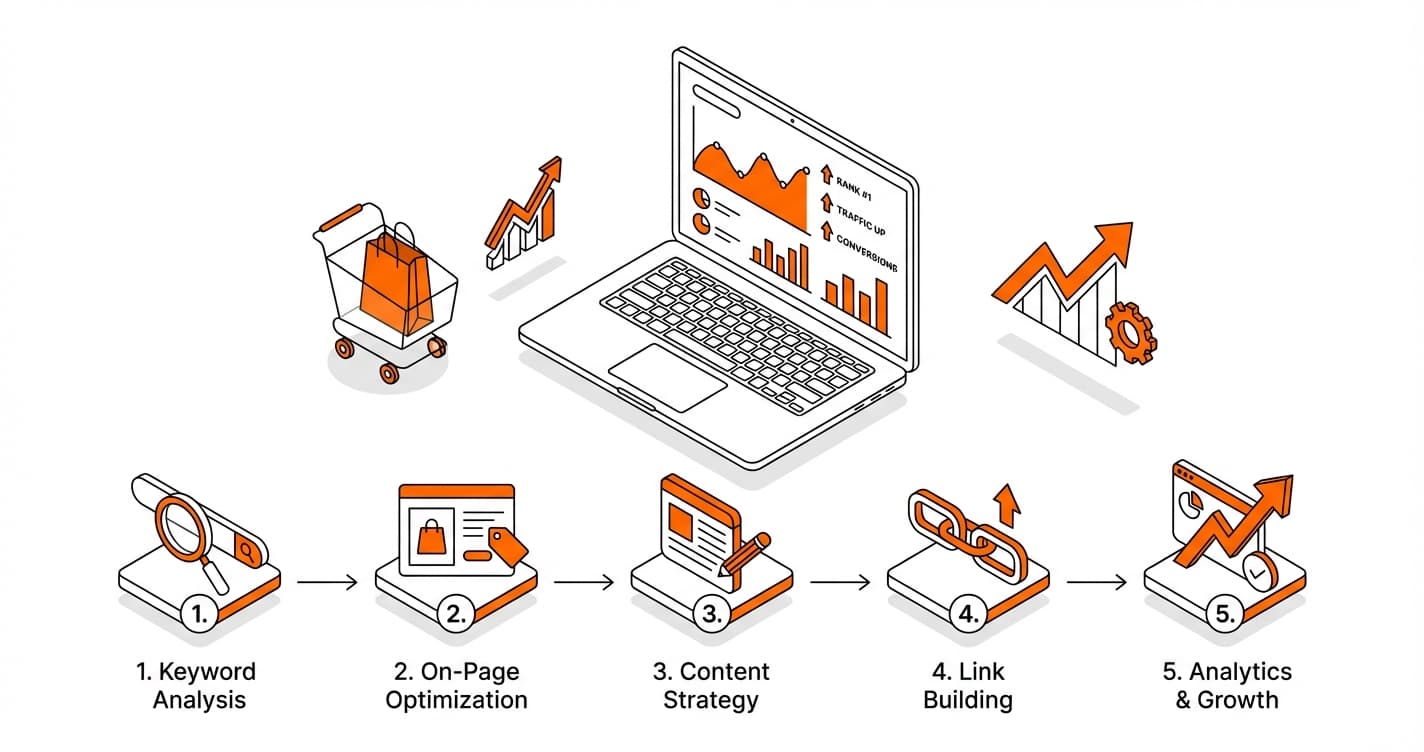
SEO for an e-commerce website is constantly evolving. With search engine updates, the rise of artificial intelligence and increasing online competition, adopting an effective organic search strategy has never been more important. In 2026, simply adding a few keywords to your product pages is no longer enough: e-commerce SEO now relies on a holistic approach combining content, user experience, site authority and technical performance.
For an e-commerce website, organic search often represents one of the most profitable long-term traffic sources. Unlike paid advertising, SEO attracts qualified visitors who are already searching for a product or a solution. When a site is well optimized, it can generate a steady flow of traffic and sustainably grow its sales.
However, e-commerce SEO has its own specific challenges. Online stores must manage hundreds, sometimes thousands, of product pages while avoiding issues such as duplicate content, poor site structure or technical performance problems.
In this article, we will explore 5 essential SEO tips for an e-commerce website in 2026 to improve your visibility on Google, attract more qualified traffic and increase your conversions.
1. Optimize Internal Linking Between Product Pages and Collection Pages to Strengthen SEO
Internal linking is one of the cornerstones of SEO for an e-commerce website. Yet it remains largely underutilized by many online stores. In 2026, an effective SEO strategy relies on a clear site architecture and optimized internal linking between product pages, collection pages and editorial content.
Internal linking involves creating links between the different pages of a website to facilitate user navigation and help search engines understand the site’s structure. For an e-commerce website, it also allows you to pass SEO authority (PageRank) to your most important pages.
The first step is to properly structure your collection pages. These pages are often the most strategically important for SEO, as they target transactional keywords that users are actively searching for. For example, a collection page can rank for queries such as « 14-inch laptop sleeve » or « women’s laptop bag ».
Product pages should then be intelligently linked to these collections. Each product page should contain an internal link to its main collection in order to reinforce the site’s thematic consistency. This link helps search engines understand that the product belongs to a specific category.
For example, a product page might include a link such as: « Also discover our full collection of 14-inch laptop sleeves. » This type of internal link helps strengthen the semantic relevance of the collection page.
The reverse is equally important. Collection pages should highlight products through internal links to product pages. This creates a natural flow of PageRank and improves page indexing.
Good internal linking is not limited to products and collections. It is also essential to integrate a SEO content strategy. Blog articles can serve as genuine traffic pillars and redirect visitors to commercial pages.
For example, an SEO-optimized article can contain multiple internal links to:
- collection pages
- product pages
- other blog articles
This approach creates what is known as a topic cluster or semantic silo, where each page reinforces the overall theme of the site.
Another important element of internal linking is the anchor text of links. The anchor should contain relevant keywords without being over-optimized. For example, instead of using a simple « click here, » it is better to use an anchor such as « 14-inch laptop sleeve » or « women’s laptop case ».
However, it is advisable to vary your anchors to maintain a natural profile:
- optimized anchors
- semi-optimized anchors
- more natural anchors
This diversification helps avoid SEO over-optimization.
Site navigation also plays an important role in internal linking. A clear and well-structured menu allows search engines to easily crawl important pages. Breadcrumbs are also very useful for reinforcing the site’s structure and improving the user experience.
Finally, internal linking also helps improve time spent on the site and the user journey. By offering links to similar products, collections or complementary articles, you encourage visitors to continue browsing.
In summary, optimizing internal linking between product pages and collection pages strengthens the site’s SEO structure, improves page indexing and effectively passes internal authority to strategic pages.
2. Build an SEO Content Strategy with Regularly Published Articles
For an e-commerce website, content has become one of the most powerful levers for improving organic search rankings. In 2026, ranking solely through product pages and collection pages is becoming increasingly difficult, as competition for transactional keywords is fierce. This is why it is essential to build an SEO content strategy based on the regular publication of articles.
The principle is straightforward: publish optimized content that answers users’ questions in order to attract qualified traffic from Google. This content then redirects visitors to the commercial pages of the site, such as collections or product pages.
An effective strategy involves publishing blog articles on a regular basis, ideally one article per day or several articles per week depending on your resources. This frequency allows you to quickly increase the number of pages indexed by Google and capture a large volume of long-tail queries.
Long-tail keywords are more specific search queries, often made up of several words. They are generally less competitive and attract highly targeted traffic. For example, instead of targeting only a keyword like « laptop bag, » you can create articles around queries such as:
- which laptop bag to choose for traveling
- which laptop sleeve for a 14-inch PC
- how to protect your laptop in a bag
Each article then becomes an SEO entry point to your e-commerce website.
For this strategy to work, it is important to produce high-quality content that is well-structured and optimized for search engines. A good SEO article should clearly answer a specific question or need while providing genuine value to the reader.
The structure of the article also plays an important role. It is advisable to use:
- an optimized H1 title
- multiple H2 and H3 headings
- clear and well-organized paragraphs
- important keywords in bold to reinforce semantic relevance
This structure helps Google better understand the topic covered and improves the readability of the content.
Thematic consistency is also essential. Articles should be related to the e-commerce site’s universe in order to strengthen the domain’s authority on a specific topic. For example, a site specializing in computer accessories should publish content related to:
- laptop protection
- computer accessories
- tips for transporting a laptop
This helps build strong topical authority in the eyes of search engines.
Internal linking is another key element of this strategy. Each article should contain multiple internal links to:
- collection pages
- product pages
- other blog articles
These links transfer SEO authority to commercial pages and improve user navigation.
A well-built content strategy also allows you to create what is known as a content cluster or semantic silo. Multiple articles covering the same thematic universe will reinforce each other and improve the site’s overall visibility.
Finally, publishing content regularly sends a positive signal to search engines. A site that publishes frequently demonstrates that it is active and offers up-to-date content. This can encourage Google’s bots to crawl the site more often.
In summary, building an SEO content strategy with regularly published articles increases organic traffic, captures long-tail queries and strengthens the e-commerce site’s authority within its niche.
3. Build a Consistent Backlink Strategy to Strengthen Site Authority
In e-commerce SEO, one of the most important factors for improving a site’s rankings remains domain authority. For Google, a site that receives backlinks (links from other websites) is often perceived as more credible and more relevant. This is why building a consistent backlink strategy is essential for strengthening an e-commerce site’s visibility over the long term.
A backlink is simply a link placed on another website that points to your online store. These links act as votes of confidence in the eyes of search engines. The more quality links a site receives, the greater its chances of gaining authority and ranking higher in search results.
However, not all backlinks carry the same value. Google places greater importance on links coming from relevant, thematically related sites that themselves have a certain level of authority. A good link-building strategy therefore prioritizes links that are consistent with your e-commerce site’s universe.
For lasting results, it is advisable to implement a monthly backlink strategy. An often effective approach is to acquire between 8 and 10 backlinks per month. This frequency creates a progressive and natural growth of the site’s link profile.
One of the most important elements of a backlink strategy is the diversification of link anchors. The anchor is the clickable text used to create the link. To appear natural to Google, it is important to vary the types of anchors used.
There are generally three main categories:
- optimized anchors, which contain the exact target keyword
- semi-optimized anchors, which include a variation of the keyword
- de-optimized or natural anchors, such as the brand name or a URL
For example, if you want to rank a collection for the query 14-inch laptop sleeve, it can be effective to use a combination of anchors such as:
- « 14-inch laptop sleeve » (optimized)
- « 14-inch laptop case » (semi-optimized)
- « view the collection » or the brand name (de-optimized)
This diversification helps build a natural link profile, which reduces the risk of a penalty related to over-optimization.
It is also important to vary the types of pages targeted by backlinks. Many sites send all their links to the homepage, which is not always the most effective strategy. A good strategy involves distributing backlinks across:
- the homepage
- collection pages
- certain blog articles
- sometimes strategic product pages
This distribution strengthens the site’s overall authority while pushing key pages higher in search results.
Blog articles can also play an important role in this strategy. By receiving backlinks, these articles can capture traffic and then pass SEO authority to commercial pages through internal linking.
It is also recommended to prioritize links placed within editorial content rather than isolated links or links placed in low-visibility areas. Backlinks naturally integrated into an article generally carry more SEO value.
Finally, an effective link-building strategy relies on consistency. Acquiring a few links each month is often more beneficial than obtaining a large number of backlinks all at once. This natural progression more closely mirrors the normal behavior of the web.
In summary, building a consistent backlink strategy strengthens an e-commerce site’s authority, improves its credibility in Google’s eyes and increases its chances of ranking for competitive keywords.
4. Optimize Product Pages to Capture SEO Traffic and Improve Conversions
In an e-commerce SEO strategy, product pages play a central role. They do not simply serve to present a product to visitors: they can also become genuine SEO traffic acquisition pages. A well-optimized product page can both rank for transactional keywords and increase conversion rates.
To achieve this, it is essential to work on several key elements: content structure, semantic optimization, internal linking and user experience.
The first step is to avoid generic product descriptions or content copied from suppliers. On many e-commerce sites, product pages contain content identical to that found on other sites. This duplicate content can severely limit a page’s SEO potential.
It is therefore recommended to write a unique and optimized description that provides real added value to the user. A good product page should clearly explain:
- the product’s features
- the benefits for the user
- the situations in which the product can be used
The goal is to answer the questions a visitor might have before making a purchase.
The structure of the product page also plays an important role in SEO. A well-organized page helps Google understand the content and improves readability for users.
An optimized product page might for example include:
- an H1 title optimized with the main keyword
- an introductory descriptive paragraph
- H2 or H3 headings to structure the information
- dedicated sections for product specifications
This structure allows important keywords to be naturally integrated without making the text feel forced.
Semantic optimization is also essential. A product page should not simply repeat a main keyword. It should incorporate a rich lexical field around the product to help Google understand the page’s topic.
For example, for a 14-inch laptop sleeve, it is relevant to include related terms such as:
- laptop protection
- laptop case
- safe PC transport
- laptop accessory
This semantic richness allows you to capture more long-tail queries.
Internal linking is another powerful lever for optimizing product pages. Each product page should contain links to:
- the main collection
- other similar products
- sometimes related blog articles
These links improve user navigation and reinforce the site’s SEO structure.
User experience also influences SEO performance and conversions. A product page should be clear, easy to read and pleasant to browse. Visual elements play an important role: high-quality images, an airy layout and easily accessible information.
Visitors should be able to quickly understand:
- what the product offers
- why it is useful
- what sets it apart from other products
Another essential point concerns customer reviews. Reviews add credibility and reassure potential buyers. They can also enrich the page with user-generated content, which is often valued by search engines.
Finally, technical elements such as SEO tags should not be overlooked. The title tag, meta description, image alt tags and the page URL should all be optimized to include relevant keywords.
In summary, optimizing product pages not only improves the SEO visibility of an e-commerce website, but also increases conversions by delivering a clear and compelling user experience.
In 2026, SEO for an e-commerce website no longer relies solely on keywords, content or backlinks. Signals related to user experience and technical performance have become essential criteria for ranking on Google. A fast, smooth and enjoyable website can significantly improve its organic search rankings while also increasing conversion rates.
Google now places great importance on the quality of the user experience. The search engine’s goal is simple: to offer users the most relevant pages, but also the most pleasant ones to browse.
One of the first elements to optimize is site loading speed. A slow e-commerce website can result in a significant loss of visitors. Numerous studies show that users often leave a page if it takes more than a few seconds to load. An excessively high loading time can therefore increase the bounce rate and reduce the chances of conversion.
To improve technical performance, several optimizations can be implemented:
- compressing product images
- using high-performance hosting
- enabling caching
- minimizing unnecessary scripts
These optimizations improve site speed and deliver a better experience to visitors.
Another important factor is mobile optimization. Today, a large share of e-commerce traffic comes from smartphones. Google also uses a mobile-first index, meaning that the mobile version of a site is given priority when evaluating its SEO.
An e-commerce website must therefore be perfectly adapted to mobile screens:
- simple navigation
- easily tappable buttons
- product pages that are readable on smartphones
A smooth mobile experience can strongly influence SEO performance and sales.
Site navigation also plays a major role in user experience. A well-structured site allows visitors to quickly find the products they are looking for. A clear architecture with logical menus, well-organized categories and breadcrumbs makes navigation easier.
This structure also helps search engines understand the hierarchy of pages and crawl the site more efficiently.
Core Web Vitals have also become important indicators for Google. These metrics measure several aspects of the user experience:
- the loading speed of the main content
- the visual stability of the page
- responsiveness during interactions
A site that performs well on these criteria has a greater chance of achieving strong SEO results.
Site security is another essential technical element. An e-commerce website must use the HTTPS protocol, which ensures the security of data exchanged between the site and its users. Google considers this protocol a trust signal.
Finally, the overall user experience strongly influences visitor behavior. If a site is pleasant to browse, users spend more time on pages, view more products and are more likely to complete a purchase.
Simple elements can improve this experience:
- a clear layout
- high-quality images
- readable product descriptions
- a simple checkout process
In summary, improving user experience and technical site performance enhances both the organic search rankings and the commercial performance of an e-commerce website. A fast, well-structured site optimized for users sends positive signals to Google and drives visitor conversions.
LALucien Arbieu
AI expert and digital transformation consultant at PeakLab.