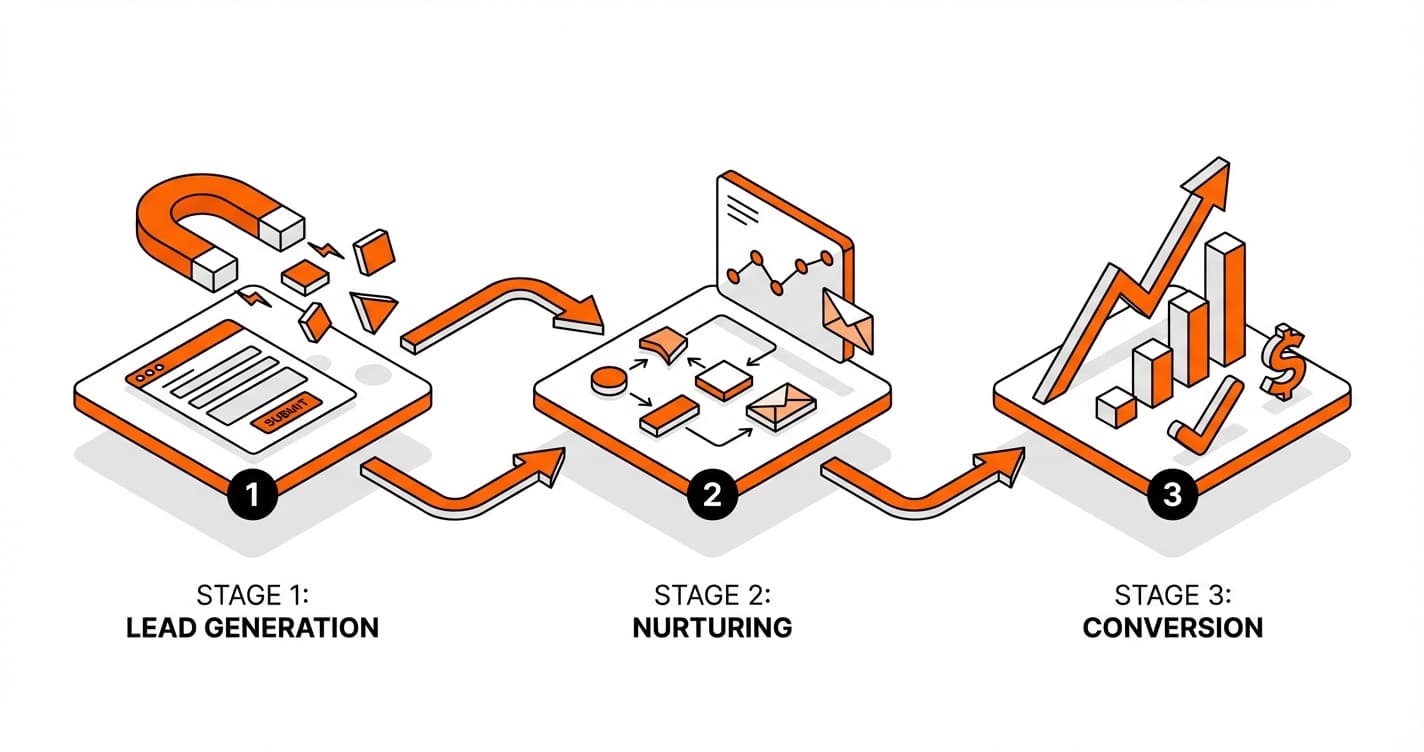
In an increasingly competitive digital environment, attracting customers no longer happens by chance. To generate qualified traffic and grow your business, it is essential to put in place an effective acquisition strategy.
But concretely, what is an acquisition strategy? It is a set of levers and actions designed to attract prospects, convert them into customers, and optimize their journey.
SEO, advertising, social media, email marketing… the channels are numerous, but you still need to know how to use them intelligently.
In this article, you will discover the fundamentals of an acquisition strategy, the main levers to activate, and best practices for generating concrete results.
What Are the Main Levers of an Acquisition Strategy?
An acquisition strategy relies on several complementary levers. The goal is not to activate all of them, but to choose those that match your target audience, your market, and your resources. Here are the main levers you need to know.
SEO (Organic Search)
SEO is one of the most powerful long-term levers. It involves optimizing your website to appear in search engine results. This is achieved through creating relevant content, technically optimizing the site, and building its authority.
The main advantage of SEO is its ability to generate qualified, sustainable traffic. Once well-positioned, your site can attract visitors continuously, without depending on an advertising budget.
Paid Advertising (SEA)
SEA encompasses advertising campaigns on search engines and social networks. Unlike SEO, it delivers fast results.
This lever is particularly effective for testing an offer, launching a product, or generating traffic immediately. However, it requires a budget and careful management to be profitable.
Social Media
Social media has become indispensable in an acquisition strategy. It allows you to reach a broad audience, build a community, and strengthen your brand’s visibility.
Depending on your target audience, some platforms will be more relevant than others. The goal is to publish engaging content and build a relationship with your audience.
Content Marketing
Content marketing involves creating useful content to attract and convert prospects. Blog articles, videos, guides, or newsletters… this lever allows you to address your audience’s needs.
It is often used alongside SEO, as it helps improve rankings and strengthen your credibility.
Email Marketing
Email marketing remains a highly effective lever for converting and retaining customers. It allows you to communicate directly with your audience, share offers, and maintain the relationship.
When used well, it can generate an excellent return on investment.
Influencer Marketing
Influencer marketing involves collaborating with content creators to promote your brand. This lever allows you to reach a qualified audience and strengthen credibility.
It is particularly effective for brands looking to build their awareness quickly.
Partnerships and Affiliate Marketing
Partnerships and affiliate marketing allow you to leverage other players to generate traffic and sales. This can take the form of collaborations, referrals, or affiliate programs.
This lever is valuable for expanding your audience without investing directly in advertising.
How to Build an Effective Acquisition Strategy Step by Step?
Building an effective acquisition strategy is not something you can improvise. It relies on a clear, structured, results-oriented methodology. Here are the essential steps to follow to put a high-performing strategy in place.
The Key Steps to Follow
Define your objectives First and foremost, you need to clarify your goals: generate traffic, obtain leads, increase sales, or improve brand awareness. Precise objectives guide your entire strategy.
Identify your target audience An effective strategy is built on a thorough understanding of your audience. Define your persona: needs, pain points, behaviors, and channels used. The more precise your target, the more effective your acquisition will be.
Analyze your market and competitors Study your environment. Who are the key players? Which levers are they using? This analysis helps identify opportunities and differentiate yourself.
Choose the right acquisition levers Based on your target audience and objectives, select the most relevant channels: SEO, advertising, social media, email… It is better to focus on a few well-mastered levers than to spread yourself too thin.
Create a content strategy Content is at the heart of acquisition. You need to produce content tailored to your audience and to each stage of the customer journey. This includes articles, sales pages, social posts, and emails.
Set up a conversion funnel Attracting traffic is not enough. You need to turn your visitors into customers. Put in place a clear journey with calls to action, optimized pages, and a smooth user experience.
Launch and test your actions Once your strategy is defined, take action. Test different formats, messages, and channels to identify what works best.
Analyze performance Track your results using key indicators: traffic, conversion rate, acquisition cost. This analysis helps identify strengths and areas for improvement.
Continuously optimize An acquisition strategy is never set in stone. You must adjust your actions based on results to improve your performance.
Summary Table of Steps
Step
Objective
Expected Outcome
Define objectives
Set a direction
Clear strategy
Identify the target audience
Better understand the audience
Relevant messaging
Analyze the market
Identify opportunities
Differentiating positioning
Choose the levers
Select the right channels
Effective acquisition
Create content
Attract and engage
Qualified traffic
Set up a funnel
Convert visitors
Increased sales
Test actions
Identify high-performing levers
Better results
Analyze performance
Measure effectiveness
Action optimization
Continuously optimize
Improve the strategy
Sustainable growth
In summary, an effective acquisition strategy relies on a structured approach, from defining objectives to continuous optimization. Each step is essential to building a high-performing and sustainable system.
Free tool
AI Specifications Generator
Create professional project specifications in minutes with our AI-powered tool.
What Are the Mistakes to Avoid in an Acquisition Strategy?
Putting an acquisition strategy in place is a key step in growing your business. Yet many companies make mistakes that limit their results, or even prevent them from performing altogether. Identifying these pitfalls saves time, optimizes resources, and improves return on investment.
The first mistake is not defining clear objectives. A strategy without precise goals lacks direction. Generating traffic without knowing why, launching campaigns without indicators, or wanting to « be visible » without a concrete plan often leads to disappointing results. A good strategy is built on measurable, coherent objectives.
Another common mistake is not knowing your target audience well. Many companies try to reach as many people as possible without truly understanding their audience’s needs. The result: messages are too generic and largely ineffective. A high-performing acquisition strategy is built on a deep understanding of the ideal customer.
A lack of consistency across levers is also problematic. Using multiple channels without an overarching strategy can scatter your efforts. For example, publishing content that is disconnected from your advertising campaigns, or failing to align your message across different touchpoints, reduces overall effectiveness.
A very common mistake is wanting to move too fast. Some levers, like SEO, take time to produce results. Giving up too early or constantly changing strategy prevents you from achieving sustainable performance. Patience and consistency are essential.
Lack of performance tracking is another critical issue. Without analysis, it is impossible to know what is working and what is not. Failing to monitor your indicators is like flying blind. An effective strategy relies on data and regular adjustments.
Another mistake is neglecting the conversion funnel. Attracting traffic is one thing, but if your site does not convert, your efforts are wasted. A poor user journey, poorly optimized pages, or ineffective calls to action can significantly reduce your results.
Content is often underestimated. Publishing content without a strategy, without added value, or without SEO optimization severely limits its impact. Content must address your audience’s needs and fit into an overall logic.
Insufficient investment is also a barrier. An acquisition strategy requires time, skills, and sometimes a budget. Expecting results without investing enough can lead to weak performance.
Finally, copying other companies’ strategies without adapting them is a frequent mistake. Every business has its own specificities. An effective strategy must be tailored to your market, your target audience, and your objectives.
In summary, the main mistakes to avoid are:
the absence of clear objectives
a poor understanding of the target audience
a lack of consistency
the absence of tracking
an ineffective conversion funnel
A high-performing acquisition strategy relies on rigor, consistency, and adaptability. Avoiding these mistakes allows you to maximize your results and build sustainable growth.
Conclusion: Why Is an Acquisition Strategy Essential?
An acquisition strategy is no longer optional — it is a central element for growing a business sustainably. In a competitive environment, attracting customers cannot be left to chance. It requires a structured, consistent, results-oriented approach.
As we have seen, an effective strategy rests on several pillars: clear objectives, a thorough understanding of the target audience, the right choice of levers, and continuous optimization. It is this combination that makes it possible to generate qualified traffic, convert visitors, and maximize profitability.
The challenge is not simply to attract people, but to attract the right people, at the right time, with the right message. A well-designed acquisition strategy creates a high-performing system capable of delivering results over the long term.
It is also important to understand that this strategy is constantly evolving. Consumer behaviors, tools, and trends change. Adapting and regularly testing new approaches is essential to staying competitive.
In summary, a well-built acquisition strategy allows you to:
structure your growth
optimize your investments
improve your performance
It is an indispensable lever for any business that wants to grow effectively.
What is a digital acquisition strategy?
A digital acquisition strategy is a set of actions put in place to attract visitors online and convert them into customers. It relies on different levers such as SEO, advertising, social media, and email marketing.
What is the difference between acquisition and conversion?
Acquisition involves driving traffic to your website or channels. Conversion comes next: it is the moment when a visitor takes an action (purchase, sign-up, contact). A good strategy combines both.
What is the best acquisition lever?
There is no single best lever. SEO is ideal for the long term, while advertising delivers fast results. The choice depends on your objectives, your budget, and your target audience.
How much does an acquisition strategy cost?
The cost varies depending on the levers used. SEO requires time but little direct budget, while advertising requires a financial investment. What matters is achieving a positive return on investment (ROI).
How long does it take to see results?
It depends on the channels. Advertising can generate immediate results, whereas SEO can take several months. An effective strategy often combines short-term and long-term approaches.
Should you use multiple acquisition channels?
Yes, it is recommended to diversify your levers. This helps reduce risk and optimize performance. However, it is better to master a few channels than to use too many without a strategy.
How do I know if my strategy is effective?
You need to track key indicators such as:
traffic
conversion rate
acquisition cost
revenue
This data allows you to adjust your strategy.
What is the most common mistake?
One of the most common mistakes is not defining clear objectives or failing to track performance. Without analysis, it is difficult to improve your results.
Can a small business implement an acquisition strategy?
Yes, regardless of the size of the business. It is possible to start with simple actions, such as SEO or social media, and then gradually expand your strategy.
LA
Lucien Arbieu
AI expert and digital transformation consultant at PeakLab.