Artificial intelligence reached a decisive turning point in 2025 and 2026. After years of chatbots capable of answering questions and generating content, a new generation of AI tools has emerged: AI agents. These systems no longer simply respond. They act, plan, decide and execute complex tasks autonomously in pursuit of a goal defined by the user.
A chatbot answers a question. An AI agent does something fundamentally different. It breaks down a complex objective into a series of steps, uses external tools, accesses real-time information and makes intermediate decisions to reach the expected outcome. It acts in the real world rather than simply talking about it.
In 2026, AI agents have moved from prototype stage to operational tools used by thousands of companies to automate entire workflows and multiply their teams’ productivity. In this article, we explain precisely what an AI agent is, how it works and what its most concrete applications are.
What is the difference between an AI agent and a classic chatbot?
The confusion between an AI agent and a classic chatbot is one of the most common in the field of artificial intelligence in 2026. These two technologies share a conversational interface and a language model foundation, but their capabilities, architecture and level of autonomy are fundamentally different. Understanding this distinction is essential for choosing the right technology for your needs and for not conflating what amounts to simple conversational automation with what constitutes genuine agentic intelligence.
A classic chatbot is an automated conversation system that answers questions or executes simple commands within a predefined scope. Its fundamental characteristic is its reactive and stateless nature. It receives a message, generates a response and waits for the next message. It has no persistent memory between sessions, no ability to initiate actions autonomously and no mechanism for breaking down a complex objective into successive steps. Early chatbots such as Siri, Alexa or the customer service chatbots of the 2010s perfectly illustrate this model. They are useful for simple, repetitive tasks but incapable of real autonomy as soon as complexity increases.
An AI agent is structurally different across four fundamental dimensions that clearly distinguish it from the classic chatbot.
The first dimension is autonomous action. Whereas a chatbot always waits for a human instruction at each step, an AI agent can initiate actions autonomously to reach a defined objective. If you ask it to analyze your market’s competitive landscape and prepare a report, it will itself decide which sources to consult, which tools to use, in what order to carry out the steps and how to structure the final result — without asking for your input at every intermediate micro-decision.
The second dimension is the use of external tools. An AI agent can connect to APIs, databases, web applications, search tools and third-party services to accomplish its tasks. This ability to interact with the real digital world is what allows it to act concretely rather than simply talk. A classic chatbot can only generate text. An AI agent can send an email, modify a file, perform a web search, update a CRM or trigger an advertising campaign.
The third dimension is multi-step planning and reasoning. An AI agent automatically breaks down a complex objective into a logical sequence of actions, executes each step, evaluates the result obtained and adapts its strategy if necessary before moving on to the next step. This sequential and adaptive reasoning is fundamentally absent from classic chatbots, which process each message in isolation without any overarching vision of the objective to be achieved.
The fourth dimension is memory and persistence. An AI agent can maintain context and memory across long tasks that span several hours or several days. It remembers what it has done, what it has learned and the current state of progress of the task in order to pick up where it left off. This persistence is essential for complex tasks that require many successive steps and a globally consistent approach.
In short, a chatbot responds, an AI agent accomplishes. This simple distinction captures the essence of the difference between these two technologies. The chatbot is a conversation tool. The AI agent is an autonomous digital collaborator capable of taking on entire workflows with minimal human supervision. It is this qualitative leap that explains the massive enthusiasm for AI agents in 2026 and their growing adoption across all industries.
How does an AI agent actually work?
Understanding how an AI agent concretely works allows you to measure its real potential and its current limitations. Because behind the apparent simplicity of the conversational interface lies a sophisticated technical architecture that combines several indispensable components to produce truly autonomous and useful behavior.
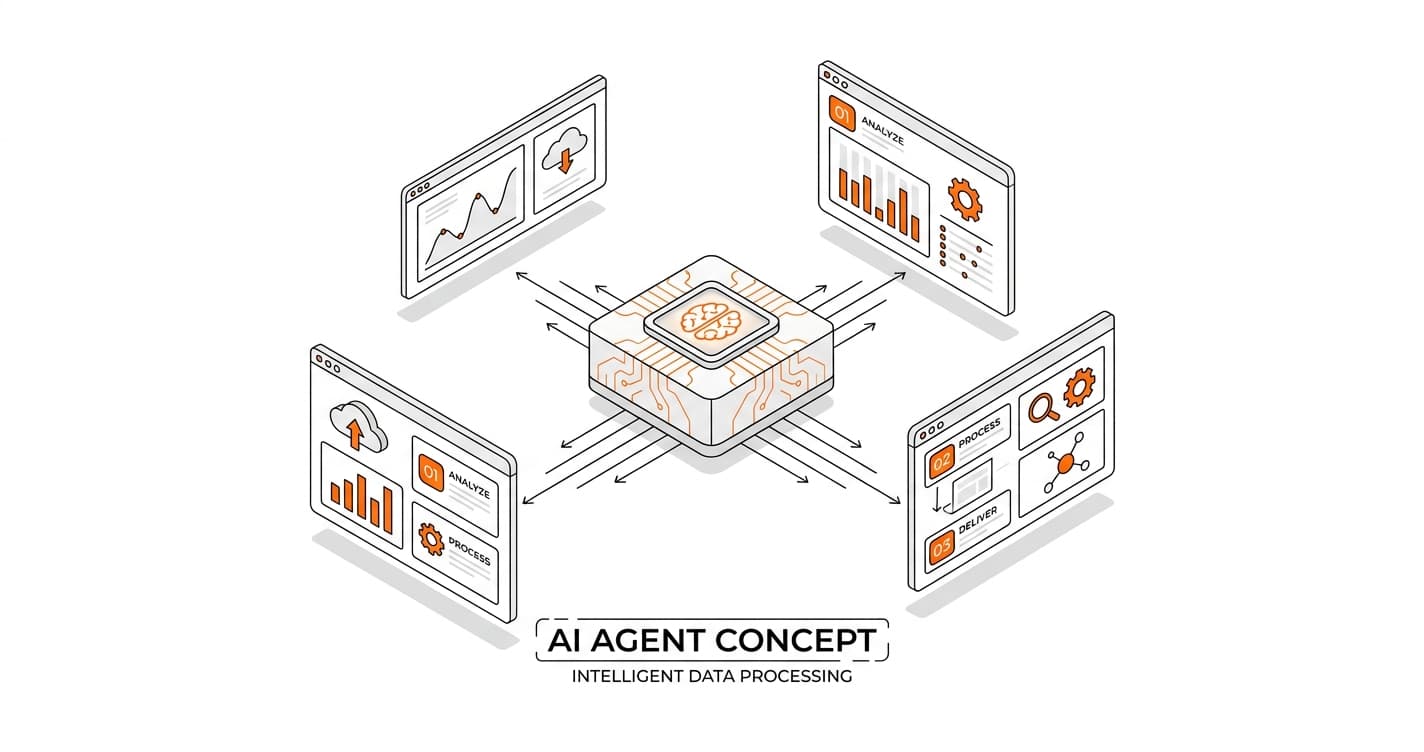
The functioning of an AI agent is based on a reasoning and action loop referred to in the technical literature as the ReAct loop, an acronym for Reasoning and Acting. At each step of this loop, the agent performs three successive operations. It observes the current state of the task and the available information. It reasons to decide what action to take next based on the defined objective. And it acts by using the tool best suited to that particular step. The result of this action becomes the new observation that triggers the next cycle, until the objective is reached or a blockage requiring human intervention is identified.
The language model is the brain of the agent. It is responsible for reasoning, planning and decision-making at each step of the loop. Models such as Anthropic’s Claude, OpenAI’s GPT-4o or Google’s Gemini are the most commonly used brains to power AI agents in 2026, as their complex reasoning and instruction-understanding capabilities are sufficiently advanced to drive multi-step tasks in a coherent manner.
The tools are the agent’s arms. These are the interfaces that allow it to interact with the real digital world. Web search, reading and writing files, sending emails, accessing databases, calling APIs, browsing websites, executing code. Each tool is an additional action capability that extends the scope of tasks the agent can accomplish autonomously.
Memory is what gives the agent its coherence over time. It comes in several complementary forms. Short-term memory, which stores the context of the current task. Long-term memory, which retains relevant information between sessions. And external memory, which accesses structured knowledge bases via RAG-type systems, Retrieval Augmented Generation.
Finally, the orchestrator is the system that coordinates all of these components, manages the sequence of actions, decides when to request human validation and ensures that the agent remains aligned with the initial objective throughout the execution of the task.
What are the advantages of an AI agent?
AI agents represent a technological breakthrough whose advantages for businesses and entrepreneurs are concrete, measurable and immediately perceptible in day-to-day operations. Here are the most significant benefits that explain the growing adoption of these systems in 2026.
Multiplied productivity on repetitive and complex tasks
The first advantage of AI agents is their ability to multiply human productivity on tasks that combine repetitiveness and complexity. An AI agent can process in a few minutes a volume of work that would take a human collaborator several hours. Analyzing a competitive market, drafting dozens of personalized emails, conducting daily monitoring across dozens of information sources or handling a large volume of customer requests are tasks that AI agents accomplish with unmatched speed and consistency. This productivity multiplication allows human teams to focus on high-value-added tasks that require creativity, empathy and strategic judgment.
Total availability without interruption or fatigue
The second advantage is the permanent availability of AI agents. Unlike a human collaborator who has working hours, vacation time and periods of fatigue that impact their productivity, an AI agent is available 24 hours a day, 7 days a week, 365 days a year with consistent execution quality. This total availability is particularly valuable for companies that operate across multiple time zones, manage international customer service or need to process information outside of standard business hours.
Instant scalability with no significant marginal cost
The third advantage is the near-instant scalability of AI agents. Whereas doubling the processing capacity of a human team requires months of recruitment, training and onboarding with significant fixed costs, doubling the capacity of an AI agent system can be done in a few hours at very low marginal cost. This scalability is particularly valuable for fast-growing companies or those facing seasonal activity peaks that require rapid adaptation of operational resources.
A significant reduction in human errors on repetitive processes
The fourth advantage is the reliability and consistency of execution. Human errors on repetitive tasks are inevitable, particularly at high volumes and on monotonous tasks that generate attentional fatigue. An AI agent executes the same task with the same level of precision whether it is the first or the thousandth iteration. This consistency is particularly valuable in processes that require absolute precision, such as data verification, regulatory compliance or the processing of financial transactions.
A capacity for continuous learning and improvement
The fifth advantage is the ability of AI agents to improve over time. Feedback, corrections made by human users and new data integrated into the models allow agents to progressively refine their reasoning and improve the quality of their outputs. This continuous improvement creates a cumulative competitive advantage for organizations that adopt these systems early, as they benefit from agents that become increasingly performant and adapted to their specific processes over time.
A reduction in operational costs on automatable tasks
The sixth advantage is economic. By automating tasks that previously required dedicated human resources, AI agents make it possible to significantly reduce operational costs on automatable processes. This reduction does not necessarily mean eliminating positions but rather a reallocation of human resources toward higher-value-added activities that generate better profitability for the organization.
What are the current limitations of AI agents?
Despite their considerable advantages, AI agents in 2026 have real and significant limitations that every decision-maker must understand before integrating them into their processes. Informed adoption requires an honest understanding of what these systems cannot yet do correctly.
Hallucinations and factual errors
The first fundamental limitation of AI agents is their tendency to produce hallucinations, a technical term that refers to the generation of false information presented with apparent confidence. The language models that power AI agents can invent facts, figures, bibliographic references or technical information that do not exist. This limitation is particularly problematic in contexts where factual accuracy is critical, such as law, medicine, finance or regulatory compliance. Human supervision of AI agent outputs remains indispensable for tasks where a factual error can have serious consequences.
Difficulty handling ambiguity and imprecise instructions
The second limitation is the sensitivity of AI agents to the quality of the instructions they are given. An AI agent is only as good as the prompt that guides it. Ambiguous, incomplete or poorly formulated instructions produce disappointing or even counterproductive results. This dependence on prompting quality requires users to develop a specific skill in communicating with these systems, which is not always intuitive for non-specialists. The ability to formulate precise objectives and clear constraints is a new competency that organizations must develop in order to fully leverage AI agents.
Lack of contextual judgment and common sense
The third limitation is the absence of genuine contextual judgment and common sense that humans exercise naturally. An AI agent can perfectly execute a defined task while making intermediate decisions that seem logical within its own reasoning but that a human with full context would immediately identify as inappropriate. This limitation is particularly visible in new and unanticipated situations for which the agent has no precedent in its training data and must improvise reasoning that may lack nuance.
Security risks and prompt injection attacks
The fourth limitation concerns the security of AI agents. Prompt injection attacks are malicious techniques that involve inserting hidden instructions into the data the agent processes in order to divert its behavior from its initial objective. An agent tasked with analyzing emails can be manipulated via an email containing malicious instructions that alter its behavior. These security risks are particularly concerning for agents that have access to sensitive systems and that process data from uncontrolled external sources.
Computational cost and latency on complex tasks
The fifth limitation is economic and technical. AI agents that perform complex reasoning across many steps consume significant computational resources that generate non-negligible costs at scale. The latency between the launch of a task and the delivery of the result can also be substantial on complex multi-step workflows, which limits their use in contexts that require real-time responses.
Dependency on connected tools and third-party APIs
The sixth limitation is the fragility of the tool chain on which the agent relies. An AI agent whose functioning depends on several third-party APIs is vulnerable to the outages, modifications and limitations of each of those APIs. If one of the connected tools becomes unavailable or changes its interface, the agent may become blocked or produce incorrect results without the user being immediately informed.
What exactly is an AI agent?
An AI agent is an artificial intelligence system capable of acting autonomously to accomplish complex objectives by breaking those objectives down into successive steps, using external tools and making intermediate decisions without human intervention at each step. Unlike a classic chatbot that simply answers questions within a predefined scope, an AI agent plans, executes and adapts to reach a result defined by the user. It can browse the web, send emails, analyze data, modify files and interact with third-party applications autonomously.
What is the difference between an AI agent and a virtual assistant like Siri or Alexa?
Classic virtual assistants like Siri or Alexa are reactive systems that execute simple, predefined commands in response to voice instructions. They do not plan, do not reason about complex objectives and cannot autonomously chain a series of actions to accomplish a multi-step task. An AI agent is structurally more sophisticated because it has sequential reasoning capability, access to multiple tools and autonomous action capacity that allow it to manage entire workflows without constant supervision.
Can AI agents replace human employees?
AI agents can automate many tasks that were previously performed by humans, particularly repetitive, structured tasks based on clear rules. However, they cannot replace humans on dimensions that require creativity, empathy, moral judgment, emotional intelligence and adaptation to genuinely new and unanticipated situations. The most realistic and productive vision is one of human-AI collaboration where agents take on automatable tasks to free humans for higher-value-added activities.
How much does it cost to implement an AI agent for a business?
Costs vary considerably depending on the complexity of the agent, the integrated tools, the volume of tasks processed and the platform chosen. No-code solutions like Make or Zapier allow simple agents to be created for a few dozen euros per month. Specialized platforms like LangChain, AutoGPT or enterprise solutions offer pricing ranging from a few hundred to several thousand euros per month depending on volumes and features. The cost of API calls to language models like Claude or GPT-4 is added to these platform fees and depends directly on the volume of tasks processed.
Are AI agents secure for processing sensitive data?
The security of AI agents is a major issue that must be taken seriously before any integration into critical processes. The main risks include data leaks via language model APIs, prompt injection attacks and unauthorized access via connected tools. For sensitive data, it is essential to choose solutions that offer contractual confidentiality guarantees, to use models deployed in a private environment rather than public APIs and to implement human validation mechanisms for high-impact actions.
What are the best tools for creating an AI agent in 2026?
The ecosystem of AI agent creation tools has grown considerably in 2026. For non-technical profiles, no-code platforms like Make, Zapier and n8n allow simple agents to be created via visual interfaces. For developers, frameworks like LangChain, LlamaIndex and CrewAI offer advanced capabilities for creating complex agents with great architectural flexibility. Turnkey platforms like Relevance AI or Dust allow business agents to be deployed without code with intermediate levels of customization suited to the needs of SMEs and startups.
Can an AI agent work with other AI agents simultaneously?
Yes, and this is one of the most promising developments in agentic AI in 2026. Multi-agent architectures make it possible to create systems where several specialized agents collaborate simultaneously on different parts of a complex task, each contributing its specific expertise and passing the baton to the next agent in a coordinated chain. For example, a research agent collects information, an analysis agent interprets it, a writing agent produces the final report and a validation agent checks the consistency of the result. This multi-agent orchestration multiplies the capabilities of individual AI systems.
How do you effectively supervise an AI agent to avoid errors?
Human supervision remains indispensable for AI agents in 2026, even the most advanced ones. Best practices for supervision include defining mandatory human validation checkpoints for high-impact actions such as sending emails, modifying critical data or financial transactions. Implementing detailed logs that trace every decision and every action of the agent to enable post-hoc analysis in the event of an unexpected result. And defining clear action boundaries that limit the tools and access available to the agent to the strict minimum necessary to accomplish its task.
LALucien Arbieu
AI expert and digital transformation consultant at PeakLab.