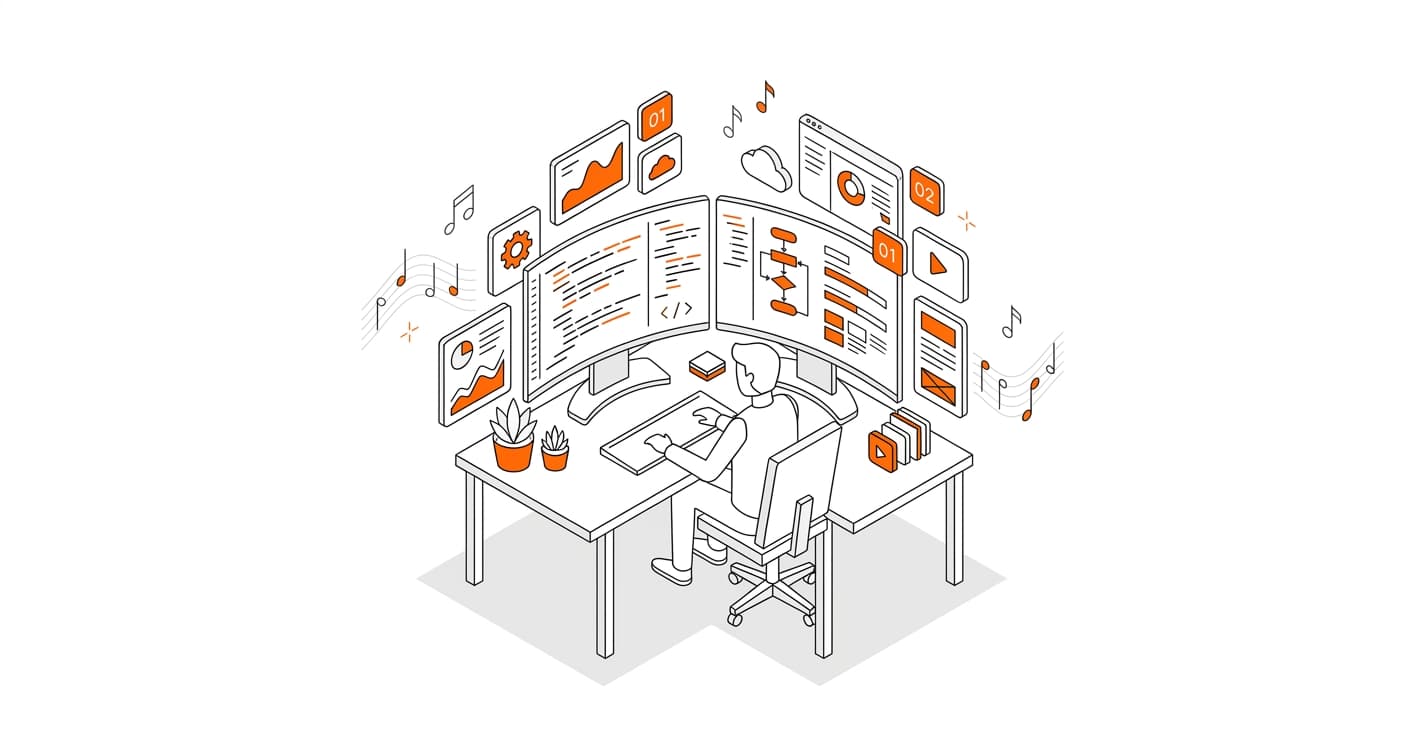
Just a few years ago, creating a functional web application or piece of software required years of training, a deep mastery of complex programming languages, and often an entire team of developers. In 2026, that reality has changed radically. Vibe Coding — or intent-driven development — is completely redefining the way software is built, enabling anyone to turn an idea into a working product simply by having a conversation with an artificial intelligence.
The term was introduced by Andrej Karpathy in February 2025. The computer scientist, co-founder of OpenAI and former AI lead at Tesla, described his approach as conversational — using natural language commands while the AI generates the corresponding functional code. Within a few months, what had been an experimental concept became one of the most defining trends in the global technology industry.
Vibe coding is a software development practice that makes building applications more accessible, particularly for people with limited programming experience. It marks the end of an era in which software development required years of technical training, transforming millions of people with no coding background into creators capable of designing and launching applications in a matter of seconds.
The numbers illustrate the scale of the phenomenon. In 2026, Google searches for « Vibe Coding » increased by 2,400% and the global market is estimated at $4.7 billion. Cursor surpassed $2 billion in annualized revenue in March 2026, and Lovable reached $400 million in ARR with only 146 employees. These staggering figures bear witness to a profound paradigm shift in the world of software development.
In this article, we explain precisely what Vibe Coding is, how it works in practice, which are the best tools available in 2026, and above all, its real limitations that many people forget to mention.
Full Definition: How Does Vibe Coding Work?
Vibe Coding is a software development method in which the user describes what they want to build in natural language — as if explaining their idea to a collaborator — and lets an artificial intelligence generate the corresponding functional code. Vibe Coding is a natural-language-driven, AI-assisted workflow where you describe objectives and iteratively guide AI agents, rather than writing every line of code yourself. It is a fundamental paradigm shift: the developer no longer types code character by character — they orchestrate, direct, and validate.
To understand concretely how Vibe Coding works, imagine this scenario. You want to build a task management application. Instead of opening a code editor and writing hundreds of lines of JavaScript, React, or Python, you open a Vibe Coding tool and simply type: « Create a web-based task management app with an authentication system, the ability to add tasks by category, and a dashboard displaying priority tasks. » The AI then generates the entire front-end, back-end, and database code in seconds. You review the result, refine through dialogue — « Add a clearer error message, » « Make the interface more minimal and clean » — and iterate until you reach the desired product.
With traditional programming, you focus on implementation details by manually writing the specific commands, keywords, and punctuation a language requires. Vibe coding lets you focus on the desired outcome. You describe your goal in plain language — for example, « create a user login form » — and the AI handles the code.
There are in reality two levels of Vibe Coding application, corresponding to very different profiles and objectives. « Pure » vibe coding is the most exploratory form — a user fully trusts the AI-generated output, assuming it works as intended. As formulated by Karpathy, this amounts to « abstracting away the code, » which is perfectly suited to rapid ideation or « throwaway weekend projects » where speed is the primary goal. Responsible AI-assisted development is the practical, professional application of the concept — the user guides the AI, then reviews, tests, and understands the code it generates, taking full ownership of the final product.
This conversational cycle is at the heart of how Vibe Coding works. Instead of writing every line by hand from the start, the developer formulates an intent — « Build me a React authentication page with validation, error handling, and a clean design. » The tool then proposes a first version. The developer then refines: « Add a clearer error message, separate the form component, write the tests, and replace local state with React Hook Form. » The cycle becomes conversational. You no longer code solely character by character — you orchestrate, correct, and validate a stream of proposals.
What makes Vibe Coding possible in 2026 — and what was not yet the case two years ago — comes down to three major technological developments. Model reasoning is the first factor: models like Gemini or GPT-5 no longer simply predict the next word — they understand complex logical dependencies, making it possible to create entire applications without major compilation errors. Context unification is the second factor: tools like Cursor or Windsurf can read codebases of 100,000 files instantly. The third factor is the democratization of interfaces — platforms like Lovable, Bolt.new, and Replit have made these capabilities accessible to non-technical profiles, with no complex installation or prior configuration required.
An important distinction deserves to be highlighted to avoid any confusion. The key difference from no-code is that vibe coding generates real source code — React, TypeScript — that is exportable and maintainable by any developer. Unlike traditional no-code tools that produce proprietary configurations that are difficult to evolve, Vibe Coding generates real code, which gives it a flexibility and portability that no-code solutions cannot offer.
The Best Vibe Coding Tools in 2026
The Vibe Coding tools ecosystem has experienced explosive growth in 2026, with dozens of platforms competing for the attention of developers, entrepreneurs, and non-technical creators. Here are the essential tools to know, organized by use case profile.
Claude Code: The Best Tool for Professional Developers
Claude Code and Windsurf round out the landscape for advanced use cases. Developed by Anthropic, Claude Code has established itself in 2026 as the most powerful Vibe Coding tool for professional developers and technical teams. Its primary strength lies in its ability to reason across entire codebases — not just isolated files. Claude Code understands the overall architecture of a project, anticipates the side effects of each change, and produces code of remarkable quality and consistency. Accessible directly from the terminal via a command-line interface, it integrates naturally into existing development workflows — Git, CI/CD, automated testing. Using Claude Code with the Claude Sonnet 4 model, a simple natural language request automatically generates the corresponding code files and configuration files. For teams that need reliability, control, and superior technical depth, Claude Code is the reference choice in 2026.
Cursor: The AI-Augmented IDE Favored by Developers
Cursor surpassed $2 billion in annualized revenue in March 2026, doubling its revenue in just three months. The company is valued at $29.3 billion and the platform processes more than one billion lines of code daily. Cursor is a VS Code-based code editor in which AI is natively integrated at every level of the experience. It can read an entire codebase, suggest contextual changes, and generate complete features from a simple description. Cursor is reserved for experienced developers who want to retain full control over their code while benefiting from high-level AI assistance. It is the preferred tool for professional development teams who want to multiply their productivity without abandoning their code quality practices.
Lovable: The Best Tool for Non-Developers
Lovable represents the most astonishing case study of the vibe coding boom. Launched in 2024, this Stockholm-based startup reached $100 million in ARR in eight months — an absolute record in the history of B2B software. By March 2026, ARR had reached $400 million. Lovable allows anyone — with no programming knowledge whatsoever — to create a complete web application from a natural language description. The platform automatically handles the back-end via Supabase, one-click deployment, and the entire technical infrastructure. Lovable is the best choice for non-technical SMBs: automatic backend, one-click deployment, starting from €25 per month. It is the ideal tool for entrepreneurs, product managers, and teams who want to validate an idea quickly without hiring a developer.
Bolt.new: The Best Tool for Semi-Technical Profiles
Bolt.new, developed by StackBlitz, occupies a particularly relevant intermediate position in the Vibe Coding landscape. Bolt.new targets semi-technical profiles and offers direct access to the generated code, compatibility with multiple frameworks, and pricing starting at $25 per month. It enables the creation of web applications from a natural language description while giving access to the real source code — which sets it apart from purely no-code tools. Junior developers, technical designers, and freelancers who want to accelerate their output without losing control of their code will find a perfect balance between accessibility and flexibility.
Replit: The Best Tool for Collaborative Prototyping
Replit has just raised $400 million at a $9 billion valuation, reflecting the massive enthusiasm for AI-assisted development tools. Replit offers a complete, browser-based development environment — no installation required — with an integrated AI capable of generating, correcting, and deploying code in real time. Its particular strength is collaboration: multiple users can work simultaneously on the same project, making it an ideal tool for hackathons, distributed teams, and educational projects. In 2026, Replit is among the tools that allow entrepreneurs and developers to transform an idea into a finished product through simple natural dialogue.
Windsurf: The Rising Alternative to Cursor
Windsurf, developed by Codeium, is the serious alternative to Cursor for professional developers seeking an advanced Vibe Coding experience within an augmented IDE. Its flagship feature is the ability to maintain long context across an entire project — enabling it to understand interdependencies between files and produce consistent changes at the scale of a whole application. In 2026, teams are gravitating toward managed backends that AI tools understand well, and Windsurf integrates naturally with these modern architectures to reduce context overhead and infrastructure overhead. For developers working on complex projects who want an open alternative to the Cursor ecosystem, Windsurf is a top-tier choice.