
Scoping and MVP creation
We define the audience, subscription model and essential journeys for a useful first release.
Our SaaS development agency builds custom software: MVPs, B2B platforms and product rebuilds. We scope journeys, subscriptions and integrations before development.
Three questions to prepare a useful conversation.
Question 1/3
From idea to live product, we build the functions your users need.
We define the audience, subscription model and essential journeys for a useful first release.
Sign-up, roles, onboarding, dashboards and administration: every screen serves a clear use.
We connect your SaaS to the APIs, CRM or ERP it needs and choose appropriate customer data isolation.
Product audits, security, production launch and maintenance: we prioritize changes with your team.
Your SaaS project
Tell us about your users, business model and open questions. We will scope the next useful deliverable with you.
Turn expertise into a product: provide a shared service to several customers without manually rebuilding every delivery
Launch a B2B offer: test and then equip users, administrators and support teams with distinct roles
Take over an existing SaaS: document weak points, prioritize remediation and prepare changes without claiming the rebuild will be invisible
Industrialize an operation: connect onboarding, permissions, data, subscriptions, integrations and operations in a maintainable product
User journeys, roles, integrations, exclusions and acceptance conditions are tied to verifiable deliverables before development begins.
The estimate separates scoping, development, third-party services, operations and approval dependencies; it does not force every SaaS project into the same timeline.
The proposal states which code, environments, credentials and documentation will be handed over, and which components remain external services.
Monitoring, backups, maintenance, any on-call coverage, reversibility and post-launch responsibilities are clarified before production.
A real project
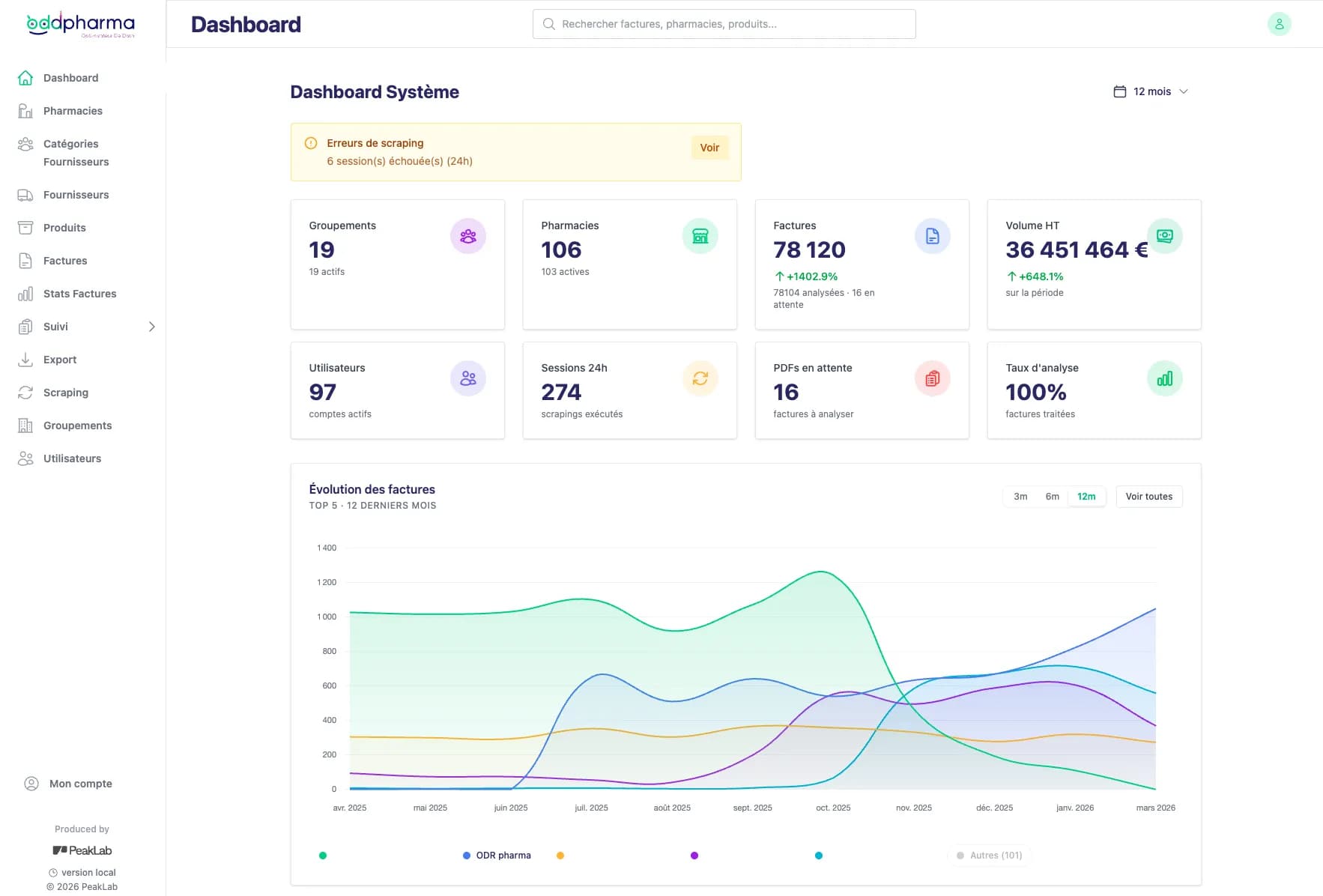
See how ODD Pharma structured data collection, dashboards and reports in its white-label platform.
Case study · ODD Pharma
PeakLab built a white-label platform for ODD Pharma that collects data, presents it in a dashboard and generates reports for its customers.
This case describes a delivered scope; outcomes for another project depend on its users and context.
We clarify users, the service model, budget and MVP priorities.
We define journeys, roles, data and integrations before building.
We deliver in stages and test key functions with your team.
We prepare deployment, documentation and the next maintenance decisions.
Evolve your SaaS
A first conversation to clarify users, constraints, risks and the next useful decision. No commitment.
Budget, timing, integrations, growth, architecture, security and handover: decisions to clarify before development.
If an existing product covers the essential journeys at an acceptable cost and with acceptable constraints, replacing it is not automatically worthwhile. Custom development becomes more relevant when a differentiating process, roles, data, integrations or service model cannot be handled properly otherwise. Scoping compares existing software, automation, an internal application and SaaS before recommending a build.
A SaaS product is operated over time for several organizations or customer groups. A business application primarily supports internal processes. An MVP or POC reduces a defined uncertainty. An MVP may become a SaaS product, but that transition requires architecture, operations, support and security to be reassessed from observed usage.
Budget depends on the number of journeys and roles, integrations, data migration, customer isolation, security requirements, availability targets and operating model. The proposal separates scoping, design, development, third-party services and recurring costs so equivalent scopes can be compared. A headline price without these assumptions would be misleading.
The schedule depends on how much is already defined, the scope, approvals, data migration, external dependencies, acceptance and operating requirements. After scoping, we tie each stage to deliverables, dependencies and acceptance criteria. We do not promise a universal timeline or a commercial launch date before those elements have been reviewed.
No. A shared application with logical data isolation may suit some products, while other contexts require stronger separation. The decision depends on users, volumes, data, risks, service commitments and integration constraints. We document the decision and known limits instead of automatically equating SaaS with multi-tenancy.
Security is addressed throughout the development lifecycle: access, secrets, dependencies, reviews, critical tests, backups, restoration, logs and incident response. On April 21, 2026, ANSSI published a study on integrating security into the software lifecycle and CI/CD pipelines. These are recommendations to adapt to risk, not an automatic certification of the product.
We identify exportable data, formats, access, documentation, external services and the work required for handover. The EU Data Act has applied since September 12, 2025 and governs provider switching for relevant services. Its scope and applicable duties must be assessed for the offer; exporting data does not mean transferring protected components that were not included in the agreement.
No. The French consumer protection authority explains that certain categories of consumer services have been subject to accessibility requirements since June 28, 2025, with scope and exemptions to assess. We include accessibility in design decisions; legal qualification depends on the service, its users and the company.
The proposal specifies the repository, rights, access, documentation and third-party components. PeakLab can provide maintenance or prepare an internal handover or transfer to another team. Service levels, response times, hosting responsibilities and recurring costs are defined in the agreement; they are not assumed to be identical for every project.
Yes, when those tools offer APIs, webhooks or another suitable means of exchange. Scoping establishes which data flows in each direction, how often and under which permissions. We also check third-party limits, error handling and integration costs before including them in the project scope.
We define the events that represent actual use with your team: sign-up, activation, returning users, feature use and support requests. Depending on the subscription model, tracking can also connect MRR, churn, customer acquisition cost (CAC) and customer lifetime value (LTV). These indicators guide the next SaaS improvements; their evolution also depends on the offer, acquisition channels and commercial strategy.
Copyright © PeakLab 2026. All rights reserved.