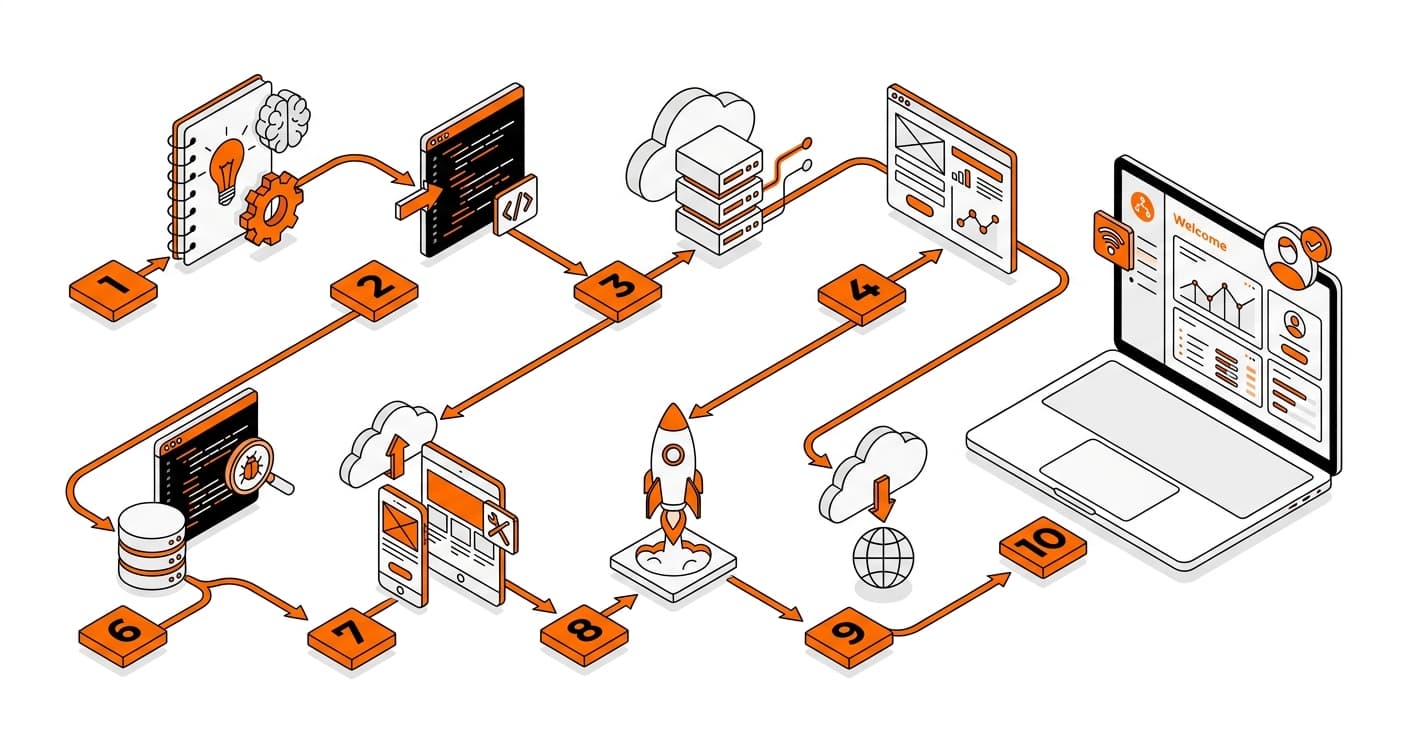
SaaS, or Software as a Service, has become one of the most attractive business models in digital entrepreneurship. A software product accessible online via subscription, with no installation, no client-side maintenance, infinitely scalable and generating predictable recurring revenue. Giants like Salesforce, Slack, Notion and Figma have built multi-billion-dollar valuations on this model. And every year, hundreds of independent founders launch profitable micro-SaaS products from their laptops with small teams and modest initial budgets.
Yet building a SaaS from scratch is a project that demands far more than a good idea and development skills. It is a structured process that simultaneously covers problem validation, product design, technical development, pricing strategy, acquiring the first customers, managing user feedback and laying the foundations for sustainable growth. Skipping a step or tackling them in the wrong order is one of the most common reasons SaaS projects fail before ever reaching their first paying customer.
The good news is that the path to building a successful SaaS in 2026 is better mapped than ever. The methods, tools and resources available allow a solo founder or a small team to validate an idea, build a product and acquire paying customers within a few months on a reasonable initial budget. No-code tools like Bubble or Webflow make it possible to build MVPs without writing a single line of code. Platforms like Stripe simplify subscription management. And organic acquisition strategies via SEO or content marketing enable growth without relying solely on paid advertising.
Step 1: Identify and validate a real problem to solve
The first step in building a SaaS is also the most fundamental and the most frequently rushed. The vast majority of SaaS products that fail do not fail because the product is poorly built or poorly marketed. They fail because they address a problem customers do not have, or a problem they are not willing to pay to solve. Identifying and validating a real problem before writing a single line of code is the most important decision you will make throughout the entire journey of building your SaaS.
The first classic mistake is starting from a feature idea rather than a problem. Many founders arrive with a precise vision of what they want to build — a project management tool with features X, Y and Z — without having first verified whether their target users actually feel the pain that product is supposed to solve. This product-first approach is risky because it confuses the solution with the problem and often leads to building a product nobody truly needs.
The right approach is the problem-first approach. It begins with observation and listening rather than design. Identify an industry or an audience you know well — ideally a domain in which you have worked yourself or whose challenges you understand in depth. Your own professional frustrations are often the best sources of SaaS ideas, because they tell you that a problem exists, that it is painful and that a solution would be welcome.
The most effective tool for validating a problem is the qualitative interview. Before thinking about the product, conduct between fifteen and twenty in-depth interviews with people belonging to your target audience. These interviews should not pitch your idea but explore the difficulties, frustrations and current workflows of your interviewees. The most revealing questions are: what is the hardest part of your work in this area? What tools do you use today and what frustrates you about them? Have you ever looked for a solution to this problem and what did you find? How much does managing this problem currently cost you in time or money?
These interviews generate invaluable insights that no market intelligence tool or market analysis can replicate. They allow you to understand not only whether the problem exists but also how the people affected experience it, what alternative solutions they already use and how much they would be willing to pay for a better solution. This last point is critical, because a real problem that nobody would pay to solve is not a viable SaaS opportunity.
Validation also involves an analysis of existing competition. If competitors exist in your target market, that is excellent news. It confirms that a market exists and that customers are willing to pay for this type of solution. Analyse their customer reviews on platforms like G2, Capterra or Trustpilot to identify recurring user frustrations, missing features and possible angles of differentiation. The negative reviews of your future competitors are your best source of inspiration for building a product that genuinely solves the problems existing solutions fail to address.
A problem is sufficiently validated to justify building a SaaS when three conditions are met. The problem is frequent — it regularly and systematically affects enough people to constitute an addressable market. It is painful — the people affected feel genuine frustration and are actively looking for a solution. And it is monetisable — the people affected have a budget or are willing to pay for a solution that would resolve this problem effectively and reliably.
Step 2: Define your ideal customer and your value proposition
Once the problem is validated, the second step is to define precisely who you are going to help and what you are going to promise them. These two definitions — the ideal customer and the value proposition — are the foundations of every decision you will make going forward. Your product roadmap, your pricing strategy, your acquisition channels and your commercial messaging all depend directly on the clarity of these two elements.
Defining your ideal customer
The ideal customer of a SaaS, often called the ICP or Ideal Customer Profile, is the precise profile of the customer who derives the most value from your product, has the highest propensity to pay and generates the least friction in the sales and onboarding cycle. Defining this ICP with precision is one of the most impactful decisions you can make at the start of your SaaS project.
The natural temptation is to want to address everyone. The broader the audience, the larger the potential market seems. This is a misleading line of reasoning that leads to building a generalist product that truly satisfies nobody. SaaS products that succeed are almost always those that started with a very specific market segment and gradually broadened their audience once their position was consolidated in that initial segment.
Your ICP must be defined across several complementary dimensions. The industry and size of the target company. The role and responsibilities of the decision-making user within that company. Their priority professional goals and the metrics by which they are evaluated. Their daily frustrations related to the problem you are solving. Their level of digital maturity and familiarity with SaaS tools. And finally their available budget and their purchasing decision process. The more precise your ICP, the more effective your product, your messaging and your acquisition efforts will be.
Building your value proposition
The value proposition is the central promise you make to your ideal customer. It answers in one or two sentences the fundamental question: why your SaaS rather than another existing solution? An effective value proposition must be clear, specific, memorable and differentiating. It does not describe what your product does on a functional level. It expresses what your customer concretely gains by using it.
A strong value proposition is built on the following formula: we help X achieve Y without Z. X is your precisely defined ideal customer. Y is the concrete, measurable benefit they obtain. Z is the main constraint or pain point you allow them to avoid. This structure forces you to go beyond functional description to express the real value delivered.
Differentiation is the other essential dimension of your value proposition. In an increasingly competitive SaaS market, being different is as important as being good. Your differentiation can rest on several dimensions. Vertical specialisation in a specific sector where you bring expertise that generalist solutions cannot match. Simplicity of use compared to complex, feature-bloated competitors. Native integration with tools specific to your target audience. A more accessible or more predictable pricing model than the alternatives. Or a radically different approach to the problem that delivers superior results.
Your value proposition must be tested with your target audience before being set in stone. Share it with the people you interviewed during validation and observe their reaction. A value proposition that resonates generates an immediate recognition response — a « that’s exactly what I need » that confirms you have correctly identified and articulated the value you deliver.
Step 3: Build your SaaS MVP
The third step is the one most founders look forward to and approach with the most energy. Building the product. But before diving into development, a fundamental question deserves to be asked honestly: do you need to write code to validate your SaaS? The answer, in many cases, is no. And this reality can save you several months of development and thousands of euros in initial budget.
Start as simply as possible
The MVP of a SaaS is not necessarily a complete web application with a sophisticated technical architecture. It is the simplest possible version of your product that allows a first group of users to solve their problem and give you real feedback on their experience. Depending on the nature of your SaaS, your MVP can take very different forms.
A Concierge MVP involves manually delivering the service your SaaS will later automate. If your product is meant to automate report generation for marketing agencies, start by producing those reports manually for five clients. This approach lets you validate the value delivered, understand precisely what clients expect and refine your product before investing in developing the automation. It is time-consuming, but it is the safest way to build the right product from the outset.
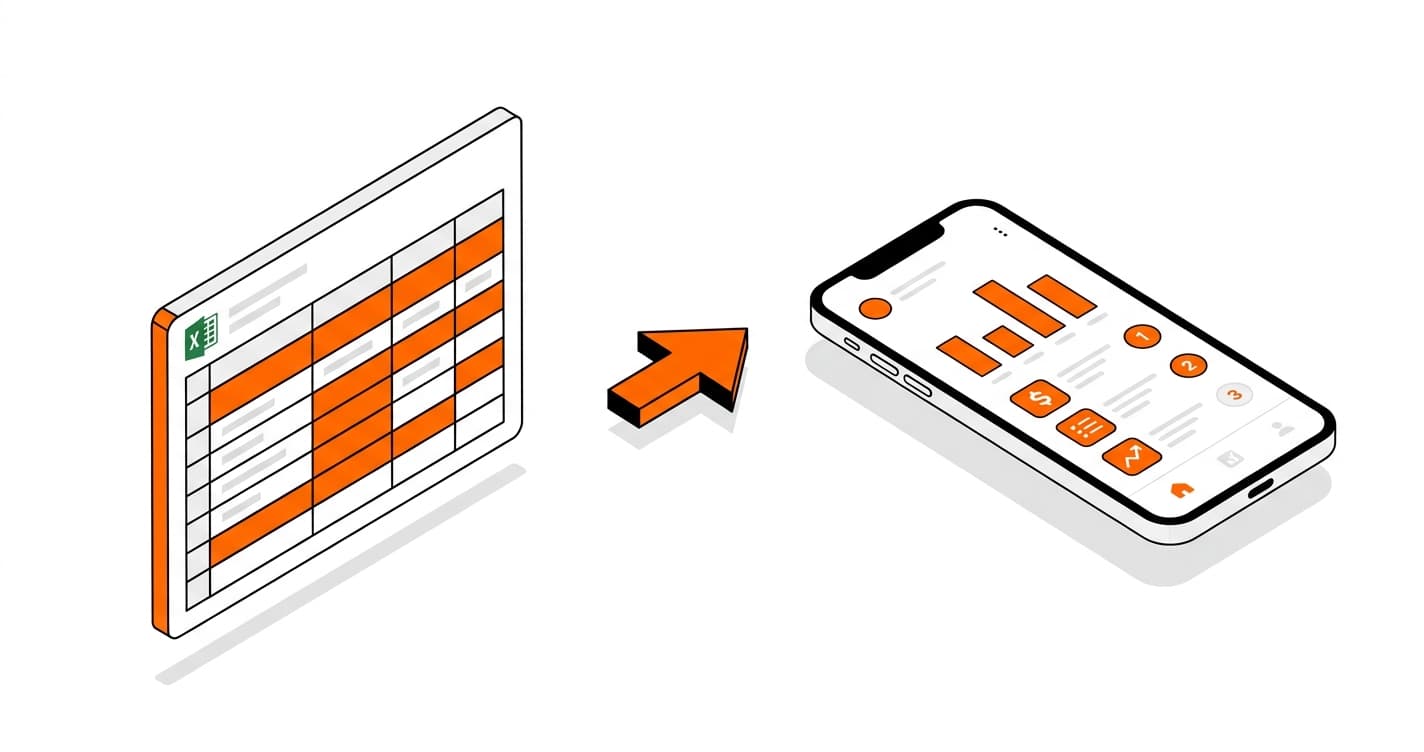
A no-code MVP uses tools like Bubble, Webflow, Glide or Softr to build a functional interface without writing a single line of code. These platforms allow you to create complete web applications with authentication, databases, user interfaces and integrations in a matter of weeks rather than months. For many SaaS products, a no-code MVP is perfectly sufficient to acquire the first paying customers and validate the model before investing in a more robust technical architecture.
Define the MVP scope with discipline
If you choose to develop your MVP with code, discipline in defining the scope is absolutely critical. The temptation to add features is constant and dangerous. Every additional feature extends timelines, increases complexity and delays the moment when you will receive real feedback from real users.
To define the scope of your MVP, list all the features you are considering and subject each one to two blunt questions. Is this feature strictly necessary for a user to be able to solve their problem with my product? And is it necessary to test my critical hypotheses? If the answer to either of these questions is no, the feature is excluded from the MVP. Everything else can wait for the next version.
Choose the right tech stack
If you are developing your MVP with code, the choice of tech stack should be guided by development speed and the skills available in your team, rather than by performance considerations at a scale your MVP will not yet reach. A Next.js application with a PostgreSQL database hosted on Vercel, a Ruby on Rails application or a Django application are all perfectly suitable choices for a SaaS MVP that needs to be launched quickly. Do not over-engineer your technical architecture from the start. Scalability problems are good problems to have, and they generally arise much later than you expect.
Integrate Stripe from the MVP
A common mistake is to defer the integration of the payment system. Integrating Stripe from the MVP is essential for two reasons. First, because willingness to pay is the most reliable validation indicator that exists. A user who takes out their credit card confirms perceived value far more clearly than any qualitative feedback. Second, because building a robust payment system takes time, and deferring it creates unnecessary friction in your monetisation process at the very moment you will need it most.
Step 4: Acquire your first paying customers
Acquiring the first paying customers is the step that separates a side project from a real SaaS. It is also the one most founders dread the most and approach with the least method. Yet the first ten customers of a SaaS are not acquired through sophisticated advertising campaigns or well-optimised SEO. They are acquired with a single resource: your network and your ability to sell directly.
The first rule of early customers is not to wait for the product to be perfect before starting to sell. A functional MVP that genuinely solves your ideal customer’s problem is more than sufficient to close your first sales. Perfection is the enemy of revenue in the first weeks of a SaaS. Your first customers are not waiting for a finished product. They are waiting for a solution to their problem and a responsive team to support them.
The most effective method for early customers is direct outreach. Identify within your LinkedIn network, among your former professional contacts or in your circle the profiles that match your ICP exactly. Send them a personal, non-automated message that describes the problem you solve and proposes a fifteen-minute discovery call. This message must be short, precise and centred on their problem rather than on your product. The ideal opening line mentions a context specific to their situation that proves you know them and that your message is not generic.
The response rate to truly personalised outreach is significantly higher than that of a mass message. Ten ultra-personalised messages sent to profiles perfectly aligned with your ICP generate more paying customers than a hundred generic messages sent to an unqualified list. This discipline of precise targeting is fundamental in the first weeks of acquisition.
Online communities are a second acquisition source that is particularly effective for the first customers of a SaaS. Slack communities, Facebook groups, Reddit forums, Discord communities and sector-specific LinkedIn groups bring together precisely the profiles of your ICP in spaces where they are actively looking for solutions to their problems. Participating authentically in these communities by adding value before talking about your product is the best way to build credibility that facilitates acquisition. Answering questions, sharing useful resources and demonstrating your expertise naturally positions you as a reference in your field even before your product is widely known.
Product Hunt and other product discovery platforms such as BetaList or Hacker News can generate a spike in traffic and sign-ups at the time of your MVP launch. A well-prepared launch on Product Hunt with a polished page, a clear demo video and mobilisation of your network to generate votes can bring in several hundred sign-ups in a single day. These platforms are particularly effective for SaaS products targeting a tech and startup audience.
The question of pricing for early customers deserves particular attention. Many founders underprice their product out of fear of rejection or lack of confidence in the value delivered. This mistake is costly on two counts. It reduces your initial revenue and creates a pricing precedent that is difficult to correct later. Charge your first customers at the price you intend for the market. If your product genuinely solves their problem, they will pay. And if some refuse because of the price, that information is valuable for calibrating your pricing positioning.
Finally, every early customer deserves a manual, personalised onboarding. Call them, guide them through the product, gather their feedback and treat their issues as an absolute priority. These first customers are your most valuable collaborators in building the right product. Their satisfaction is your best commercial argument for the customers that follow.
Step 5: Build an effective pricing strategy
Pricing is one of the most impactful and least well-mastered decisions in building a SaaS. A pricing mistake can kill a SaaS that everything else had built well. Pricing too low signals a lack of confidence in your value, attracts poorly qualified customers and undermines your economics. Pricing too high without clearly perceived value creates a barrier to entry that slows your growth. Finding the right balance is an iterative exercise that begins with the first customers and evolves with the maturity of your product.
The pricing models available for a SaaS
The first choice to make is that of the pricing model. SaaS has several proven models whose selection depends on the nature of your product, your audience and your growth strategy.
Freemium is the best-known model. It consists of offering a free version with limited features and proposing one or more paid plans to access advanced functionality. Its main advantage is the reduction of the barrier to entry, which facilitates acquisition and virality. Its major drawback is that the vast majority of freemium users never convert to a paid plan, which can create significant infrastructure and support costs without proportional revenue. Freemium works well for SaaS products with strong natural virality and low organic acquisition costs, such as collaborative tools or individual productivity tools.
The flat-rate subscription model offers one or more monthly or annual plans at a fixed price based on the level of features or the number of users. It is the simplest model for the customer to understand and for the founder to manage. It generates predictable recurring revenue and facilitates financial planning. Annual plans with a discount are particularly attractive because they improve cash flow and reduce churn by committing the customer for a longer period.
Usage-based pricing charges the customer based on their actual consumption of the product — number of API calls, volume of data processed, number of emails sent. This model is particularly suited to infrastructure SaaS products and tools whose delivered value is directly proportional to usage. Its advantage is that it perfectly aligns perceived value with the price paid. Its drawback is the unpredictability of monthly revenue, which complicates financial management.
How to set the right price level
The most effective method for setting your prices is that of value delivered rather than production costs. SaaS pricing is not calculated from your development and hosting costs. It is calculated from the economic value your product creates for your customer. If your SaaS allows a company to save 10,000 euros per month by automating manual tasks, a subscription of 500 euros per month represents an ROI of 20 to 1 that is easily justifiable.
A practical tool for calibrating your pricing is the Van Westendorp test, a simple method that involves asking your target audience four questions. At what price would this product seem too expensive for you to buy? At what price would this product seem so cheap that you would doubt its quality? At what price would this product seem a little expensive but that you would still consider buying? And at what price would this product seem like a very good deal? The answers define an acceptable price range and an optimal price point for your target market.
Finally, never forget that pricing is not a definitive decision. The best-performing SaaS products regularly adjust their pricing based on the value delivered, the maturity of the product and market signals. Raising prices as the product improves is not only legitimate but often necessary to sustain growth and fund ongoing development.
Step 6: Build a scalable acquisition strategy
Once your first paying customers have been acquired through direct outreach and your personal network, the time comes to build an acquisition strategy that can work at scale without you having to manually contact every prospect. This is the transition from survival mode to growth mode, and it requires strategic thinking about the acquisition channels best suited to your SaaS, your target audience and your available resources.
The first question to ask before choosing your acquisition channels is that of the tolerable CAC — the maximum customer acquisition cost your economics can sustain. This figure is calculated by dividing your average LTV — the lifetime value of a customer over their entire subscription period — by a reasonable ratio. An LTV to CAC ratio of 3 is generally considered the minimum viable for a healthy SaaS. If your average LTV is 1,200 euros, your maximum tolerable CAC is 400 euros. This economic framework is the compass that guides your choice of acquisition channels and your marketing investment decisions.
SEO and content marketing constitute the most powerful and most durable organic acquisition channel for SaaS products in 2026. By creating quality content that answers the questions your ideal customers are asking even before they search for a solution like yours, you generate qualified traffic with purchase intent at no marginal cost per visit. A well-ranked article on Google can generate qualified leads for years after its publication. This durability is the major competitive advantage of SEO over all paid channels. The trade-off is the patience required. SEO takes between six and twelve months to produce significant results, which means starting early and maintaining a consistent editorial effort over time.
Paid advertising via Google Ads and Meta Ads offers a faster but more expensive alternative for generating qualified leads. Google Ads on high purchase-intent keywords — such as comparative queries between your product category and your competitors — can generate highly qualified leads with short conversion timelines. Meta Ads is better suited to SaaS products whose audience is clearly identifiable through demographic and behavioural criteria. Paid advertising is particularly useful for quickly testing messages and acquisition angles before investing heavily in slower organic channels.
LinkedIn content marketing is a particularly powerful acquisition channel for B2B SaaS products. Regularly sharing insights, data, experience reports and learnings related to your area of expertise allows you to build a qualified and engaged audience among the decision-makers in your target market. The founder’s personal brand is often the most cost-effective acquisition channel in terms of cost and lead quality during the early growth phases of a B2B SaaS.
Product-led growth is an acquisition model particularly suited to SaaS products whose product itself can become a growth driver. By integrating natural viral mechanisms into the product — team invitations, result sharing, public pages generated by users — you turn your existing customers into ambassadors who naturally recruit new users without additional marketing effort. Notion, Figma, Calendly and Slack have all built a significant share of their growth on this model.
Partnerships and integrations are an often underestimated but particularly effective acquisition channel for SaaS products targeting users who are already equipped with other tools. Being listed in the app marketplaces of Shopify, HubSpot, Salesforce or Monday.com gives you access to millions of qualified users who are actively looking for solutions that complement their existing tools. These partnerships can generate a significant volume of qualified leads at very low marginal cost once the integration has been developed and certified.
Step 7: Reduce churn and maximise retention
In a SaaS, retention is the most powerful and most underestimated growth lever. Acquiring new customers costs on average five to seven times more than retaining existing ones. And a SaaS with high churn resembles a leaky bucket: no matter how much water you pour in, it never really fills up. Reducing churn is therefore a strategic priority as important as acquisition, if not more so.
Churn refers to the monthly or annual cancellation rate of your customers. A monthly churn of 5% may seem low, but it means you are losing 60% of your customer base in a year. A monthly churn of 1% is a healthy SaaS that can grow sustainably. This difference illustrates just how significantly a few churn percentage points impact the long-term trajectory of your SaaS.
The first cause of churn is onboarding failure. If a customer does not quickly understand how your product solves their problem and does not see value within the first hours or days of use, they will cancel before they have truly tested the product. Investing in structured onboarding, progressive welcome emails, in-app tutorials and personalised support for early customers is the most impactful action for reducing churn in the initial phase.
The second cause is lack of engagement. A customer who does not regularly use your product is a customer on the verge of cancelling. Monitoring warning signals such as absence of login for several days, non-use of key features or a reduction in usage frequency allows you to intervene proactively before the customer decides to leave. A personalised re-engagement email or a proactive call from your customer success team at the right moment can save a subscription that seemed lost.
The third retention lever is ongoing value. A customer stays subscribed as long as the perceived value of your product exceeds its monthly cost. Communicating regularly about new features, improvements made and results that other customers are achieving with your product keeps perceived value high and reinforces the customer’s sense of investment in your product.
Finally, annual contracts are a powerful mechanical lever for reducing churn. A customer who commits to a year is statistically twelve times less likely to cancel immediately than a monthly customer. Incentivising your customers to switch to annual billing through an attractive discount is one of the most profitable actions you can take with your existing base.
Step 8: Measure the right SaaS metrics
A SaaS that does not measure the right metrics is flying blind. Data is the nervous system of a high-performing SaaS. It allows you to quickly identify what is working, what is not and where to focus efforts to maximise growth. But not all metrics are equal, and the temptation to track dozens of indicators simultaneously often leads to analytical paralysis rather than informed decisions.
The central metric of a SaaS is MRR, or Monthly Recurring Revenue. It is the figure that summarises the financial health of your SaaS in a single indicator. It breaks down into several complementary components that reveal the growth dynamic with precision. New MRR generated by new customers acquired in the month. Expansion MRR generated by upgrades from existing customers. Churned MRR lost due to cancellations. And Net New MRR, which is the algebraic sum of these three components and represents the actual net growth for the month.
The churn rate is the second fundamental metric. Distinguish customer churn — the percentage of customers who cancel — from revenue churn — the percentage of revenue lost. Revenue churn is often more revealing because it accounts for the value of the customers lost. A customer churn of 5% can mask a revenue churn of 15% if it is your largest customers who are leaving.
LTV and CAC form the most important pair of metrics for evaluating the economic viability of your SaaS. LTV, or Lifetime Value, represents the total revenue generated by a customer over their entire subscription period. CAC, or Customer Acquisition Cost, represents the total cost of acquiring a new customer. The LTV to CAC ratio must be greater than 3 to indicate a healthy business model. Below 3, you are spending too much to acquire customers whose value does not justify the investment.
NPS, or Net Promoter Score, measures the satisfaction and propensity of your customers to recommend your product. A high NPS above 50 indicates a satisfied customer base that constitutes a natural growth engine through word of mouth. A low NPS is a warning signal indicating product or customer experience issues that must be addressed as a priority before scaling acquisition.
Finally, time to value — the time it takes a new customer to perceive the value of your product for the first time — is the most predictive metric of long-term retention. The shorter this delay, the higher your retention rate will be.
Step 9: Scale your SaaS
Scaling a SaaS means multiplying your revenue without proportionally multiplying your costs. This is the fundamental promise of the SaaS model and what distinguishes it from other business models. But scaling prematurely — before you have validated your product-market fit and stabilised your retention — is one of the most costly mistakes you can make. Scaling amplifies what already exists. If your product has a churn or onboarding problem, scaling acquisition will only make those problems worse at a larger scale.
The signal that you are ready to scale is the achievement of product-market fit. This concept, which is difficult to define precisely, manifests through several converging indicators. A monthly retention rate above 95%. An NPS above 40. Customers who return spontaneously after a break. Organic referrals without solicitation. And regular, deep use of your product’s key features by the majority of your active customers.
The first dimension of scaling is acquisition scaling. Once your acquisition channels have been validated with your first customers, the goal is to progressively increase the budgets and resources allocated to the most profitable channels. Doubling your Google Ads budget on campaigns whose CAC is proven to be below your profitability threshold is a rational and predictable decision. Hiring a first growth marketer or content manager to accelerate your SEO is an investment whose return is measurable over twelve to eighteen months.
The second dimension is team scaling. Up to a certain MRR level, a SaaS can operate with a very small team or even solo. But beyond a certain threshold — generally around 20,000 to 30,000 euros in MRR — the first hires become necessary to simultaneously maintain the quality of the product, support and acquisition. The first recruits of a SaaS are the most important because they define the culture and standards of the organisation. Prioritise autonomous, versatile profiles capable of building processes rather than simply executing them.
The third dimension is technical scaling. What your technical architecture supports with ten customers may collapse with a thousand. Anticipating technical scalability issues before they arise is less costly than resolving them urgently in production. Performance monitoring, database optimisation, implementation of CDNs and caching architectures are technical investments that are ideally made ahead of high-growth phases.
Useful resources