In 2026, the price of an AI SaaS development typically ranges between €25,000 and €250,000, with lower budgets for a simple AI micro-SaaS and significantly higher amounts for complex, scalable, and highly customized platforms. This range may seem wide, but it is easily explained: an AI SaaS is not limited to a web interface with a few standard features. It also requires integrating an artificial intelligence layer, managing data, planning cloud infrastructure, securing the platform, and anticipating recurring costs.
Today, companies use AI in SaaS platforms to automate business tasks, personalize the customer experience, analyze large volumes of data, generate content, or predict certain outcomes. This potential creates a genuine competitive advantage, but it also involves technical and budgetary choices far more complex than those of a traditional SaaS.
The real cost of an AI SaaS development depends on many factors: type of AI integrated, level of customization, quality of available data, security requirements, regulatory compliance, and expected performance level. A tool based on a simple API integration of an existing model will obviously not carry the same cost as a platform with an LLM, RAG architecture, fine-tuning, advanced dashboard, and optimized cloud infrastructure.
In other words, the price does not cover development alone. It also includes project scoping, business auditing, UX/UI design, architecture decisions, AI model setup, testing, deployment, and often the first building blocks of maintenance. This is precisely why two AI SaaS projects can show such significant budget differences.
In this article, we will break down the true cost of an AI SaaS in 2026, the different cost components, the variations by project type, and the factors that can drive the budget up or, conversely, help optimize it. The goal is straightforward: to help you understand the why and the how, so you can avoid unpleasant surprises and estimate your project more realistically.
Why can the cost of an AI SaaS development vary so much from one project to another?
The cost of an AI SaaS development can range from one extreme to another, or even beyond. This significant variation is explained by a simple reality: every project is unique. Unlike conventional software, a SaaS integrating artificial intelligence relies on technical, strategic, and business parameters that directly influence the budget.
Understanding these factors is essential to avoid estimation errors and build a viable project with a strong return on investment (ROI).
The complexity of the integrated artificial intelligence
The first determining factor is the level of AI complexity. Not all AI SaaS solutions are created equal.
A project that simply uses APIs such as OpenAI, Claude, or Gemini will be faster and less expensive to develop. Conversely, a SaaS requiring a custom model, fine-tuning, or a RAG architecture will demand far more resources.
The more advanced the AI, the more it requires:
- development time
- specialized skills
- thorough testing
This is one of the main levers that can push a project from €30,000 to over €150,000.
Data management and data quality
An AI SaaS relies on one key element: data. Without reliable data, artificial intelligence cannot function properly.
Yet preparing data represents a cost that is often underestimated:
- collection
- cleaning
- structuring
- storage
In some projects, data management can account for 20 to 30% of the total budget. The more complex or voluminous the data, the higher the cost.
Technology choices and infrastructure
The choice of technical architecture has a strong impact on the budget. An AI SaaS typically requires a high-performance cloud infrastructure, often with GPU resources to run the models.
Several options exist:
- public cloud (AWS, Azure, Google Cloud)
- private infrastructure (on-premise)
- hybrid solutions
Each choice involves different costs, particularly in terms of:
- scalability
- maintenance
- consumption
A poor technical decision can double costs in the long run.
The human skills involved
An AI SaaS cannot be built by a single profile. It requires a multidisciplinary team:
- front-end and back-end developers
- data scientists
- AI engineers
- cloud experts
- cybersecurity specialists
The cost therefore depends on the number of profiles involved, their expertise, and their location. An experienced team in Western Europe will cost more, but will often deliver greater security and quality.
The level of project customization
A generic AI SaaS is always less expensive than a bespoke SaaS.
The more features you add, the higher the budget:
- custom dashboards
- CRM/ERP integrations
- external APIs
- complex automations
Each feature involves development, testing, and maintenance. This factor is often what transforms a standard project into a premium, high-value-added solution.
Security and compliance requirements
In certain sectors (healthcare, finance, HR), security requirements are high. This involves:
- GDPR compliance
- sensitive data management
- security audits
- advanced protection systems
These elements add an additional technical layer and can significantly increase the overall cost.
Scalability and long-term vision
An AI SaaS must be able to evolve. A platform that grows from 10 to 1,000 users must be capable of handling the load without issue.
This requires an architecture designed from the outset:
- microservices
- auto-scaling
- monitoring
- MLOps
Poor anticipation can lead to a complete project overhaul, which represents a major cost.
How much does an AI SaaS cost depending on the project type (micro-SaaS, B2B platform, complex solution)?
The cost of an AI SaaS depends heavily on the type of project you want to develop. In 2026, there is no single price, but rather several investment levels based on complexity, features, and business objectives.
To better understand, we can distinguish three main categories: the AI micro-SaaS, the B2B AI SaaS platform, and the complex, scalable AI solution.
The AI micro-SaaS: ideal for testing an idea quickly
The AI micro-SaaS is often the starting point for entrepreneurs or startups. The goal is simple: validate an idea quickly with a controlled budget.
This type of project is generally based on:
- one core feature
- an API integration (OpenAI, Claude, etc.)
- a simple interface
- few external integrations
Examples: SEO content generator, customer review analysis, automatic summarization tool.
The cost is relatively accessible, as complex AI model development is avoided. The bulk of the budget is focused on UX, the backend, and AI integration.
👉 Estimated budget: €25,000 to €60,000
👉 Timeline: 2 to 6 months
This is the ideal solution for testing a market before scaling.
The B2B AI SaaS platform: a growth lever
The second category covers business AI SaaS solutions aimed at companies. Here, the level of complexity and value steps up significantly.
These platforms generally include:
- a customized AI
- advanced dashboards
- business automations
- integrations with CRM, ERP, or internal tools
- multi-user management
Examples: customer scoring, HR automation, predictive sales analytics.
The budget increases because the project requires:
- more development
- better data management
- a more robust architecture
👉 Estimated budget: €80,000 to €175,000
👉 Timeline: 4 to 9 months
This type of AI SaaS often delivers a fast ROI, particularly through automation and reduced operational costs.
The complex AI SaaS solution: high performance and scalability
Finally, there are the most ambitious projects: complex AI SaaS platforms.
These solutions are generally aimed at demanding sectors such as:
- healthcare
- finance
- industry
- cybersecurity
They require:
- proprietary AI models
- training on specific data
- advanced cloud infrastructure
- strong security and compliance
- high scalability
The level of requirement is very high, both technically and from a regulatory standpoint.
👉 Estimated budget: €200,000 to €500,000+
👉 Timeline: 6 to 12 months (or more)
These projects represent a significant investment, but make it possible to create a lasting competitive advantage.
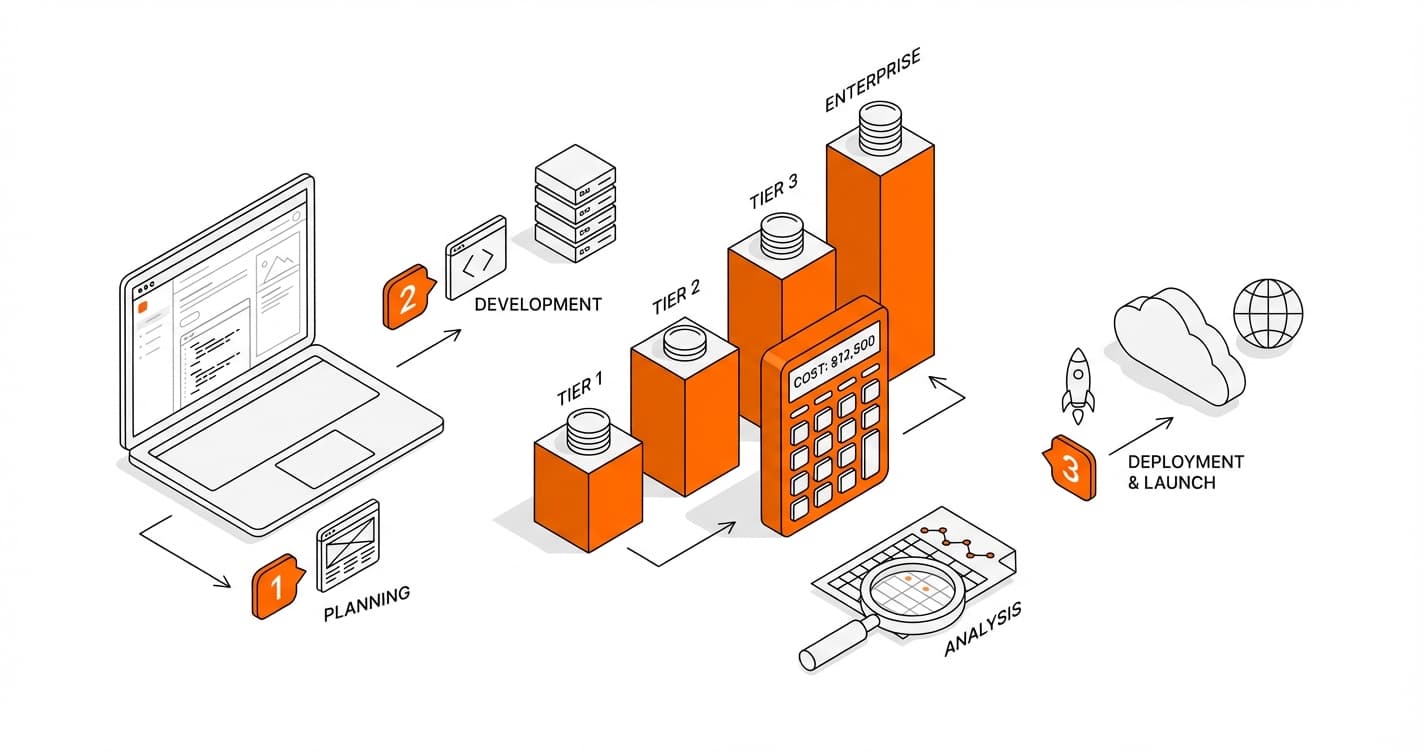
Summary table of AI SaaS costs
| AI SaaS Type | Estimated Budget | Complexity | Main Objective | Average Timeline |
|---|---|---|---|---|
| AI Micro-SaaS | €25,000 – €60,000 | Low | Test an idea / launch quickly | 2 to 6 months |
| B2B AI SaaS | €80,000 – €175,000 | Medium | Automate / scale a business | 4 to 9 months |
| Complex AI SaaS | €200,000 – €500,000+ | High | Build an advanced, scalable solution | 6 to 12 months |
In summary, the cost of an AI SaaS depends above all on your ambition. The more complex, customized, and performance-driven your project, the higher the investment. The key is to choose the right level from the outset, based on your market and your objectives.