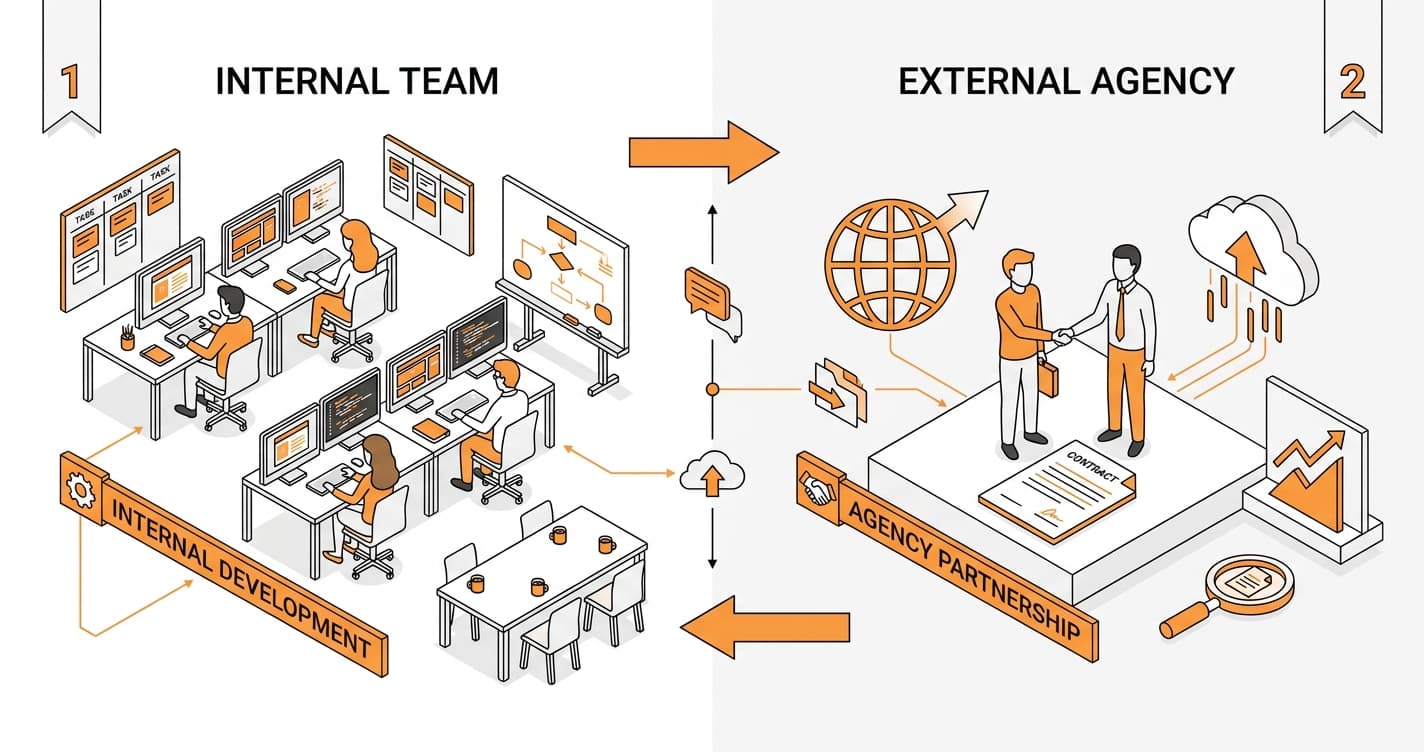
You’ve validated your SaaS idea, you have your first potential customers, and you’re ready to kick off product development. Every non-technical founder — or any team without in-house technical resources — faces a fundamental question at this point: should you recruit and build an internal development team, or outsource development to a specialized agency or freelancers?
This decision is one of the most structurally significant you’ll make throughout the entire life of your SaaS. It determines your development speed, the technical quality of your product, your ability to iterate quickly based on user feedback, and your long-term fixed costs. And contrary to what many founders believe, there is no universal answer. The best option depends entirely on your specific situation, your available resources, the complexity of your product, and your growth ambitions.
In-house development offers total control over quality, velocity, and product evolution — but requires investments in recruitment and technical management that can be prohibitive for a SaaS in its launch phase. Outsourcing allows you to get started faster with a controlled budget, but exposes you to risks of dependency, variable quality, and maintenance costs that can weigh heavily on cash flow as the product evolves.
In this article, we objectively analyze the pros and cons of each approach to help you make the decision best suited to your situation and avoid the most costly mistakes SaaS founders make on this question.
The pros and cons of in-house development for a SaaS
In-house development means building a team of salaried developers who work exclusively on your SaaS from your offices or remotely. This approach is favored by SaaS companies that have raised funding or have sufficient resources to sustain the fixed costs of a dedicated technical team. Here is an objective analysis of its advantages and disadvantages.
The first fundamental advantage of in-house development is iteration speed and responsiveness. A dedicated internal team can respond immediately to user feedback, fix a critical bug within hours, and deploy a new feature within days. This responsiveness is particularly valuable in the early stages of a SaaS, where the ability to pivot quickly based on market feedback is often decisive for the product’s survival. An external agency or freelancers typically have other clients to manage simultaneously, which inevitably extends response and execution times.
The second advantage is the accumulation of product knowledge. Developers who work exclusively on your SaaS for several months develop a deep understanding of the architecture, technical decisions, and specific constraints of your product. This accumulated expertise is a valuable asset that improves the quality of technical decisions and reduces the risk of costly mistakes caused by a lack of context. This accumulation of knowledge is nearly impossible to replicate with external contractors who rotate across projects regularly.
The third advantage is total control over quality and priorities. With an internal team, you alone decide which features to build, which quality standards to uphold, and the pace of deployment. You are not subject to the contractual constraints of an agency that would bill for every change beyond the original scope.
The disadvantages, however, are significant. The first and most impactful is the high fixed cost. A senior fullstack developer in France costs between €50,000 and €90,000 gross per year, to which you must add employer contributions, equipment, software, and management overhead. For a minimal team of two to three developers, the monthly cost can quickly exceed €15,000 to €25,000 before generating a single euro in revenue.
Comparative table of pros and cons
| Criterion | Advantage | Disadvantage |
|---|---|---|
| Responsiveness | Immediate fixes and iterations | Requires ongoing management |
| Product knowledge | Deep accumulated expertise | High risk if a key developer leaves |
| Quality control | Standards defined internally | Depends on the skills you recruit |
| Cost | Predictable over the long term | Very high and fixed from day one |
| Flexibility | Full availability on your project | Slow and costly to scale |
| Recruitment | Team aligned with the vision | Long, difficult, and expensive in 2026 |
| Intellectual property | Fully proprietary codebase | Requires solid contracts |
| Product culture | Strong buy-in on the vision | Requires quality management |
In-house development is the best option for SaaS companies that have raised funding, validated their business model, and need maximum development velocity to seize a market opportunity. For SaaS products in the validation phase or with a limited budget, the financial and organizational risks of this approach may be too significant to take on from the outset.
The pros and cons of outsourcing development for a SaaS
Outsourcing development means entrusting the technical creation of your SaaS to a specialized agency or independent freelancers rather than building an internal team. This approach is particularly common among non-technical founders who want to launch their SaaS quickly without the constraints and costs of in-house recruitment. Here is an honest analysis of its advantages and disadvantages.
The first major advantage of outsourcing is speed to start. Engaging a specialized SaaS development agency allows you to begin building your product within days rather than spending months on recruitment. Agencies like Peaklab, which specializes in end-to-end SaaS creation, have technical teams immediately available with all the skills needed to cover every aspect of development — technical architecture, frontend and backend development, API integrations, security, and deployment. This immediate availability is a considerable advantage for founders who have a market window to capture quickly.
The second advantage is access to multidisciplinary expertise. A SaaS-specialized agency like Peaklab has built its expertise across dozens of projects similar to yours. It knows the architectures best suited to the specific constraints of SaaS products, the most robust technologies for each use case, and the most common technical mistakes to avoid. This accumulated expertise is valuable because it lets you benefit from experience gained on projects you haven’t had to go through yourself.
The third advantage is controlled initial costs. Outsourcing your SaaS development transforms a high monthly fixed cost tied to an internal team into a variable cost directly linked to the volume of development commissioned. This flexibility is particularly valuable for SaaS products in the validation phase that don’t yet have sufficient recurring revenue to sustain the fixed overhead of an internal team.
The first disadvantage is technical dependency on the service provider. If your agency or freelancer becomes unavailable or decides to end the collaboration, you may find yourself with a product whose architecture you don’t understand well enough to evolve quickly with another provider. This dependency is particularly risky if the delivered code is not sufficiently documented and structured to be easily taken over by another team.
The second disadvantage is the risk of variable quality. Not all agencies and freelancers deliver the same level of technical quality. Poorly architected code produced by a less rigorous provider can generate considerable technical debt that will make future evolutions costly and complex. This is why choosing the right provider is as important a decision as choosing the technology. Specialized agencies like Peaklab, with a proven track record across dozens of SaaS projects, offer quality guarantees far superior to those of generalist providers.
| Criterion | Advantage | Disadvantage |
|---|---|---|
| Time to start | Immediate, no recruitment needed | Longer response times than in-house |
| Expertise | Multidisciplinary and SaaS-specialized | Varies depending on the provider chosen |
| Initial cost | Variable and controlled | Can exceed the planned budget |
| Responsiveness | Solid during planned phases | Less reactive than an internal team |
| Dependency | No HR overhead to manage | High risk if provider becomes unavailable |
| Quality | Excellent with Peaklab | Variable with generalist providers |
| Code ownership | Code delivered and proprietary | Requires precise contracts |
| Scalability | Resources adjustable to your needs | More complex coordination |
Outsourcing is the most accessible and most recommended strategy for non-technical founders launching their first SaaS with a controlled budget — provided you choose a SaaS development specialist like Peaklab, whose sector expertise and technical rigor guarantee a quality product ready to scale from the very first weeks after launch.