Launching a SaaS is an entrepreneurial adventure that demands most of the founders’ attention and resources during the early development phases. But once the product is live and the first customers are on board, a fundamental and often underestimated question becomes increasingly pressing. What does SaaS maintenance actually cost over the long term, and how can you anticipate these costs to keep the project financially viable?
SaaS maintenance is a permanent, non-negotiable expense that every founder must factor into their financial model from day one. Unlike a static website whose maintenance is limited to a few annual updates, a SaaS is a living software product that requires continuous technical attention to remain functional, secure, performant, and competitive in a market that never stops evolving. This reality is often discovered too late by founders who correctly anticipated initial development costs but find themselves overwhelmed by recurring maintenance expenses.
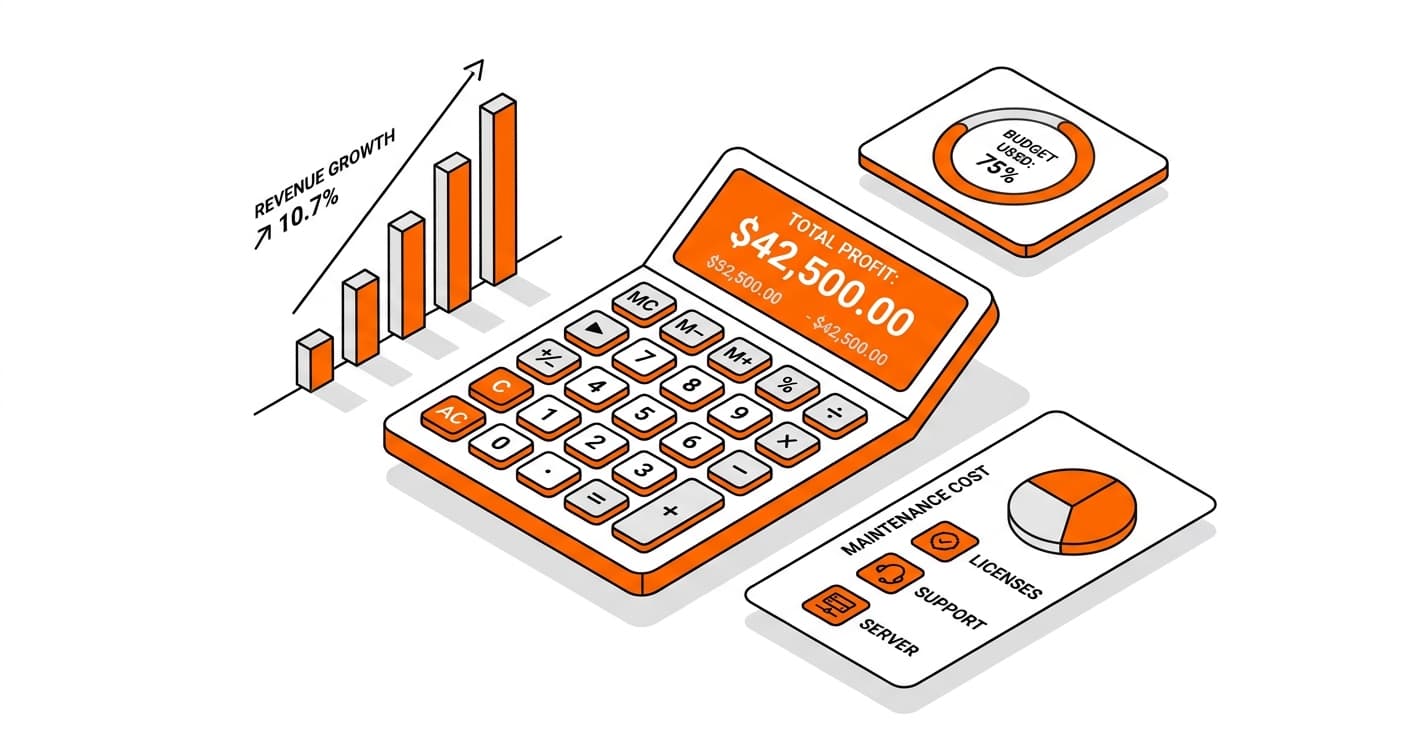
These maintenance expenses cover a wide range of dimensions that go far beyond simple bug fixes. Server infrastructure and cloud hosting, security updates, feature improvements requested by customers, monitoring and incident management, technical support, and updates to third-party dependencies and libraries. Each of these items generates recurring costs whose combined total can represent a significant share of a growing SaaS’s revenue.
In this article, we present a comprehensive and realistic analysis of every cost item related to SaaS maintenance to help you properly budget for this often-overlooked dimension of managing a SaaS product.
Why SaaS Maintenance Is a Permanent, Non-Negotiable Cost
Before analyzing the various SaaS maintenance cost items, it is essential to understand why these costs are structurally permanent and non-negotiable in order to adopt the right budgetary mindset and avoid the most common financial planning mistakes made by SaaS founders.
A Software Product That Naturally Degrades Without Maintenance
The first reason is that every software product naturally degrades over time without active maintenance. This counter-intuitive reality is called technical debt, and it accumulates progressively even without any changes to your SaaS codebase. The libraries and frameworks your SaaS is built on regularly publish updates that fix security vulnerabilities, improve performance, and introduce new features. If you do not keep these dependencies up to date, your SaaS gradually accumulates vulnerabilities that expose your customers to security risks and your infrastructure to instability risks. An application that goes unmaintained for two to three years can reach such a degraded technical state that a full update becomes as costly as a partial redevelopment.
Security Threats That Are Constantly Evolving
The second reason is the permanent evolution of security threats facing web applications in 2026. Cyberattacks against SaaS products have become considerably more sophisticated and frequent in recent years. SQL injections, XSS attacks, ransomware, data breaches, and brute-force intrusion attempts are daily threats that your infrastructure must be able to detect and neutralize in real time. SaaS security maintenance is not a one-time action but a continuous process that requires permanent monitoring of newly discovered vulnerabilities, regular security audits, and reactive updates as soon as a critical flaw is identified. Neglecting this dimension of maintenance exposes your SaaS to security incidents whose financial and reputational consequences can be catastrophic.
Customer Expectations That Are Constantly Evolving
The third reason is the permanent evolution of your customers’ expectations. A SaaS that does not evolve functionally is a SaaS that deteriorates in the eyes of its users, even if its code remains technically stable. Your customers use other tools alongside your SaaS whose features and user experience continuously improve. Their expectations of your product evolve accordingly, and what seemed satisfactory a year ago may feel insufficient today compared to what your competitors offer. Functional maintenance — continuously improving your product in response to customer feedback and market changes — is a non-negotiable dimension of maintaining a competitive SaaS.
Cloud Infrastructure Costs That Scale With Growth
The fourth reason is the evolution of infrastructure costs as your SaaS grows. Cloud hosting costs on platforms such as AWS, Google Cloud, or Azure are directly correlated with your application’s usage volume. The larger your customer base grows, the greater your needs for compute capacity, storage, and bandwidth — and the higher your infrastructure costs climb. This progression is not linear and can generate significant budget surprises for founders who have not correctly anticipated how their cloud architecture will scale with their growing user base.
Regulatory Requirements That Impose Continuous Changes
The fifth reason is the evolution of the regulatory framework your SaaS is subject to. GDPR in Europe, cybersecurity directives, sector-specific standards depending on your target market, and national legislative changes all impose continuous adaptations to your product to maintain regulatory compliance. These legal obligations are non-negotiable, as non-compliance exposes your company to potentially very significant financial penalties that far exceed the cost of the compliance updates themselves.
The Different SaaS Maintenance Cost Items
SaaS maintenance generates costs spread across several distinct items whose combined total constitutes the monthly and annual maintenance budget to integrate into your financial model. Here is a detailed analysis of each item with representative cost ranges based on the size and maturity of the SaaS.
The first item is cloud infrastructure and hosting. This is generally the largest and most variable cost item depending on your application’s usage volume. The main cloud platforms such as AWS, Google Cloud, and Azure charge based on consumption of compute resources, storage, databases, and bandwidth. For a SaaS in the launch phase with a few dozen customers, infrastructure costs typically start between €100 and €500 per month. For a growing SaaS with several hundred customers, these costs can quickly reach €1,000 to €5,000 per month depending on the architecture and optimizations in place.
The second item is technical human resources. SaaS maintenance requires the regular involvement of developers for bug fixes, security updates, feature improvements, and incident management. Whether you have an in-house team or outsource these services, this item often represents the largest budget volume in maintenance. A senior freelance developer charges between €500 and €800 per day in France in 2026. A specialized agency like Peaklab, which supports SaaS products through their maintenance and evolution, offers monthly maintenance packages that allow you to control this variable cost by converting it into a predictable fixed expense.
The third item is third-party tools and licenses. Your SaaS relies on a set of third-party tools and services whose subscriptions constitute a recurring expense. Monitoring and alerting tools, transactional email services, authentication solutions, analytics and tracking tools, payment services, and third-party APIs. These subscriptions add up quickly and represent between €200 and €2,000 per month depending on the sophistication of your technology stack.
The fourth item is security and audits. Maintaining the security of a SaaS requires regular investment in surveillance tools, annual penetration tests, and periodic security audits. This item is often under-budgeted by founders who treat it as an optional expense, when in fact it is an essential safeguard against incidents whose potential cost far exceeds that of prevention.
Summary Table of SaaS Maintenance Cost Items
| Cost Item | Early-Stage SaaS | Growing SaaS | Mature SaaS |
|---|---|---|---|
| Cloud infrastructure | €100–€500/month | €500–€5,000/month | €5,000–€50,000/month |
| Technical human resources | €500–€2,000/month | €2,000–€10,000/month | €10,000–€50,000/month |
| Third-party tools and licenses | €200–€500/month | €500–€2,000/month | €2,000–€10,000/month |
| Security and audits | €100–€300/month | €300–€1,000/month | €1,000–€5,000/month |
| Technical customer support | €0–€500/month | €500–€3,000/month | €3,000–€15,000/month |
| Compliance and legal | €100–€300/month | €300–€1,000/month | €1,000–€5,000/month |
| Estimated total | €1,000–€4,000/month | €4,000–€22,000/month | €22,000–€135,000/month |
This table clearly illustrates that SaaS maintenance costs evolve significantly as the business grows. For SaaS products in the launch phase, a monthly maintenance budget of between €1,000 and €4,000 is a realistic estimate that must be integrated into the project’s financial model from the outset. This budget anticipation is essential to avoid unpleasant surprises that can jeopardize the viability of a SaaS whose founders have not correctly anticipated the true long-term cost of its maintenance.