Web App

What Is the Difference Between SaaS Software and On-Premise Software?

LALucien Arbieu9 min read
What Is the Difference Between SaaS Software and On-Premise Software?

Today, when a company wants to adopt a new digital tool, one question comes up every time: should you choose SaaS software or on-premise software? Behind these two models lie major differences in terms of cost, security, maintenance, and flexibility.

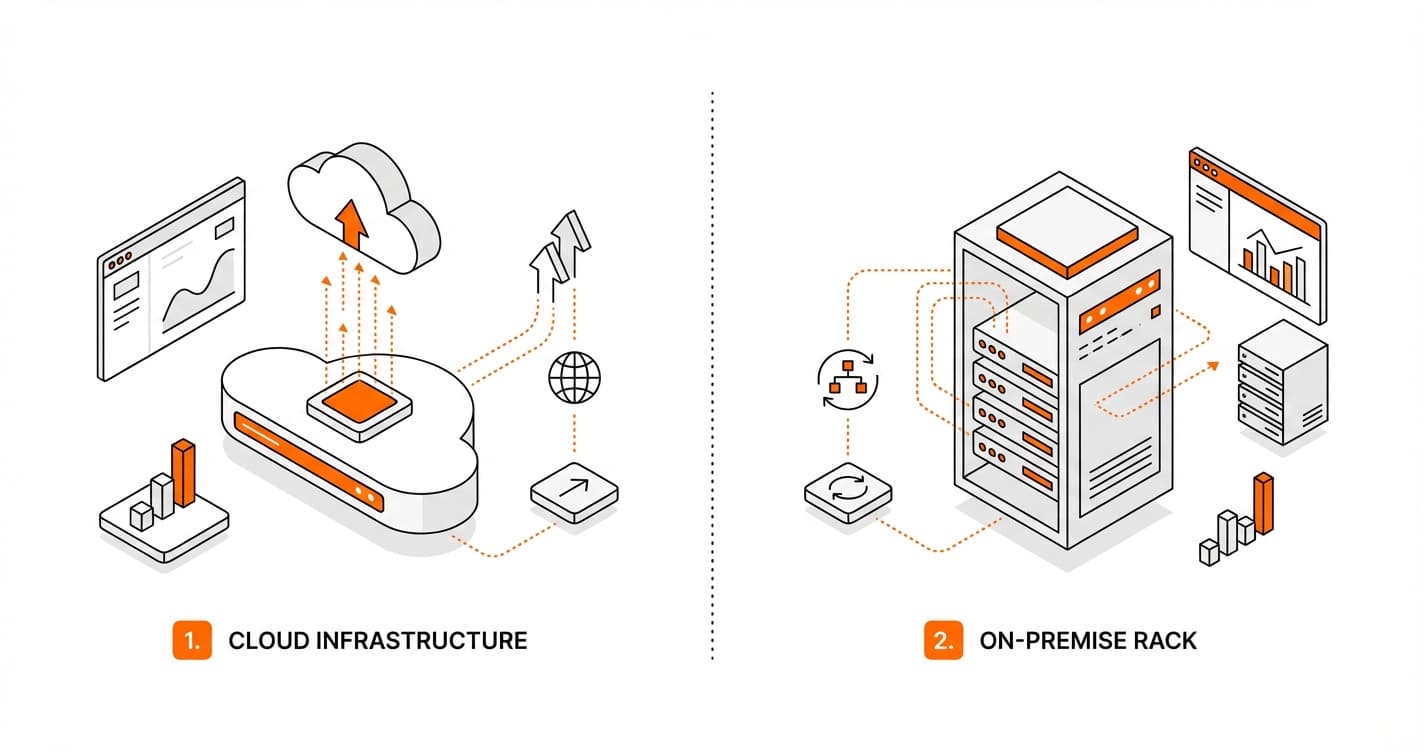
SaaS (Software as a Service) runs via the cloud and is accessible online, while on-premise software is installed directly on the company’s internal servers. These two approaches address very different needs and constraints.

So, what is the difference between SaaS software and on-premise software? What are the advantages and disadvantages of each solution? And most importantly, which one is best suited to your organization in 2026?

In this article, we analyze both models in detail to help you make an informed strategic choice.

What Is SaaS Software and How Does It Work?

The SaaS (Software as a Service) model has established itself as a benchmark in the world of professional software. More and more companies are adopting this solution for its flexibility, rapid deployment, and subscription-based business model. To fully understand the difference between SaaS software and on-premise software, it is essential to grasp the fundamentals.

Definition of SaaS Software

SaaS software is an application hosted in the cloud and accessible via the Internet. Unlike traditional software installed on a computer or on a company’s internal servers, SaaS requires no heavy local infrastructure.

The software vendor hosts the application on its own servers or on cloud infrastructure (AWS, Azure, Google Cloud, etc.). Users simply access it through a web browser or a dedicated application.

The SaaS business model is generally based on a monthly or annual subscription. The client company pays to use the service without permanently purchasing a software license.

Among the best-known examples of SaaS software are:

  • CRM platforms
  • Project management tools
  • Online accounting solutions
  • Marketing automation platforms
  • Collaborative software

SaaS is now ubiquitous in professional environments.

How Does SaaS Software Work?

SaaS software operates on a centralized cloud-based architecture.

When a user logs in, they access a single version of the software hosted on remote servers. All data is stored and processed on those servers, not on the user’s computer.

Here are the main characteristics of how it works:

Access is provided via a secure Internet connection. No complex download is required.
Updates are automatic. The vendor deploys new features without any action required from the client.
Maintenance is handled by the provider. The user company does not need to manage patches or technical security.
Data is automatically backed up on the cloud infrastructure.

This model offers great operational flexibility. Teams can connect from any device, as long as they have an Internet connection.

SaaS also operates on a scalability logic. A company can increase or decrease the number of users according to its needs, without any additional hardware investment.

In terms of security, SaaS vendors invest heavily in advanced protocols: data encryption, multi-factor authentication, server redundancy. However, responsibility is shared: the vendor secures the infrastructure, while the company must secure user access.

Finally, SaaS enables simplified integration with other tools via APIs. This makes it easy to build a connected digital ecosystem (CRM, billing, marketing, customer support).

SaaS vs On-Premise: What Are the Key Differences in Cost, Security, and Flexibility?

Choosing between SaaS software and on-premise software is a strategic decision that directly impacts cost structure, security management, and the company’s capacity to evolve. In 2026, this choice goes beyond a simple technical preference: it determines agility and competitiveness.

Differences in Cost

The business model is one of the first major distinctions.

SaaS operates on a monthly or annual subscription system. Costs are spread over time and are generally predictable. There is no heavy upfront infrastructure investment. The company pays for a service that includes hosting, maintenance, and updates.

Conversely, on-premise software requires a significant initial investment. License purchases, server acquisition, installation, and configuration represent a substantial cost. On top of that come maintenance fees, updates, and internal IT management.

In the short term, SaaS often appears more accessible. In the long term, the total cost depends on the number of users, the duration of use, and the need for evolution.

Differences in Security

Security is a central criterion when choosing between SaaS and on-premise.

With SaaS, data is hosted in the cloud, on the provider’s servers. Major vendors invest heavily in advanced protocols: data encryption, server redundancy, multi-factor authentication, and regulatory compliance.

However, some companies may be reluctant to outsource their sensitive data.

The on-premise model offers complete control over infrastructure and data. The company manages its environment end to end. This autonomy is particularly sought after in regulated industries.

On the other hand, this control implies full responsibility. If internal cybersecurity is insufficient, the risk may be higher than with a specialized provider.

Differences in Flexibility

Flexibility is often the key argument in favor of SaaS.

SaaS allows users to be added or removed quickly, without hardware investment. Updates are automatic and access is possible from any Internet-connected device.

The on-premise model, by contrast, is more rigid. Any evolution requires technical intervention, sometimes the purchase of new servers or a hardware upgrade.

However, on-premise offers deeper customization. Some companies with specific needs prefer this capacity for technical adaptation.
Free tool

AI Specifications Generator

Create professional project specifications in minutes with our AI-powered tool.

Try it free

Comparison Table: SaaS vs On-Premise

Criterion SaaS Software On-Premise Software
Business model Monthly/annual subscription License + upfront investment
Initial cost Low High
Maintenance Managed by the provider Managed internally
Updates Automatic Manual or scheduled
Hosting Cloud Internal servers
Security Managed by the vendor (shared responsibility) Full control by the company
Flexibility Very high (rapidly scalable) More rigid
Customization Limited to available options Deep customization possible
Deployment Fast Longer and more technical

In summary, SaaS favors agility, speed, and simplicity, while on-premise prioritizes control and customization. The choice depends on your budget, your regulatory constraints, and your growth strategy.

Which Model Should You Choose for Your Business in 2026?

In 2026, the choice between SaaS software and on-premise software is no longer purely a technical question. It is a strategic decision that must align with your business model, your IT maturity, your security requirements, and your growth ambitions.

The right model depends above all on your context.

If Your Priority Is Agility and Speed

Fast-growing companies, startups, and SMBs that want to deploy a tool quickly generally favor SaaS. Why? Because it enables near-immediate deployment with no heavy hardware investment.

In 2026, speed of execution is a competitive advantage. SaaS offers:

  • Fast setup
  • Automatic updates
  • Instant scalability
  • Simplified management

If your IT team is small or if you want to focus on your core business rather than infrastructure, SaaS is often the most rational choice.

If Your Priority Is Control and Customization

Conversely, large enterprises or organizations operating in highly regulated sectors may prefer on-premise software.

This model is relevant if:

  • You have strict data sovereignty requirements
  • You must comply with specific regulatory constraints
  • You need deep customization
  • You have a strong internal IT team

On-premise offers complete control over the technical environment. However, this control comes at a cost in terms of maintenance and human resources.

If You Are Taking a Hybrid Approach

In 2026, many companies are adopting a hybrid approach. Some strategic applications remain on-premise, while other tools (CRM, marketing, collaboration) are SaaS.

This strategy makes it possible to combine:

  • The flexibility of the cloud
  • Local control for sensitive data

The hybrid model is becoming particularly relevant for companies undergoing digital transformation.

The Key Criterion: Your 3–5 Year Vision

The real question is not just « which model is better? » but « which model supports your medium-term strategy? ».

If your goal is to scale quickly, expand internationally, or adopt automation at scale, SaaS is often the better fit.

If your priority is long-term stability, deep customization, and full control over data flows, on-premise may remain relevant.

What Is the Main Difference Between SaaS Software and On-Premise Software?

The main difference lies in hosting and management. SaaS software is hosted in the cloud by a provider and accessed via the Internet on a subscription basis. On-premise software is installed on the company’s internal servers, which the company itself maintains and secures.

Is SaaS More Secure Than On-Premise?

Security depends more on the quality of the infrastructure than on the model itself. SaaS vendors invest heavily in encryption, server redundancy, and regulatory compliance. With on-premise, security relies entirely on the skills and resources of the internal IT team.

Is SaaS Always Cheaper?

In the short term, SaaS requires less upfront investment. However, over the long term, the total cost depends on the number of users, the duration of use, and the features selected. On-premise involves a high initial cost, but can be amortized over several years.

Can SaaS Software Be Customized?

SaaS software generally offers customization options, but within a framework defined by the vendor. On-premise, on the other hand, often allows for deeper customization, particularly for complex technical environments.

Does SaaS Require a Permanent Internet Connection?

Yes. SaaS software runs via the cloud and requires an Internet connection to access data and features. On-premise can operate on a local network without depending on an external connection, depending on the configuration.

Which Model Is Best Suited to SMBs?

In 2026, SaaS is often the preferred choice for SMBs due to its flexibility, low initial cost, and ease of deployment. It allows companies to quickly benefit from powerful tools without heavy infrastructure.

Is Data Always Accessible With SaaS?

SaaS providers generally offer high availability guarantees (SLA). However, access depends on the Internet connection and the stability of the provider’s servers.

Can You Switch From On-Premise to SaaS?

Yes, many companies are migrating to the cloud. However, this transition requires careful planning: data migration, system compatibility, team training, and risk management.

LA
Lucien Arbieu
AI expert and digital transformation consultant at PeakLab.

Your project deserves foundations that measure up.

In one call, we tell you what's feasible, at what price, and in what timeframe. With full transparency.

Web development, automation & AI agency

[email protected]
Newsletter

Get our tech and business tips delivered straight to your inbox.

Follow us
Crédit d'Impôt Innovation - PeakLab agréé CII

© PeakLab 2026