Raising funds is often presented as a mandatory step for any entrepreneur launching an ambitious SaaS. Press articles celebrate multi-million-euro funding rounds, podcasts glorify founders who convinced VCs to back their vision, and startup culture sometimes equates success with the amount of capital raised rather than the real value created. In this environment, the question of whether you need to raise funds to build your SaaS deserves to be examined objectively and without bias.
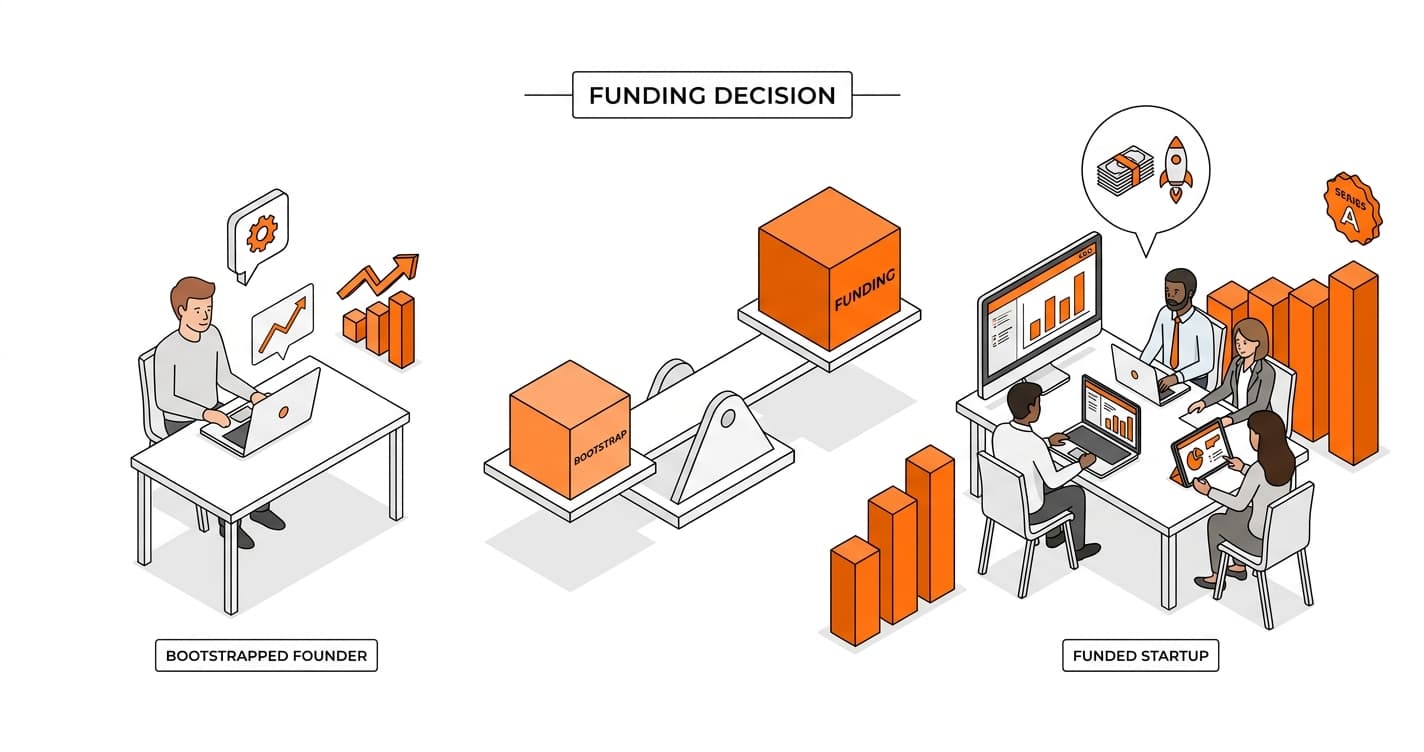
The honest answer is that raising funds is not a necessity to build a successful SaaS. Hundreds of profitable SaaS businesses generating several million euros in annual recurring revenue have been built without ever raising a single euro from external investors. This approach, known as bootstrapping, consists of funding your SaaS’s growth solely through its own revenue, without diluting your equity or submitting to the profitability and growth requirements imposed by investors. It receives far less media coverage than spectacular funding rounds, but it produces companies that are often more solid, more profitable, and more aligned with their founders’ vision.
However, raising funds can be a powerful and relevant lever in specific situations. When your market demands very rapid growth to seize a temporary window of opportunity, when developing your product requires significant upfront investment that your current revenue cannot fund, or when your growth model relies on economies of scale that require a critical mass of users to be reached quickly, fundraising can decisively accelerate your trajectory.
In this article, we help you make this major strategic decision by objectively analyzing the advantages and disadvantages of fundraising for a SaaS, and by giving you the criteria to determine whether this option is suited to your specific situation.
What is fundraising and how does it work for a SaaS?
Fundraising refers to the process by which a company obtains external capital from investors in exchange for an equity stake in the business. For a SaaS in its creation or growth phase, this operation makes it possible to accelerate product development, hire a team, fund customer acquisition, and scale more quickly than the revenue generated by the business alone would allow.
The fundraising process for a SaaS typically unfolds across several successive rounds, whose size and requirements increase as the company grows. The pre-seed is the first funding round, which generally takes place before the product has even been developed or during the initial validation phase. Amounts raised at this stage are modest, typically between €50,000 and €500,000, and investors are primarily business angels, people close to the founder, or pre-seed funds specializing in the very earliest stages of development. At this stage, the investor is betting above all on the quality of the founding team and the relevance of the market opportunity being addressed.
The seed round is the second round, which takes place when the SaaS has a functional MVP and initial proof of commercial traction. Amounts raised range from €500,000 to €3 million depending on the target market and the ambition of the project. Seed investors are typically venture capital funds specializing in early-stage development or experienced business angels from the technology sector. At this stage, they evaluate product quality, the size of the addressable market, growth metrics, and the team’s ability to execute its vision.
The Series A is the first significant institutional funding round, which takes place when the SaaS has demonstrated a repeatable business model with solid metrics for recurring revenue growth, customer retention, and acquisition efficiency. Amounts raised in a Series A typically range from €3 million to €15 million. Series A investors are established venture capital funds that take a significant equity stake in exchange for their investment and actively engage in the company’s governance and strategy.
In return for their investment, investors receive shares in your company’s capital, making them partners in your entrepreneurial journey. This equity dilution is the fundamental trade-off of fundraising. With each new round, founders give up an additional fraction of their ownership of the company. After several successive rounds, it is not uncommon for a founder to hold only 20 to 30% of the capital in their own SaaS, with the remainder distributed among the various investors who participated in the successive funding rounds.
Investors who take a stake in a SaaS have precise expectations regarding the growth trajectory and the return on their investment. They typically seek a return of five to ten times the amount invested within five to eight years, via an exit through acquisition or an IPO. This expectation of high returns pushes founders to adopt an aggressive growth strategy that may not align with their original vision or entrepreneurial values.
The advantages of fundraising for a SaaS
Fundraising offers real and tangible advantages for SaaS businesses that find themselves in the right conditions to benefit from it. Here are the most significant benefits that can justify diluting your equity and committing to this demanding process.
Significant acceleration of growth
The first and most obvious advantage is the ability to accelerate growth well beyond what the revenue generated by the business alone would allow. The funds raised make it possible to invest massively and simultaneously in product development, hiring, and customer acquisition without waiting for the revenue from one stage to fund the next. This acceleration is particularly valuable in markets where a temporary window of opportunity demands quickly capturing a dominant position before better-funded competitors close the door. A SaaS with sufficient resources to grow faster than its competitors can build durable competitive advantages in terms of customer base, brand, and data that become difficult to overcome even for well-funded new entrants.
Access to a network and strategic expertise
The second advantage is often underestimated by founders who have not yet worked with professional investors. The best venture capital funds bring far more than money. They bring a network of strategic contacts including potential customers, commercial partners, candidates for key positions, and other founders who have faced the same challenges. They also bring sector and operational expertise acquired through investments in dozens of SaaS businesses at different stages of development. This combination of network and expertise can considerably accelerate the resolution of complex problems and open doors that would remain closed without the backing of a recognized investor.
Credibility and legitimacy in the market
The third advantage is the external credibility that a successful fundraise from recognized investors confers. For certain types of customers, particularly large enterprises and public-sector organizations that have very rigorous vendor evaluation processes, being backed by a reputable venture capital fund is a signal of solidity and longevity that can make the difference in a purchasing decision. This institutional credibility is also valuable for recruiting talent who prefer to join a project with secured funding rather than a bootstrapped one whose cash flow depends entirely on monthly revenue.
The ability to recruit top talent
The fourth advantage is the ability to recruit high-caliber profiles that would be inaccessible without the resources that fundraising provides. An experienced CTO, a seasoned VP of Sales, or a Head of Marketing with a strong track record have high salary expectations that the vast majority of bootstrapped SaaS businesses cannot meet in their early years. The funds raised provide access to these profiles, who can radically transform a SaaS’s trajectory through their skills and experience in high-growth environments.
The security of sufficient cash flow to experiment
The fifth advantage is the psychological and operational security that comes from having sufficient cash flow to experiment, fail, and pivot without jeopardizing the company’s survival. A bootstrapped SaaS must generate enough revenue to cover its costs from the very first weeks, which limits its ability to take risks and explore directions that are not immediately monetizable. A solid cash position resulting from a fundraise gives founders the freedom to invest in experiments whose return on investment may take several months or years to materialize.