
Our e-commerce agency helps SMEs build and rebuild their online store, B2C or B2B: choosing between Shopify, PrestaShop or custom, design, catalog, payment, ERP connection and SEO. A profitable website your team runs on its own.
Three questions to prepare a useful conversation.
Question 1/3
They trusted us with their latest e-commerce projects

Our commitments
Offer, ordering, payment and quality criteria are validated before going live.
Scoping, web design, development, data migration and launch are priced separately: you stay in control of the budget.
Product pages, promotions and orders are managed without a developer, with training and documentation handed over.
Updates, backups, order monitoring and fixes, with a responsiveness level set in the contract.
The right e-commerce solution depends on your offer, your sales strategy and your team, not on a trend. For a standard store, PeakLab often recommends Shopify, WooCommerce or PrestaShop. Headless or custom becomes relevant when the checkout, customer-specific pricing or connections to your software go beyond a standard theme.
As a partner, we compare options with their real costs (subscription, fees, extensions, maintenance) before proposing an architecture. The French Ministry of Economy's online store guide also distinguishes self-managed software, SaaS and custom development.
Because your margin depends as much on operations as on design. PeakLab brings experts in strategy, web design, front-end and back-end development, SEO and integrations into one team. For paid traffic and ad campaigns on Google, Facebook or Instagram, our acquisition team takes over.
Our comparison of solutions, depending on your context.
Building or rebuilding a Shopify store: custom theme, carefully chosen apps, payment and shipping ready. Ideal for a simple catalog sold in France or worldwide, with limited internal resources.
Read our comparisonOpen-source solutions to keep control of code and hosting. We take over, optimise or migrate your PrestaShop, Magento or WordPress site.
Systems migrationA configurator, negotiated prices, an ordering portal or a marketplace: a specific solution when no CMS fits your company's specifics.
Web developmentE-commerce features we build
PeakLab offers six areas of expertise to connect the customer experience with your company's operations. End-to-end support, from scoping to follow-up.
01
We study your market, customers and digital strategy to set the project's goals and scope. The deliverable, a decision aid, compares options with their costs and recommends the solution suited to your business.
02
Brand guidelines, mobile-first mockups and buying journeys designed for conversion: search, product page, cart, account and payment. A creative direction true to your brand, tested upfront.
03
Our senior developers configure Shopify or PrestaShop, or build a tailored in-house solution. Payment, shipping and data flows with your ERP, CRM and PIM are set up and tested before go-live.
04
Products, customers, orders and URLs are carried over during a redesign or a software change, with a redirect plan to protect organic rankings. Example: the headless redesign of Boissec with SEO migration.
05
Category structure, content, structured data and technical performance to gain visibility online, on Google and in AI answer engines (GEO). To go further, our SEO agency runs the content strategy.
06
We set up analytics: conversion rate, average order value and drop-offs tracked in Google Analytics, then tests to improve results. Steering relies on real data, not promises.
Client results
Not promises. Results.
Brand-creator matching platform for content marketing
Brand-creator matching platform with intelligent matching and real-time performance analytics.
+45%
Campaign engagement
x3
Active creators
Brand monitoring and protection solution
Redesign of brand monitoring solution: improved performance, modernized interface and accelerated analysis.
+25%
Analysis speed
+20%
Annual growth
Solar platform & administrative automation
Platform redesign to automate administrative procedures and accelerate photovoltaic project management.
-60%
Administrative time
+38%
Revenue generated
Our stack
Modern and proven stack for high-performance apps
Our method
01
A workshop to understand your business, stakes and constraints, then the technical choice.
02
Mockups and features validated; pricing is set in writing.
03
Site and integrations built in sprints, with your feedback at each step.
04
Order, payment and redirect testing before opening to the public.
05
Conversion tracking and CRO to optimise the site month after month.
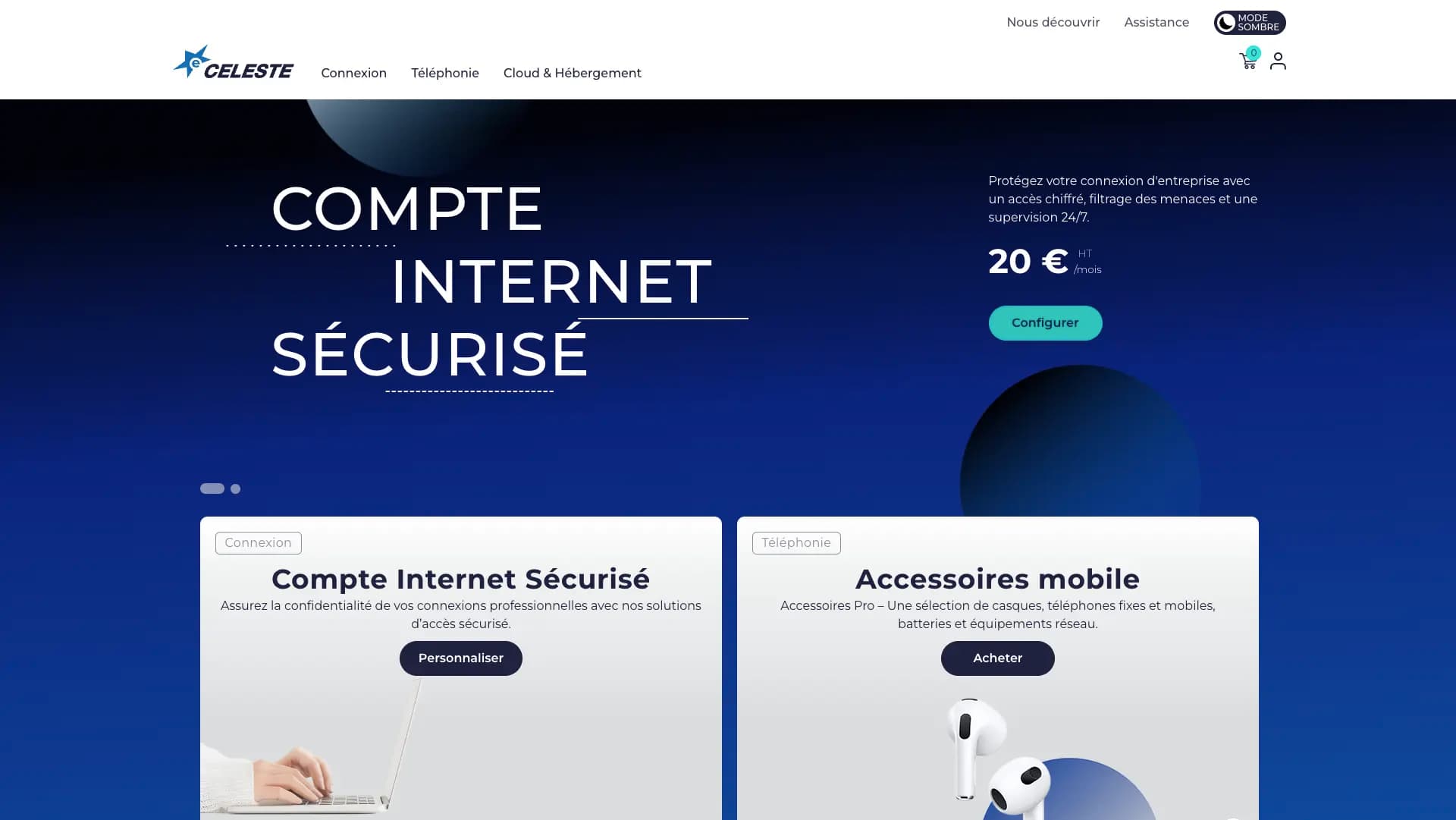
For Celeste, a telecom operator serving businesses, PeakLab designed an e-commerce site bringing together all the group's services: a single cart, a configurator with real-time pricing and a management system linked to order processing.
According to the published case, the conversion rate rose from 2.1% to 2.8% and average order value grew by 22%. These results belong to Celeste: each merchant sets its own goals.
+35% conversion rate
+22% average order value
3.2 → 4.5/5 user satisfaction
Authentic testimonials from those who trusted us.
“Thank you so much for everything, your work was incredible. We went through 1000 hurdles, and you never gave up. You were patient, organized, available, and you transformed the project into something really solid! Without you, Upcreators wouldn't exist.”

Sofiane
CEO at UpCreators
“Great collaboration experience. Lucien demonstrated excellent technical skills, organization and listening. The project progressed efficiently under great conditions with smooth communication. Reliable, involved and full of initiative. I recommend.”

Janine
Co-founder at Astérisque
“Excellent DEV. Complex Back and Front mission handled brilliantly. Real technical expertise serving our needs.”

Fabrice
Project Manager at Celeste
Before talking budget, three tools to clarify the need.
Structure goals, offer and priorities in a document you can share.
Generate my requirementsReversibilityCheck whether you can recover the code, data and access of your site.
Run the assessmentAutomationSpot the manual tasks between your site, stock and customer service.
Start the assessment
Based on rue François Ier in Paris, we work remotely with merchants across France, from Paris to Bordeaux or Nantes. First 30-minute workshop free: you leave with a recommendation, no commitment.
FAQ
Solution, price, timeline, migration, marketing and maintenance.
An e-commerce agency brings strategy, design, development, SEO and maintenance into one team. You save time, avoid platform mistakes and keep one contact accountable for the result.
Look at its projects, customer reviews, scoping method and code ownership. Be wary of sponsored rankings: a good agency also recommends a simple solution when it is enough.
Shopify suits a standard catalog and a team that wants to delegate hosting. PrestaShop, Magento or Sylius give more control at the cost of heavier maintenance. Custom is justified for B2B rules or a specific journey. We compare options against your sales, tools and recurring costs.
The price depends on the catalog, design, platform, connections to your tools and migration. Our quote separates scoping, design, development, migration, launch and maintenance. A serious estimate comes after the scoping workshop, not from a price list.
It depends on scope, your validations and integrations. A configured Shopify store and a B2B platform connected to an ERP do not follow the same schedule; the quote sets the milestones.
We carry over products, customers, orders and URLs, then prepare a redirect plan tested before the switch. Search Console tracks indexing after go-live. The risk is reduced and monitored, never zero.
Yes, if the tool offers an API or a reliable export. Each flow (stock, orders, customers, invoices) has an owner, error handling and documented recovery.
Yes, through our acquisition team: SEO, Google Ads, Facebook and Instagram Ads, steered by real sales. The site remains the main lever: an ad campaign cannot make up for a checkout that converts poorly.
A certification proves knowledge of the platform, not the quality of a project. Ask for comparable projects, references and the list of apps planned for your store.
Yes. We set up the domain name, hosting, certificates and backups, then provide technical support and maintenance under a defined contract. You remain owner of the domain and access.
A freelancer suits a targeted task. An agency brings a full team and service continuity.
European accessibility rules have covered online stores since June 28, 2025, with exemptions to check. We include keyboard navigation, contrast, labels and testing in acceptance.
Yes. Our head office is in Paris and we work remotely with merchants across France: video workshops, regular demos and a direct channel with the team.
Copyright © PeakLab 2026. All rights reserved.