PeakLab designs, rebuilds and connects B2B and B2C e-commerce sites when your catalog, pricing or operations exceed a standard theme. The choice between CMS, headless and custom starts with your sales, workflows and team.
Catalog, journeys, integrations, data, roles and acceptance criteria are approved before development.
The proposal separates scoping, design, commerce engine, connectors, migration, testing, launch and operations.
Access, catalog, order, promotion, incident and routine change procedures are documented and handed over.
Cutover, recovery, monitoring and support ownership are defined according to the project's risks.
The French government guide published on December 5, 2025 distinguishes three paths: a managed CMS, fully custom development or a turnkey SaaS product. A standard store is often better served by Shopify, WooCommerce or PrestaShop: a conventional catalog, common payment journey and small team do not automatically justify a bespoke platform.
Headless or custom becomes relevant when the buying journey creates a real advantage: a configurator, B2B pricing rules, complex catalogs, recurring orders or deep ERP, CRM, PIM, WMS and carrier integrations. We compare initial cost, recurring fees, dependencies, operations and reversibility before recommending an architecture. Our CMS versus custom guide explains this decision.
“Because your margins and operations matter more than a technology preference. PeakLab combines product, UX, web development, SEO and business integrations: we can keep a CMS, build a headless storefront or develop only the logic that differentiates you. You receive a reasoned recommendation, cost assumptions and operating limits before funding the solution.”
Six deliverables connecting the buying experience to the catalog, payments and real operations of your SME.
We map customers, channels, catalog, volumes, margins, promotions, orders, returns and existing tools. The deliverable compares configuring a CMS, extensions, headless and custom development, including cost assumptions, dependencies and operational workload. Custom is selected only when its value offsets its complexity.
Search, categories, product pages, variants, availability, cart, account and checkout are prototyped on mobile and desktop. Acceptance covers the happy path, errors, stockouts, price changes, delivery, returns and accessibility. Decisions use a baseline and measurable events without promising a universal conversion rate.
We configure or build products, variants, bundles, pricing, B2B accounts, quotes, promotions, stock and orders as required. Systems of record and administration rights are explicit. Imports, bulk updates, conflicts and histories are tested so the team can operate the back office.
The payment provider and methods depend on countries, amounts, risks and customer habits. We favor hosted or tokenized components to reduce exposure to card data, then test authentication, declines, refunds, double submissions and recovery. Legal notices, terms, consent and sector rules are validated with your qualified advisers; PeakLab does not provide legal advice.
Every connector defines the data owner, frequency, idempotency, errors, recovery and monitoring. Stock, customers, orders, shipments, returns and invoices are not assumed to synchronize without incidents. For French B2B flows, we anticipate mandatory receipt of electronic invoices on September 1, 2026 and SME issuance on September 1, 2027, subject to the applicable legal scope.
We deliver stable URLs, redirects, sitemaps, canonicals, controlled faceting and Product/Offer structured data synchronized with visible prices and availability. Google's documentation updated in July 2026 guides merchant markup. Performance budgets, consent-aware analytics, alerts, backups, dependencies and a maintenance plan complete production launch.
Excellent DEV. Complex Back and Front mission. The team managed the complexity of a multi-service project with rigor and efficiency.

Modern and proven stack for high-performance apps
Measure the current journey and qualify catalog, orders, returns, tools, ownership and priority pain points
Compare options on value, recurring costs, integrations, reversibility, security and operational workload
Test search, product, cart, payment, errors, accessibility and administration on mobile and desktop
Rehearse imports and connectors, verify redirects and events, prepare recovery and launch against a shared checklist
Monitor orders, errors, performance, SEO, costs and incidents, then prioritize changes from observed data
Measure the current journey and qualify catalog, orders, returns, tools, ownership and priority pain points
Compare options on value, recurring costs, integrations, reversibility, security and operational workload
Test search, product, cart, payment, errors, accessibility and administration on mobile and desktop
Rehearse imports and connectors, verify redirects and events, prepare recovery and launch against a shared checklist
Monitor orders, errors, performance, SEO, costs and incidents, then prioritize changes from observed data
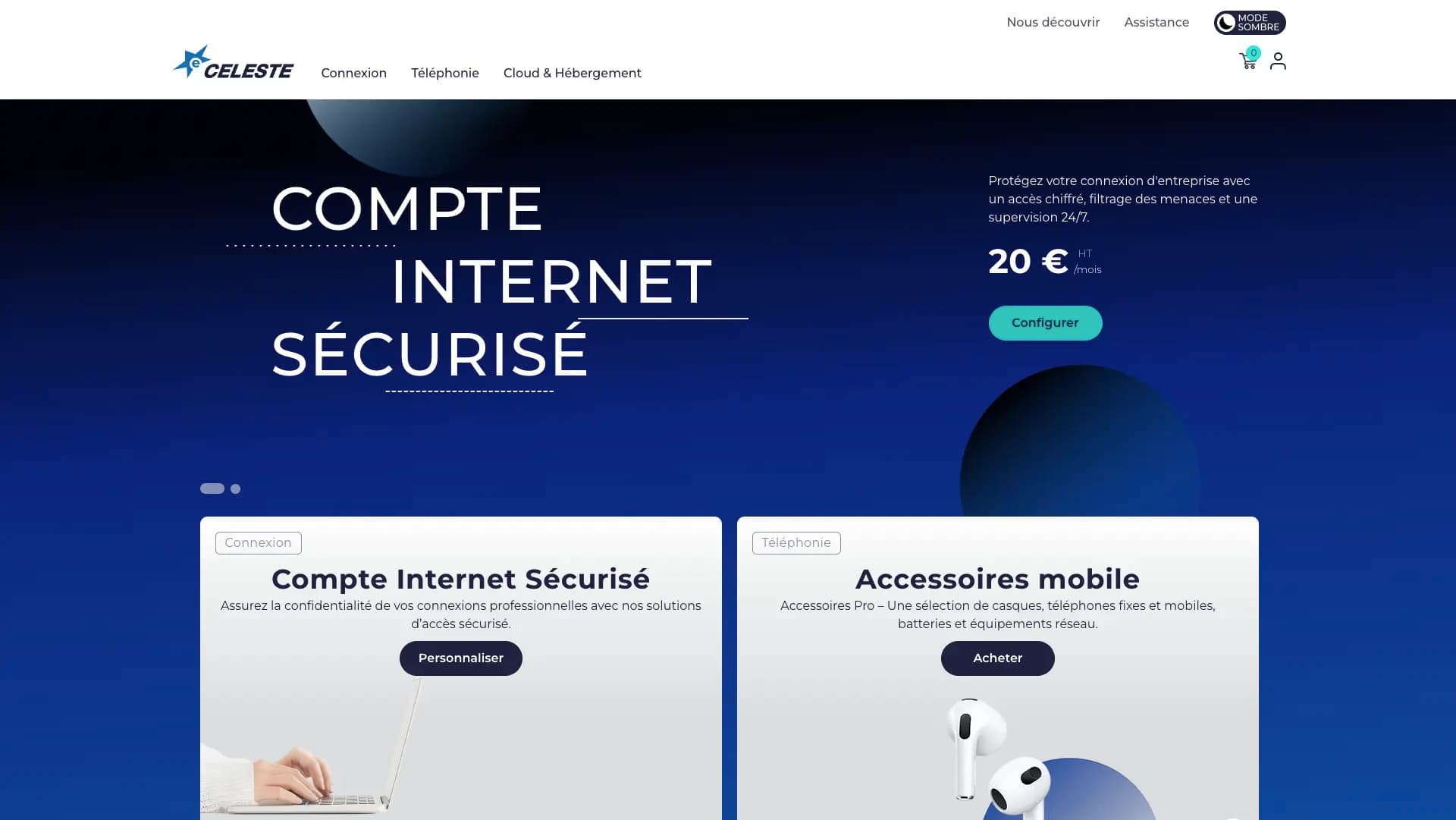
For Celeste, PeakLab worked on a B2B e-commerce platform bringing together several group services, a configuration tool with pricing and a back office connected to order processing. The published testimonial describes a complex project spanning front and back end.
We retain this functional evidence and delivered scope. The previous conversion and average order metrics are not repeated here because their period, attribution and protocol are not documented publicly. Every new project starts from its own data: conversion by step, order errors, catalog quality, operational lead times and support requests.
The scope also includes accessibility, mandatory information and personal data. The French government updated its guides on creating an online store and mandatory website information in December 2025. Online shops are also among the services covered by EU accessibility rules, with exemptions and implementation details to qualify for each business and service.

Let's review your catalog, journeys, tools, constraints and current indicators. You leave with the next decision to make before funding an architecture.
Architecture, budget, migration, payments, SEO, accessibility and maintenance: decisions to make before a rebuild.
A CMS or SaaS product often suits a standard catalog and journey when a team prefers to delegate some hosting and maintenance. Headless separates the experience from the commerce engine; custom adds proprietary logic. The decision depends on sales rules, integrations, volumes, internal skills, recurring costs and reversibility, not on a universal revenue threshold.
They depend on catalog, design, commerce engine, pricing rules, connectors, migration, countries, security and operations. The proposal separates scoping, design, development, third-party services, migration, acceptance, launch and maintenance. A configured store on an existing engine and an integrated B2B platform are not the same estimate.
We inventory products, customers, orders, content, URLs, media, rules and connectors, then rehearse imports in an acceptance environment. A redirect map, count checks, appropriate data freeze, cutover plan and recovery procedure are tested. No migration can promise zero interruption or zero SEO variation; risk is reduced, monitored and handled.
We define the funnel and baseline before changing it: product views, add to cart, checkout start, successful payment, errors, payment method use and useful segments. Changes are compared over sufficient traffic and time while accounting for campaigns, stock, prices and seasonality. The observed result belongs to that store's context and cannot be transferred automatically.
We select a payment provider according to countries, methods, contracts and risks, then use its hosted or tokenized components where possible. Tests cover authentication, declines, refunds, webhooks, duplicates and recovery. PCI responsibility, fraud, refunds and data retention are qualified with the provider, acquirer and your advisers; a technical integration alone does not establish compliance.
The architecture must control categories, products, variants, filters, pagination, stockouts and removals. We prepare URLs, canonicals, redirects, sitemaps, internal linking, unique content and Product/Offer structured data consistent with visible information. Server rendering and merchant feeds are checked, then Search Console monitors indexation and errors. See our SEO agency service too.
EU accessibility rules have covered online shops since June 28, 2025, with scope, exemptions and national measures to assess for each organization. We include keyboard navigation, structure, contrast, labels, errors and assistive technology testing in acceptance. This technical work does not replace legal analysis or a conformity audit tailored to your situation.
Requested cart functions, audience measurement, personalization and advertising do not always have the same legal basis. We map trackers and events, block those requiring a choice before consent and test acceptance, refusal and withdrawal. On January 16, 2026, the CNIL expanded its recommendations, notably for signed-in users across devices.
The back office is designed around the selected operations: products, variants, prices, stock, promotions, orders, refunds and content. We test roles, imports, errors and frequent actions with the people who will perform them. Training and documentation cover the delivered scope; a new rule or changed integration may still require technical work.
Commerce engines, dependencies, payments, connectors, catalogs, structured data and regulations evolve. Order errors, webhooks, synchronization, performance, indexation, backups and third-party costs need monitoring, and updates need testing. The contract defines ownership, alerts, response times, updates, backups and reversibility; support is not assumed to be unlimited.
Copyright © PeakLab 2026. All rights reserved.